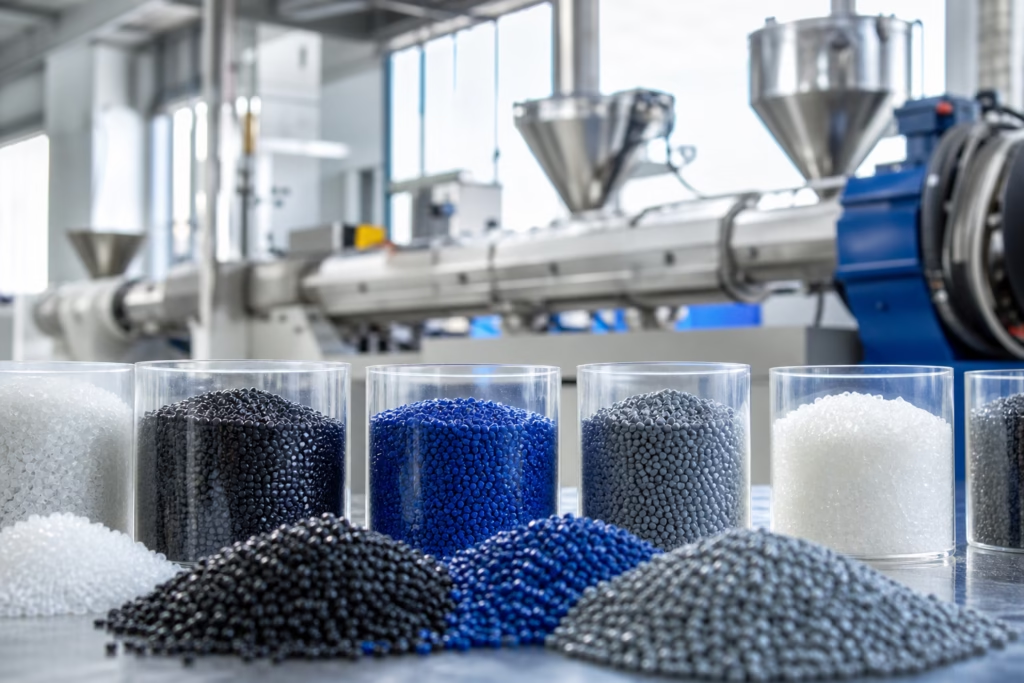
More manufacturers are realizing that a resin name on its own is not a design strategy. In modern parts development, the winning material is rarely the one that looks strongest on a datasheet; it is the one that performs reliably in the real part, on the real line, under the real service conditions. That is why application based material selection is replacing material-first thinking across automotive, electronics, appliance, and industrial programs.
custom plastic compounding support becomes especially valuable when the part needs more than an off-the-shelf resin. If a project must balance heat resistance, stiffness, impact, color, flame retardancy, or dimensional stability, we often find that the right answer is not a standard grade but a tailored compound built around the actual application. At Poly Maro, that means starting from the use case, then shaping the material system, processing window, and validation plan around it.
Why Material-Driven Selection Is Losing Ground
Traditional material-driven selection usually starts with a resin family and then tries to make the part fit that choice. A team may begin with PA6 because it is familiar, or choose PP because it is low cost, or default to ABS because it molds easily. That approach can work for simple, low-risk parts, but it often breaks down when the product has tighter thermal, mechanical, dimensional, or environmental requirements.
The problem is not that material properties are unimportant. The problem is that material properties alone do not tell the whole story. A high tensile strength value means little if the part warps during molding, absorbs moisture in service, cracks under impact at low temperature, or fails electrical requirements after aging. In practice, a resin choice that looks attractive on paper can become expensive once rework, trial-and-error tooling changes, and launch delays are added in.
Engineers and buyers are also dealing with more complex product architectures. Parts are thinner, tolerance windows are tighter, and cost targets are more aggressive. In that environment, application based material selection gives teams a clearer way to match performance, processing behavior, and business constraints at the same time.
What Material-Driven Selection Looks Like in Real Manufacturing

Material-driven selection usually begins with a question like, “What is the strongest resin?” or “Which grade do we usually use for this part family?” That can be useful as a starting memory, but it is not enough for a new project. The resin family may be correct, but the grade may be wrong because the use conditions changed. A part that once lived inside an appliance cabinet may now sit near a motor, a heater, a connector, or an outdoor exposure point.
We often see four patterns:
- Choosing a resin because the team has used it before, without rechecking service conditions.
- Selecting only from headline properties such as tensile strength or heat deflection temperature.
- Ignoring processing risks such as drying, shrinkage, warpage, or flow imbalance.
- Over-specifying the material and paying for performance that the part will never use.
In all four cases, the issue is the same: the selection process begins with the material instead of the application.
Why Application-Based Material Selection Is Rising
Application-based selection starts with the part’s real job. What does the component have to support, withstand, insulate, resist, or survive? How long must it last? What environment will it see? How will it be processed? What does the commercial target allow? Once those questions are clear, material screening becomes much more precise.
This shift is happening because modern manufacturers need better fit between product design and production reality. A material must work in three places at once: the service environment, the molding or extrusion process, and the supply chain. If it performs well in one area but fails in another, the overall project still suffers. That is why we treat application based material selection as a performance-and-process decision, not just a resin comparison exercise.
For a broader view of how technical and commercial priorities can conflict, we often point teams to this purchasing and engineering decision framework. In many projects, the biggest challenge is not identifying a technically possible material. The challenge is aligning engineering needs, procurement constraints, and production stability early enough to avoid repeated revisions later.
The Core Advantages of Scenario-First Selection
When teams move to scenario-first thinking, they usually see benefits in four areas.
Better fit to real performance needs
Instead of asking whether a material is “strong enough,” teams ask whether it can survive the specific load mode, temperature range, humidity level, chemical contact, or electrical requirement. That produces more accurate material choices and fewer surprises after pilot runs.
More stable processing
Application-driven selection pays attention to drying, viscosity, melt flow, crystallization, shrinkage, and warpage earlier in the process. That often reduces scrap, cycle-time issues, and dimensional instability.
Lower total cost
Over-specifying resin can quietly inflate unit cost, but under-specifying can be even more expensive once failures, returns, and tool modifications are counted. The right material is usually the one that meets the application with the least unnecessary premium.
Faster development
When the target is defined by use case, it is easier to shortlist candidates, test the right properties, and interpret results. Teams spend less time debating resin names and more time verifying part performance.
If your project feels like it is drifting toward excessive requirements, this the risks of over-specifying plastic materials article is a useful reminder that added performance should always justify itself in the final part, not just in a specification sheet.
How to Define the Real Application Requirements
Before comparing resins, we recommend translating the part into an application brief. A good brief does not start with a polymer family. It starts with the following questions:
- What is the part’s function in the assembly?
- What mechanical loads will it see: static, impact, cyclic, or creep-related?
- What is the operating temperature, and is there a short-term peak temperature?
- Will it contact oils, fuels, cleaners, moisture, UV, or other chemicals?
- Are electrical insulation, conductivity, or anti-static behavior required?
- What appearance matters: gloss, color consistency, surface feel, or low fiber show?
- What is the expected service life and failure tolerance?
- What process will make the part: injection molding, extrusion, or another route?
Once these answers are written down, the selection process becomes more disciplined. A connector housing, a gear, a structural bracket, and an appliance cover should never be treated as if they share the same performance priority simply because they are all plastic parts.
A Practical Framework for Application-Based Material Selection
A useful selection framework can be built around eight factors.
| Selection Factor | What to Check | Why It Matters |
|---|---|---|
| Load case | Tension, compression, impact, creep, fatigue | Determines strength, toughness, and stiffness needs |
| Temperature | Continuous and peak service temperature | Guides heat resistance and long-term stability |
| Chemical exposure | Oils, solvents, water, cleaners, fuels | Affects resistance, swelling, and property retention |
| Electrical need | Insulation, anti-static, conductive behavior | Influences resin family and additive package |
| Appearance | Color, gloss, surface quality, fiber visibility | Impacts customer acceptance and cosmetic standards |
| Dimensional target | Shrinkage, warpage, tolerance window | Determines molding stability and part fit |
| Processing route | Injection molding or extrusion behavior | Changes resin selection logic and drying needs |
| Commercial target | Cost, MOQ, lead time, supply continuity | Shapes the viable shortlist |
To evaluate these factors properly, it helps to understand the data behind them. We often advise teams to review how to read TDS and SDS for plastic compounds carefully, because a datasheet is useful only when the user interprets the test conditions, conditioning state, and limitations correctly.
For engineering design, single-point property values are not enough by themselves. Standards-based guidance such as engineering design material properties guide; why datasheets alone are insufficient reinforces the same point: design decisions should consider the full property profile and the actual service environment, not a lone number from an ideal test condition.
How Processing Conditions Change the Material Choice
One reason application based material selection is so effective is that it forces the team to consider processing early. A resin that looks attractive in service may still be a poor fit if it is too moisture-sensitive, too narrow in molding window, too viscous for thin walls, or too prone to warpage under current tooling conditions.
For injection molding, drying behavior and melt stability matter. Polyamides, for example, can demand careful moisture control before processing, while filled or reinforced compounds may bring higher stiffness but also higher shrinkage anisotropy. For extrusion, flow stability and thermal behavior may outweigh impact strength. In both cases, the part design, tooling, and cycle time are part of the material selection decision.
That is why we encourage design teams to treat processing as a selection parameter rather than a later troubleshooting issue. A material that requires extreme drying discipline, a very tight melt window, or an unusual screw design may be the wrong choice even if its headline properties look perfect.
When the process route itself affects the answer, this why processing route changes material selection logic discussion is especially relevant. The same polymer family can behave differently depending on whether the part is extruded, injection molded, or used in a reinforced structure.
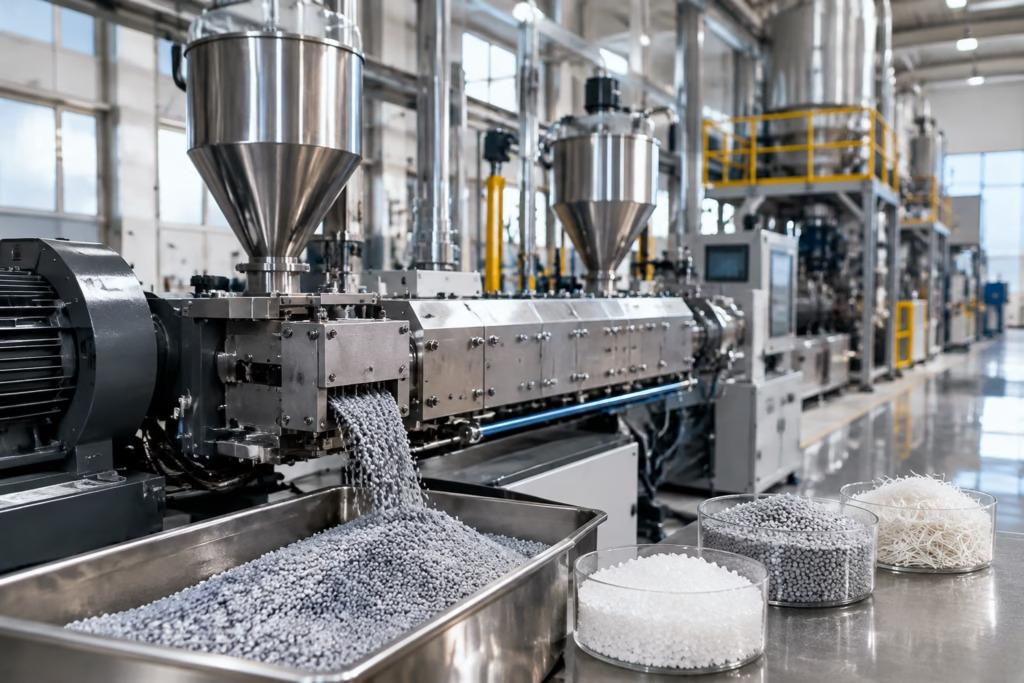
When Modified Plastics Beat Standard Resins
Standard grades are often enough for basic products, but application-driven projects frequently need modified plastics. Reinforced, filled, flame-retardant, impact-modified, heat-resistant, conductive, or UV-stabilized compounds can close the gap between standard resin capability and real-world requirements.
Some common cases include:
- Glass fiber reinforced compounds for stiffness, creep resistance, and dimensional control.
- Impact-modified grades for housings, clips, and covers that must survive drops or assembly stress.
- Flame-retardant compounds for electrical and electronic parts with safety requirements.
- Wear-resistant or lubricated compounds for gears, slides, and moving parts.
- Conductive or anti-static compounds for sensitive electronic environments.
The trade-off is that modification always changes something. More reinforcement may improve rigidity but reduce impact or surface appearance. Flame retardancy may change flow, colorability, or mechanical balance. Higher heat resistance may reduce processing forgiveness. Application-based selection helps teams choose these modifications intentionally instead of assuming there is a free performance upgrade.
Typical Application-Driven Scenarios Across Industries
Automotive components
Automotive parts often need heat resistance, chemical resistance, vibration tolerance, and dimensional stability. A bracket, housing, or under-hood component may need a different compound than an interior trim part, even if both come from the same product family. In these projects, we usually screen for service temperature, creep resistance, and long-term aging before anything else.
Electronics and electrical parts
For connectors, terminals, switch bodies, and device housings, electrical insulation, flame retardancy, tracking resistance, and dimensional precision are usually central. Surface quality and molding consistency are also important because cosmetic defects can become functional concerns in fine-feature parts. The material choice must support both electrical safety and stable mass production.
Appliance parts
Appliance components often face moderate heat, repeated assembly stress, and appearance requirements. The question is not just whether the resin can survive the service environment, but whether it can do so with consistent color, low warpage, and cost discipline in high-volume production.
Industrial parts
Industrial equipment producers often need a balanced combination of strength, wear resistance, chemical resistance, and process stability. Here, application-based selection reduces the risk of choosing a resin that performs well mechanically but fails in the factory environment due to contamination, lubrication contact, or dimensional drift.
Common Mistakes in Application-Based Material Selection
Even teams that understand the concept can still make avoidable mistakes.
- Starting with the resin family instead of the failure mode. This makes the part design adapt to the material rather than the other way around.
- Ignoring moisture and drying. Hygroscopic materials can look excellent on paper and still fail in processing if conditioning is wrong.
- Overlooking molding direction effects. Reinforced compounds may show different shrinkage or strength behavior depending on flow orientation.
- Using one test result as proof of fit. A single prototype does not guarantee mass-production stability.
- Assuming a familiar grade is still optimal. A part update, thickness change, or end-use shift can invalidate the old choice.
These mistakes are common because teams are often under schedule pressure. A simple way to reduce risk is to slow down the first screening step and separate “familiar” from “fit.” The familiar resin may still be the best option, but it should earn that position through the application brief, not through habit.
For a structured approach to verification, we recommend this plastic material testing and sample validation checklist. It helps teams avoid the common trap of approving a resin based on a promising sample but not enough validation around process stability, dimensional behavior, and repeatability.
How to Validate the Selection Before Mass Production
A good selection process ends with proof, not opinion. Validation should match the part’s actual risk profile. If the part is structural, test load and creep behavior. If it is electrical, validate insulation and flame-retardant needs. If it is cosmetic, check color consistency, surface finish, and sink or warpage sensitivity. If it is dimension-critical, confirm tolerance stability across multiple molding conditions.
We recommend validation in three layers:
- Material verification — confirm the grade, lot consistency, and key properties that matter to the application.
- Prototype or sample part testing — check whether the material works in the real geometry and process.
- Pre-production consistency review — verify that the material remains stable across planned volumes, drying cycles, and process settings.
This is also where supplier support matters. A capable manufacturer should be able to help translate the datasheet into a processing plan, not just ship pellets. At Poly Maro, we view validation as part of material development, because a successful resin choice must survive the full path from sample to scaled production.
How to Evaluate a Supplier for Application-Based Projects
For application-driven programs, supplier evaluation should cover more than price per kilogram. The right supplier should be able to support formulation decisions, provide batch-to-batch consistency, explain processing behavior, and respond quickly when the part requirements change.
Useful evaluation points include:
- Can the supplier customize reinforcement, impact, flame retardancy, or color?
- Do they understand the target application and failure mode?
- Can they provide stable batches and clear lot traceability?
- Do they support sample testing and processing advice?
- Is MOQ practical for your development and launch schedule?
- Can lead time align with prototype and ramp-up timing?
Procurement teams often focus first on commercial terms, which is reasonable. But for application-based projects, the best commercial offer is the one that stays stable after launch. A cheaper resin that causes repeated processing problems can cost more than a slightly higher-priced compound that runs cleanly and meets the target on the first stable trial.
A Step-by-Step Shift from Material-First to Scenario-First Thinking

If your organization is still using a material-first process, the shift does not need to be dramatic. It can happen in clear steps.
- Define the part’s real function and service environment.
- List the failure modes that matter most.
- Set performance targets for load, heat, chemistry, and electrical needs.
- Include processing constraints such as drying, flow, shrinkage, and warpage.
- Shortlist resins or compounds that fit the full application, not just the top property.
- Test prototypes in the intended geometry and process.
- Review batch consistency, commercial fit, and supply risk before final approval.
This framework helps teams avoid the common habit of asking, “Which resin should we use?” before they have asked, “What must this part actually do?” Once the second question is answered, the first question becomes much easier.
Why the Best Material Is the One That Fits the Whole Job
The shift toward application based material selection is not a trend for its own sake. It is a practical response to how modern parts are designed, processed, and purchased. Resin data still matters, but it is only one piece of a broader decision that includes service conditions, molding behavior, dimensional stability, batch consistency, and cost-performance balance.
When teams select by application first, they reduce trial-and-error, improve development speed, and make it easier to justify the final choice across engineering and procurement. That is especially important when the application has multiple constraints and no single resin property can solve everything. In our experience, the strongest project outcomes come from materials that are chosen for the job, not just for the catalog.
If your next program involves a demanding part, a tight tolerance window, or a need for customized performance, application based material selection is usually the most reliable place to start.
FAQs
What is application based material selection?
It is a selection method that starts with the part’s real use conditions, failure risks, and process requirements, then matches a resin or compound to those needs. Instead of choosing by resin family first, the team evaluates load, temperature, chemistry, electrical needs, appearance, and production fit together.
Why is application-driven selection better than datasheet-only selection?
Datasheets are useful, but they do not capture every real-world condition. A material may look ideal on paper and still fail because of moisture absorption, warpage, chemical contact, or processing sensitivity. Application-driven selection reduces that gap by connecting the material to the actual part and its service environment.
When should a manufacturer consider modified plastics instead of standard resin?
Modified plastics are worth considering when the part needs better stiffness, impact resistance, flame retardancy, conductivity, wear resistance, or dimensional stability than a standard grade can provide. They are especially useful when the part has a clear performance gap that cannot be solved by design alone.
How does processing affect material selection?
Processing can change the final part as much as the resin itself. Drying needs, melt flow, shrinkage, warpage, orientation, and cycle stability all affect whether a material is practical for injection molding or extrusion. A resin that is technically strong may still be a poor choice if it is too difficult to process consistently.
What should procurement teams ask before approving a plastic material?
They should ask whether the material fits the actual application, whether it can be supplied consistently, whether sample validation has been completed, and whether MOQ and lead time match the project plan. Price matters, but the real cost includes scrap, downtime, delays, and field risk.
How can engineers and buyers align on the same material choice?
The best way is to use a shared application brief. When both teams agree on the load case, environment, target life, processing route, and cost limit, it becomes much easier to compare options fairly. That reduces conflict and helps the selection move faster.