
In plastic pellet sourcing, the most expensive mistake is often not buying the wrong resin family, but buying two materials that look equivalent on paper and discovering they behave very differently on the machine. The resin performance gap is what buyers see when identical-looking TDS values still produce different cycle stability, warpage, color consistency, surface finish, or scrap rate in real production. For procurement teams and engineers, the challenge is to know which datasheet values matter, which ones hide risk, and how to validate a material before committing to volume.
If you are trying to narrow that risk quickly, start with how to read TDS and SDS for plastic compounds. That approach helps you separate material facts from marketing claims and makes it easier to compare resin candidates on test method, conditioning, and intended use. At Poly Maro, we see that the best purchasing decisions usually combine datasheet reading, processing review, and sample validation rather than relying on a single headline number.
What the resin performance gap means in production
The phrase resin performance gap describes the difference between expected performance based on a technical data sheet and actual performance in molding, extrusion, or end-use service. It is not a defect in the datasheet itself. Rather, it reflects the fact that plastics are processed systems, not static objects. A TDS reports values measured under defined conditions, but your production environment may use a different mold, different screw design, different residence time, different drying routine, or a different part geometry.
That gap becomes obvious when a buyer compares two materials with nearly identical density, tensile strength, flexural modulus, melt flow index, or heat deflection temperature, then sees one grade run cleanly and the other cause flashing, sink marks, unstable dimensions, or cosmetic variation. In practical sourcing terms, the material is only one part of the result. The formulation control, process window, raw material consistency, and validation discipline matter just as much.
Why two materials with the same TDS can behave differently

Two resin grades can share similar reported numbers and still differ in how they flow, crystallize, shrink, or absorb moisture. This is especially true in engineering plastics, reinforced compounds, and flame-retardant grades, where the same nominal property can be reached through different formulation routes. One supplier may achieve a value with a tighter molecular-weight distribution or different additive package, while another may use a different filler level, fiber length retention, stabilizer system, or base resin source.
Those differences are often invisible in a short datasheet summary. In injection molding, they can appear as inconsistent fill, gate blush, fiber float, poor weld-line strength, or variable demolding behavior. In extrusion, they may appear as pressure fluctuations, output instability, or surface inconsistency. That is why buyers should treat matching TDS values as a starting point, not a final approval.
Common hidden variables behind the resin performance gap
- Raw material source: base polymer origin, lot consistency, and supplier qualification can influence flow and mechanical balance.
- Compounding process: dispersion quality, feeding accuracy, screw design, and residence time affect property repeatability.
- Additive package: stabilizers, lubricants, impact modifiers, flame retardants, and colorants can change processing and long-term behavior.
- Moisture control: drying history and packaging integrity matter, especially for hygroscopic resins like PA, PET, and PBT.
- Batch consistency: lot-to-lot variation can be small on paper but large enough to affect cycle time, shrinkage, or appearance.
When we develop modified materials, we pay close attention to these hidden variables because they determine whether a resin performs consistently across the full production run. The buyer usually does not need every internal formulation detail, but they do need enough traceability to understand why one grade is stable and another is not.
Why TDS values are useful, but not enough
A TDS is valuable because it provides a common reference point for comparing density, mechanical strength, thermal behavior, flow, and sometimes electrical or flame-retardant properties. However, it is still a summary document. It rarely explains every processing sensitivity, and it does not always reveal how a grade behaves across different machine settings or part geometries. Mechanical values in particular are condition-sensitive. Standards such as ASTM D638 tensile testing conditions show how strongly test method, strain rate, and conditioning influence the numbers you see, which is why a datasheet value should never be treated as a universal guarantee for every plant and every mold.
What makes the TDS even more limited is that it often reports only a narrow window of the material’s behavior. A buyer may see a promising tensile strength and heat deflection temperature, yet still face high scrap if the resin is overly sensitive to moisture, shear, or temperature variation. In other words, the question is not only “Does the TDS look good?” but also “Will this material stay stable under our actual process and application conditions?”
| Datasheet Item | Helpful for | What It Can Miss |
|---|---|---|
| Tensile strength | Basic load-bearing comparison | Sensitivity to conditioning, strain rate, and part geometry |
| Flexural modulus | Relative stiffness comparison | Warpage risk, weld-line behavior, and reinforcement orientation effects |
| MFI or MFR | Flow comparison | Melt stability, pressure behavior, and process window width |
| Heat deflection temperature | Thermal load comparison | Real part temperature gradients and long-cycle aging effects |
| Impact strength | Toughness screening | Notch sensitivity, low-temperature behavior, and moisture influence |
Hidden quality factors buyers should verify beyond the datasheet
For commercial purchasing, the most useful question is not whether a supplier can provide a TDS, but whether the supplier can explain the material behind the TDS. That means asking about base resin traceability, production control, and how each functional property is achieved. If a supplier says two grades are “equivalent,” ask what is equivalent: mechanical output, processing behavior, color stability, long-term aging, or all of these together.
From a manufacturing perspective, the strongest material may not be the one with the highest headline number. It is often the one with the most predictable behavior across your actual process window. That is why many buyers eventually move from standard-grade comparison to a more precise discussion of modification needs. In some cases, the right answer is custom plastic compound vs standard grade, because a tailored formulation can reduce risk by matching flow, stiffness, impact, and thermal stability to the application instead of forcing a generic grade to do too much.
Key questions to ask a supplier
- Which base resin and additive system are used, and how stable are their supply sources?
- How is batch-to-batch consistency controlled during compounding and packaging?
- What conditioning or drying is required before processing?
- Does the reported TDS represent the actual production material, or a reference formulation?
- What parts, machines, or process conditions were used during validation?
How processing conditions amplify material differences
One reason the resin performance gap can appear dramatic is that processing conditions do not just reveal material differences; they amplify them. A grade with a slightly narrower processing window may run well under ideal conditions but become unstable once the machine temperature drifts, the screw speed changes, or the mold temperature rises during a long shift. That is why real validation must happen on production-relevant equipment, not only in a lab sample.
Injection molding details matter more than many first-time buyers expect. Drying level, barrel temperature profile, back pressure, injection speed, hold pressure, cooling time, and mold venting can all change the final result. In one technical guide on molding behavior, Celanese notes that processing details, machine settings, mold design, and moisture control materially affect productivity and quality in injection molding, which is exactly why same-TDS materials can still produce different outcomes in the plant.
For buyers comparing suppliers, this is where processability becomes a commercial cost factor, not just a technical preference. A resin that fills more cleanly, dries more predictably, and releases more easily can reduce cycle time losses, scrap, and troubleshooting labor. That is why we often recommend reviewing how processability changes the total cost of a plastic compound before choosing a lower-priced option that may cost more in downtime and rejects.
Processing variables that often expose the gap
- Drying: insufficient drying can reduce molecular weight or cause splay, bubbles, and brittle parts.
- Melt temperature: too low can cause poor fusion; too high can accelerate degradation or discoloration.
- Screw design: mixing efficiency and shear history influence dispersion and fiber integrity.
- Mold temperature: crystallization rate and surface finish may change noticeably with small temperature shifts.
- Cycle stability: a material that starts well but drifts over time may create hidden production risk.
Application impact: strength, warpage, surface finish, and heat resistance
The true test of a resin is not the datasheet alone but the application outcome. A buyer evaluating a housing, connector, gear, bracket, or structural component needs to know whether the material will maintain dimensions, resist deformation, and preserve appearance through the full production cycle and service life. Even a modest resin performance gap can create larger commercial consequences when the part has tight tolerances or visible surfaces.
For example, a small difference in shrinkage or crystallization behavior can create warpage that affects assembly. A minor change in impact balance can cause brittle failures in handling or cold environments. A slight difference in flow can create incomplete filling or weld-line weakness. If the application is sensitive, the evaluation should include both material properties and part-level results. In many projects, that means sample testing must be tied to the real end-use requirement rather than to a generic lab pass/fail standard.

Typical part-level differences caused by material variation
- Strength: one grade may meet the tensile value but still crack sooner at weld lines or notches.
- Warpage: a similar modulus can still produce different shrink behavior.
- Surface finish: additive package and melt stability may change gloss, haze, or flow marks.
- Impact resistance: conditioning and temperature can shift toughness dramatically.
- Heat resistance: a nominally similar thermal value may not translate to equal long-term load performance.
How to compare samples fairly
Many false conclusions in resin purchasing come from unfair comparisons. If two samples are tested under different drying conditions, different mold temperatures, or different machine settings, the result says as much about the process as it does about the resin. A fair comparison must control the test method as much as possible and document the conditions clearly. This is where a disciplined validation plan saves time and protects procurement decisions.
We recommend comparing samples on the same machine, with the same mold, under the same drying routine, and with the same target part weight or dimension. Record the actual settings used, not just the intended settings. Small differences in process can hide the real cause of a result. If you want a structured approach, use a practical material testing checklist for sample validation so that your engineering and purchasing teams evaluate the same evidence instead of debating isolated observations.
Fair comparison checklist
- Confirm identical drying method, drying time, and moisture target.
- Use the same mold and machine whenever possible.
- Keep screw, gate, and cooling conditions consistent.
- Measure part dimensions, appearance, and weight against the same criteria.
- Repeat the trial across more than one lot if the project is high risk.
Supplier evaluation checklist for reducing sourcing risk
Supplier evaluation should go beyond asking for a price and TDS. A manufacturing-grade supplier should be able to explain how the material is made, how it is controlled, and what variables matter most during production. That includes batch traceability, packaging discipline, moisture protection, and how technical support is handled during validation. Buyers often discover that the most reliable supplier is not the one with the most impressive brochure, but the one that can answer process questions clearly and consistently.
At custom plastic compounding support from Poly Maro, we often begin with application conditions first: temperature, load, appearance, flame requirement, electrical need, and process method. That helps us align formulation and validation with the real part requirement rather than forcing the buyer to adapt their production to a generic material. This is especially important when a project needs reinforcement, impact tuning, flame retardancy, or dimensional stability.
What a serious supplier should be able to explain
| Area | What to Verify | Why It Matters |
|---|---|---|
| Raw materials | Source stability and qualification | Reduces variation in flow and properties |
| Compounding control | Feeding, mixing, dispersion, and contamination prevention | Improves lot consistency and appearance |
| Testing | What is tested, how often, and under what conditions | Shows whether reported values are production-relevant |
| Packaging | Moisture protection and labeling traceability | Supports processing stability and inventory control |
| Technical support | Validation guidance and troubleshooting response | Reduces launch risk and hidden downtime |
Red flags that often signal a larger resin performance gap
Several warning signs appear repeatedly in resin purchasing projects that later become production problems. One of the most common is unstable color from lot to lot, which can signal weak pigment control or inconsistent base material. Another is inconsistent MFI or MFR from one shipment to the next, which may indicate process drift or supply inconsistency. Buyers should also be cautious when technical support is vague, sample data are incomplete, or the supplier cannot explain how a grade was validated.
Another red flag is when a resin looks good in a lab but fails to perform under real cycle conditions. That may mean the sample was selected under a narrow test condition that does not reflect production stress. If you are comparing options for a new project, it is often useful to ask whether the resin should be bought as a standard item or as a tailored formulation. In some cases, the issue is not just supply quality but material fit, which is why our article on custom plastic compound vs standard grade is often a helpful decision point for engineering and procurement teams.
Common sourcing red flags
- Color drift or gloss drift between lots
- Flow variation that changes fill balance or cycle stability
- Unclear moisture sensitivity or drying guidance
- Datasheet values with no explanation of test basis
- Slow, vague, or defensive technical responses
Practical procurement advice: balancing price, consistency, lead time, and performance
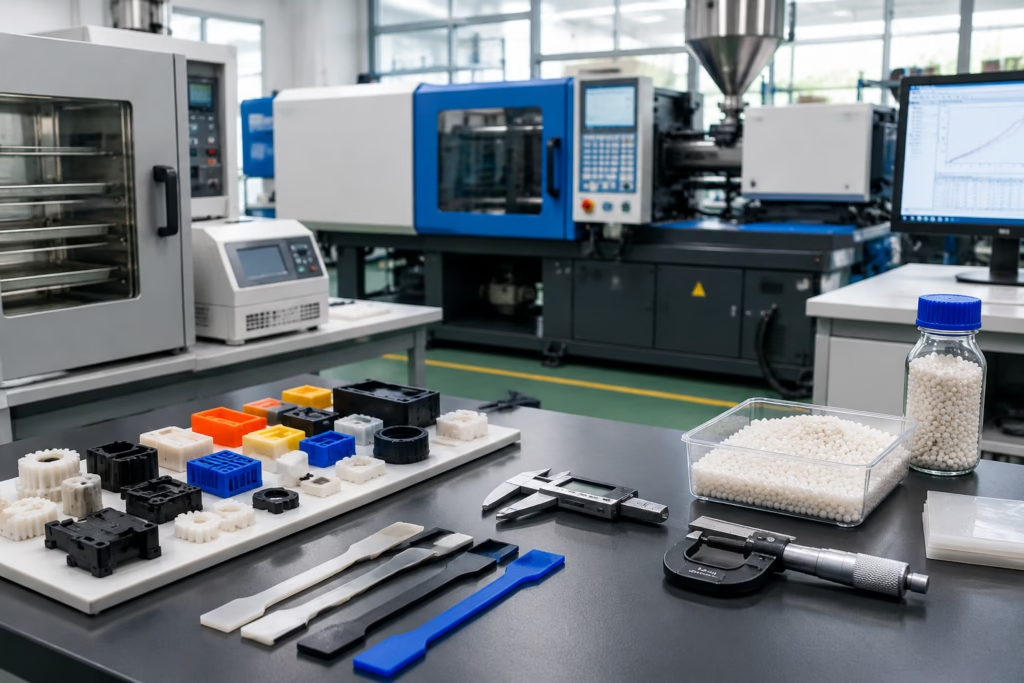
Price is always part of the purchasing decision, but it should not be the only value metric. A lower unit price can be offset by higher scrap, longer setup time, more frequent drying problems, or more customer complaints. When the application is simple and forgiving, a standard grade may be perfectly adequate. When the part is technical, visible, or high volume, consistency becomes an economic value on its own.
Procurement teams should therefore compare the full cost of adoption: sample validation time, machine tuning effort, production rate, scrap risk, inventory reliability, and supplier response speed. This is where material processability matters as much as resin price. A slightly more expensive compound can be the lower-cost choice if it produces fewer rejects and shorter launch cycles. That logic is especially important for buyers moving from trial orders to repeat production.
For teams trying to reduce sourcing uncertainty, the most useful internal question is: does the supplier help us manage risk, or only ship pellets? When we support customers, we focus on material selection, process guidance, and repeatability, not just shipment fulfillment. That is the practical difference between a commodity transaction and a manufacturing partnership.
How to move from price-based purchasing to risk-controlled selection
The best way to reduce the resin performance gap is to make the evaluation more complete. Start with the TDS, but do not stop there. Look at test method, processability, validation results, drying needs, batch consistency, and the actual part outcome. Confirm the supplier can explain why the material behaves the way it does and how it should be processed in your application. If your part is sensitive, insist on sample testing that reflects real molding or extrusion conditions, not idealized lab conditions.
At Poly Maro, we view resin selection as a risk-management exercise. The goal is not merely to meet a specification on paper, but to deliver repeatable production performance that fits the buyer’s machine, mold, and business requirements. When teams evaluate materials this way, they are far less likely to be surprised by a hidden performance gap after launch.
Frequently Asked Questions
Why can two plastic pellets with the same TDS perform differently?
Because a TDS reports values under specific test conditions, while real production depends on raw material source, compounding quality, moisture control, machine settings, and part geometry. Two grades can look similar on paper but behave differently in molding or extrusion.
Which TDS values matter most when comparing resin suppliers?
The most useful values depend on the application, but buyers usually pay close attention to tensile strength, flexural modulus, impact strength, melt flow, heat resistance, shrinkage, and drying sensitivity. Just as important is understanding how those values were measured.
How can I tell whether a supplier is reliable beyond the datasheet?
Ask about lot-to-lot consistency, validation conditions, packaging, moisture protection, and technical support. A reliable supplier should explain how the material was produced and how it should be processed, not just provide a datasheet and price.
What is the best way to compare resin samples fairly?
Use the same machine, mold, drying method, and process settings for each sample whenever possible. Then compare part dimensions, appearance, weight, and cycle stability under the same criteria. A structured checklist helps prevent misleading conclusions.
When should buyers consider custom compounding instead of standard grade resin?
Custom compounding is often worth considering when the part has tight tolerances, special heat or impact needs, flame-retardant requirements, or recurring processing issues. A tailored formulation can reduce risk when a standard grade is close but not fully fit for the application.
What are the most common warning signs of poor resin consistency?
Unstable color, changing MFI, uneven molding behavior, unexplained warpage, and weak technical communication are all warning signs. They often point to process control issues or weak supplier discipline, which can create production risk later.
Related Reading
- application-based material selection for manufacturing results
- how purchasing and engineering evaluate plastic materials differently
- why higher-performance plastics are not always the right choice
- Poly Maro technical support for material selection and validation
- Poly Maro product categories for engineering plastic solutions