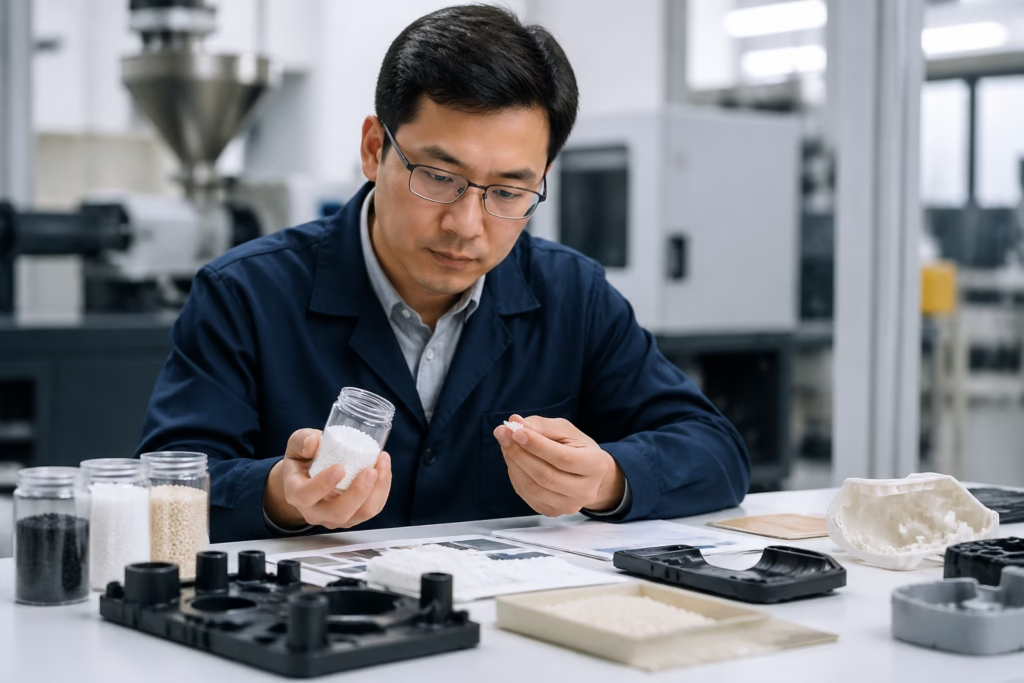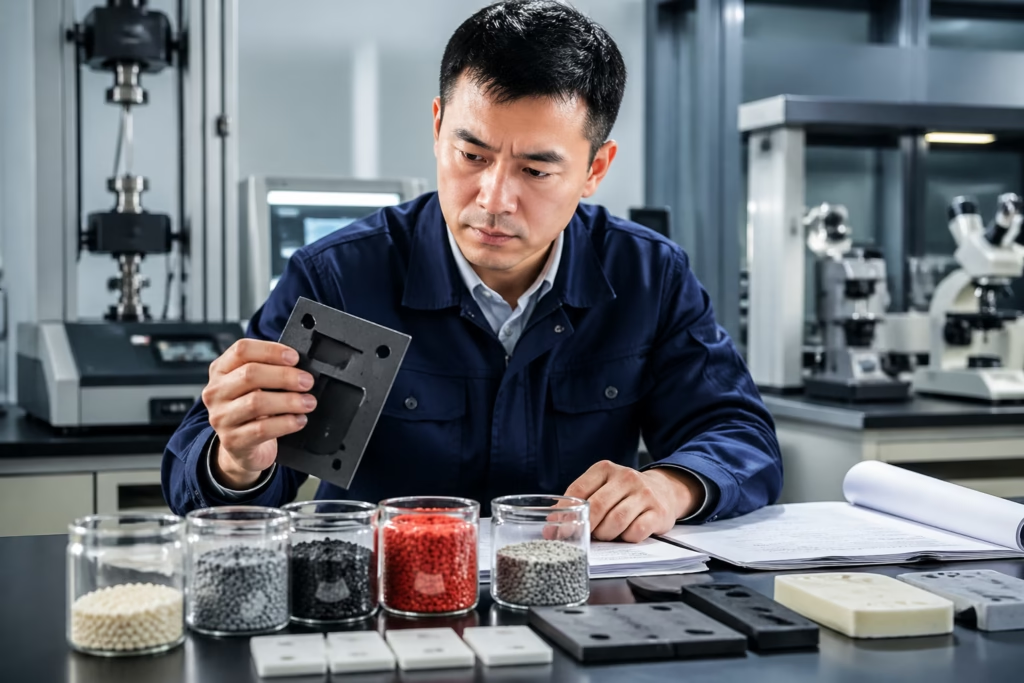
Choosing a heat resistant plastic compound starts with a simple but important question: what kind of heat exposure will the part actually face? In material selection, the phrase “heat resistant” can mean very different things depending on whether you care about long-term service temperature, a brief heat spike, or the temperature needed to process the resin into a finished part.
For material selection support, Poly Maro’s heat resistant plastic compounds are a practical starting point when you need to compare resin families and narrow down options by application.
Why “heat resistant” is a confusing label
Many buyers treat heat resistance as a single number, but plastics are usually rated across multiple temperature-related dimensions. A material may survive a high molding temperature, yet soften in service under load. Another may keep its shape for years at a moderate temperature, but cannot tolerate a very high short-term spike. That is why a good selection process begins by separating the temperature categories instead of chasing the highest number on a datasheet.
This matters because a part can fail in several ways: it can deform, creep, lose impact strength, discolor, or become brittle. The right heat resistant plastic compound should match the actual use condition, not just the headline claim.
The three temperature dimensions you need to separate

Continuous use temperature
Continuous use temperature describes the temperature a plastic can handle over long-term service without unacceptable loss of properties. This is often the most important number for parts that stay hot every day, such as electrical housings, appliance components, under-hood parts, and industrial covers.
Short-term heat resistance
Short-term heat resistance refers to brief exposure to a higher temperature, such as a momentary surge, a nearby hot surface, or a short cycle in a production process. A plastic may survive a short exposure that would be unsafe for continuous use, especially if the exposure is limited in time and the part is not heavily loaded.
Processing temperature
Processing temperature is the temperature required to melt, mold, extrude, or otherwise shape the resin. It is not a performance rating for the finished part. A material may require a high processing temperature but deliver only moderate heat performance in service, or it may process more easily while still offering solid long-term stability.
| Temperature dimension | What it tells you | Typical selection mistake |
|---|---|---|
| Continuous use temperature | Long-term service capability | Assuming short spikes prove long-term durability |
| Short-term heat resistance | Brief exposure tolerance | Assuming it predicts multi-year service life |
| Processing temperature | How the resin is manufactured | Confusing molding behavior with part performance |
Why datasheets and product descriptions get mixed up
Product descriptions often compress complex thermal behavior into one or two simplified statements. That can be useful for marketing, but it can also hide the real selection logic. For example, a material listed as “high temperature” may refer to processability, heat deflection under a test load, or continuous use in a specific environment. Without reading the fine print, buyers can easily compare numbers that are not measuring the same thing.
Poly Maro often sees this confusion when a project starts with a target temperature but no definition of load, time, or environment. In those cases, the best next step is to align the temperature claim with the actual part condition, not the catalog shorthand.
Common selection mistakes caused by temperature confusion
One common mistake is selecting a resin based only on a peak temperature number. A part that briefly sees a hot cycle may still fail if it carries load, vibrates, or sits in heat for months. Another mistake is choosing a high-temperature engineering plastic when a moderate heat-resistant compound would already meet the requirement at lower cost and easier processing.
Another frequent issue is ignoring thickness and geometry. Thin walls can cool and heat differently from thick sections, and stress concentration can accelerate creep or warpage. For a more structured decision path, a useful reference is custom plastic compound vs standard grade, especially when the thermal target is tied to mechanical or processing constraints.
When a high temperature engineering plastic is actually needed
Not every application needs a specialized high temperature engineering plastic. In some cases, a general heat-resistant compound with good dimensional stability is enough. In others, the part must retain stiffness, electrical integrity, or chemical resistance at elevated temperatures, which may require a more advanced resin family.
The question is not whether the material can tolerate heat in a vacuum. It is whether it can survive heat while also handling load, moisture, chemicals, assembly stress, and expected service life. That combination is what separates a safe selection from an optimistic one.
For example, PA66 for higher heat resistance is often evaluated when a project needs a stronger balance of stiffness, wear behavior, and elevated-temperature performance than a lower-temperature commodity resin can offer.
How to read material behavior beyond the headline number
A strong heat resistant plastic compound should be evaluated with more than one thermal datapoint. Look for heat deflection temperature, continuous use guidance, short-term peak tolerance, shrinkage behavior, and property retention after exposure. Also consider whether the reported values were measured under load, in dry conditions, or after conditioning.
It helps to ask what happens after heat exposure, not only during it. Some materials keep their shape but lose impact resistance. Others retain strength but change dimensions slightly. If the part must fit tightly, seal reliably, or align with another component, dimensional stability can matter as much as temperature rating.
What to check on the datasheet
A practical datasheet review should include the following points:
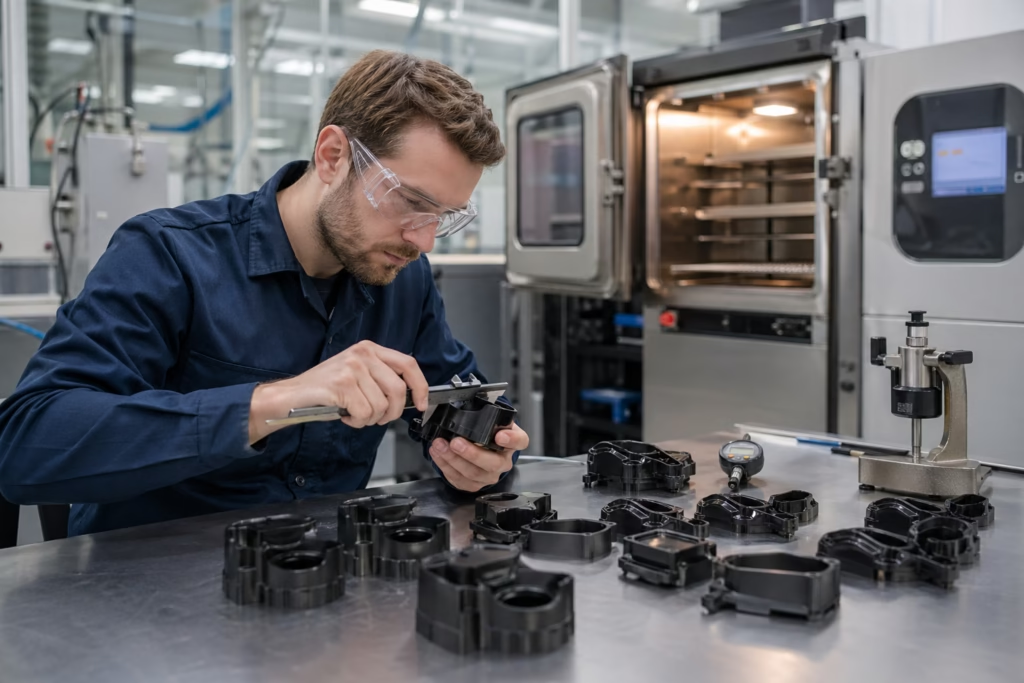
- Continuous use temperature or long-term service guidance
- Heat deflection temperature and the test load used
- Short-term thermal resistance or peak exposure guidance
- Tensile strength and modulus after heat exposure if available
- Dimensional stability, shrinkage, and warpage tendency
- Moisture sensitivity, especially for polyamides and similar systems
- Chemical resistance if the part runs hot in oils, cleaners, or process fluids
- Processing window and moldability for the intended production method
If the datasheet is incomplete, ask for technical support for heat testing so the selection is based on the real use condition rather than a generic brochure claim.
How real-world conditions change the answer
Temperature performance is rarely determined by heat alone. Load, time, airflow, humidity, UV exposure, and chemical contact all affect how a resin behaves. A part that looks stable in a bench test may creep in service if it carries a constant load at temperature. A thin wall may perform differently from a thick boss because heat and stress are distributed differently.
That is why application context should always sit alongside the temperature number. If the part sees repeated thermal cycling, the concern may be fatigue and warpage. If it sits in constant heat, the concern may be creep and property retention. If it is exposed to heat and chemicals together, the selection becomes more demanding.
When comparing similar resin families, resources like PPS vs PBT for high-temperature parts can help clarify where a higher-performance resin is justified and where a balanced compound is enough.
A simple selection checklist
Before choosing a continuous use temperature plastic, define the part’s actual conditions with these questions:
- What is the normal operating temperature, not just the peak temperature?
- Will the part be under load while hot?
- Is the heat exposure continuous, cyclical, or occasional?
- Will the part contact oil, coolant, cleaners, or other chemicals?
- Does the part need tight dimensional control after molding?
- Is impact resistance still important at elevated temperature?
- Does the production process require easy flow, fast cycle time, or specific molding conditions?
If the answers are unclear, it is often safer to compare multiple resin families rather than over-specifying the material from the start.
Typical use cases and decision patterns
For moderate heat with good dimensional stability, an engineering resin such as PBT or PC may be enough depending on the load, shape, and exposure profile. For higher continuous service temperature and improved mechanical retention, PA66 may be a better fit. For demanding high-temperature parts with stronger chemical and thermal requirements, more advanced resin systems may be required.
The practical rule is simple: choose the lowest-cost material that still meets the real service condition with margin. That margin should be based on long-term performance, not on a single short heat event. When the selection is uncertain, comparing material families side by side is usually more useful than chasing a top-line temperature figure.
For buyers who need a broader decision framework, the article PC material options is useful when impact and heat must be balanced, while PBT material selection is helpful for parts that need stable molding behavior and moderate heat performance.
Conclusion
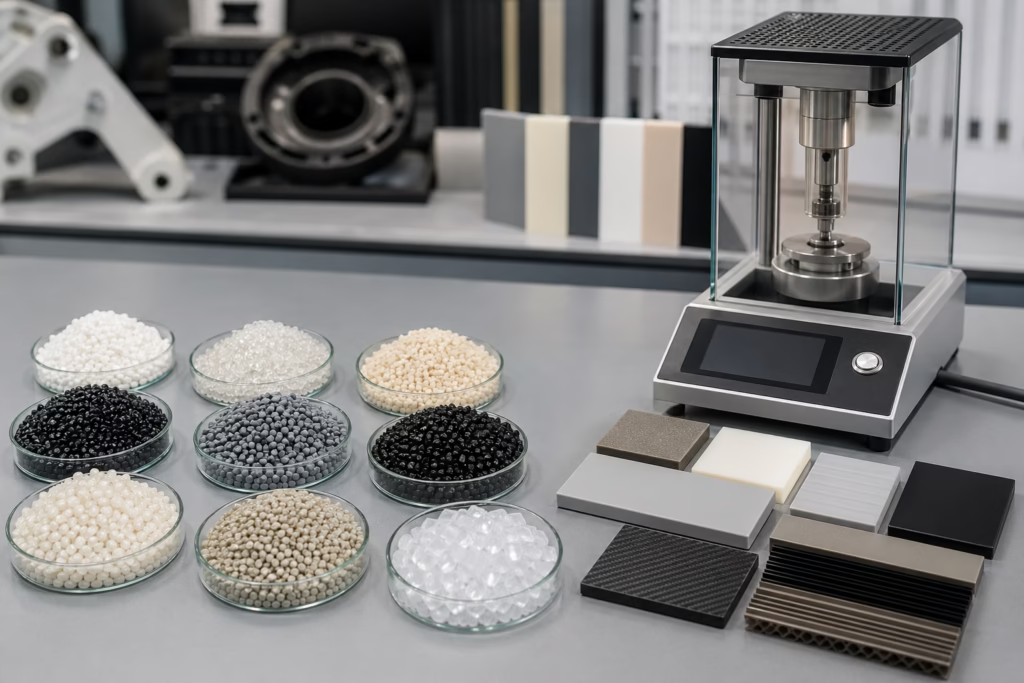
The safest way to choose a heat resistant plastic compound is to separate continuous use temperature, short-term heat resistance, and processing temperature before making a decision. Those three numbers answer different questions, and using one in place of another is one of the most common material selection errors.
If you define the real operating conditions first, you can avoid overpaying for unnecessary performance or under-specifying a part that will fail in service. For practical validation across applications, the broader application examples page can help connect material choice to real use conditions.
FAQ
What is the difference between continuous use temperature and heat deflection temperature?
Continuous use temperature describes long-term service behavior, while heat deflection temperature is a test result measured under a defined load. They are related, but they do not mean the same thing.
Can a material have high processing temperature but only moderate heat resistance?
Yes. Processing temperature is about manufacturing the resin, not how the finished part performs in service. A resin can be difficult to process yet only moderately heat resistant after molding.
Why does load matter so much in heat-resistant plastic selection?
Heat and load together increase creep and deformation risk. A material that seems stable in a no-load test may fail when it must hold shape under force at temperature.
Is a higher temperature number always better?
Not always. A higher number may mean higher cost, harder processing, or unnecessary performance for the application. The right choice is the material that matches the real exposure profile with enough margin.
When should I consider a custom compound instead of a standard grade?
Consider a custom compound when your part needs a specific balance of heat resistance, stiffness, impact, color, flame performance, or processing behavior that standard grades do not provide.
What if my part faces heat, chemicals, and dimensional constraints at the same time?
Then you should evaluate the full environment, not just temperature. Heat resistance, chemical resistance, shrinkage, and creep all need to be considered together before final material selection.