
For precision parts, moisture behavior can matter as much as initial strength. A material that looks strong on a datasheet may still drift out of tolerance after exposure to humidity, especially in fit-critical assemblies, sliding components, or parts that must stay consistent across seasons. When you evaluate a low moisture absorption plastic, the real question is not only how much load it can carry on day one, but how well it holds dimensions, stiffness, and assembly fit over time.
For related applications, it helps to judge plastics by the full environment: humidity, temperature, tolerance range, and the consequences of looseness or warpage in use.
In many projects, nylon enters the conversation first because of its reputation for toughness and mechanical strength. That reputation is valid, but it can also distract buyers from the bigger issue: whether the part will still fit and function after moisture changes the material state. For precision components, dimensional stability often matters more than peak strength.
Why moisture matters for precision parts
Many plastics absorb some water from the air, and that water can change the material’s dimensions, stiffness, and surface behavior. In a loose-fit part, this may be acceptable. In a tight-tolerance part, even a small dimensional shift can affect clearance, engagement, sealing, noise, friction, or assembly yield.
Moisture can also change how a part feels in use. A plastic that is stiff when dry may become slightly more flexible after conditioning. That is not always a problem, but it becomes a concern when the design relies on repeatable geometry. For engineers, the key point is that moisture exposure is not just a material issue; it is a fit and function issue.
| What changes with moisture | Why it matters | Typical precision-part risk |
|---|---|---|
| Dimensions | The part may grow or shift slightly | Tighter fits become loose or inconsistent |
| Stiffness | Mechanical response can soften | Deflection and alignment can change |
| Surface behavior | Friction and wear behavior may shift | Sliding and mating parts become less predictable |
| Long-term stability | Properties may drift after conditioning | Field performance differs from lab testing |
Why nylon strength alone is not enough

Nylon is often chosen because it offers good toughness, wear resistance, and a strong balance of cost and performance. In some applications, that combination is exactly right. But nylon is not automatically the best answer for precision parts, especially where humidity is high or dimensions are very tight.
The reason is simple: a strong material can still be the wrong material if it changes size too much. A gear, bushing, clip, connector housing, or alignment feature may fail functionally if its geometry moves outside the tolerance band. That is why many engineering teams evaluate nylon strength together with moisture absorption, creep behavior, and dimensional recovery after conditioning.
In manufacturer-led material selection, the goal is not to dismiss nylon, but to place it correctly. At Poly Maro, that usually means comparing use conditions first, then matching the resin system to the real performance target rather than to a single headline property.
What happens to nylon in humid environments?
Nylon can absorb moisture from the surrounding air, and that absorbed water acts like a plasticizer. The result is often a drop in stiffness and an increase in elongation, while dimensions may shift. For parts designed around close mating surfaces, this can change preload, backlash, engagement depth, or sealing performance.
That is why nylon can look excellent in a dry test room and behave differently in a plant floor, outdoor enclosure, or tropical shipping route. If the part’s tolerance stack is tight, the environment must be part of the material decision from the beginning.
For some projects, a comparison such as PA66 vs PA12 is useful because it shows how moisture behavior and mechanical profile can shift across nylon families, even before moving to other resin types.
How to judge a true low moisture absorption plastic
A genuine low moisture absorption plastic is not just a material with high strength. It is a material that maintains geometry, fit, and performance with limited change under expected humidity and temperature conditions. The exact threshold depends on the part, but the selection logic is consistent.
- Dimensional stability: Check how much the material changes after conditioning, not only in the dry state.
- Moisture uptake behavior: Look for low equilibrium absorption and slow property drift in real environments.
- Tolerance sensitivity: Decide whether a small expansion or softening would still be acceptable.
- Load condition: Separate static strength from long-term load retention and creep resistance.
- Temperature exposure: Heat can magnify the effect of moisture on fit and stiffness.
- Processing consistency: Mold shrinkage, warpage, and conditioning behavior should all be predictable.
For precision buyers, the best question is not “Which plastic is strongest?” but “Which plastic keeps the part within function over time?”
Material comparison for low moisture absorption
Different engineering plastics solve different problems. Some offer stronger moisture resistance, while others trade some moisture sensitivity for cost, toughness, or processing ease. The right choice depends on the shape, the tolerance window, and the environment.
In many fit-critical cases, POM is considered because it offers good dimensional stability, low friction, and relatively low moisture absorption, making it useful for gears, sliding parts, and precision mechanisms.
| Material | Moisture behavior | Typical strengths | Selection note |
|---|---|---|---|
| POM | Low | Good dimensional stability, low friction | Often strong for precision moving parts |
| PA66 | Moderate to high | Toughness, mechanical strength, heat resistance | Good when strength matters more than tight dimensional control |
| PBT | Low | Good stability, electrical performance, processability | Useful for housings and precision-fit parts |
| PET | Low to moderate | Stiffness, stability, good strength retention | Often selected where rigidity is important |
| PPS | Very low | Heat resistance, chemical resistance, stability | Useful in demanding environments with tight control needs |
| PEI | Low | High heat resistance, stability, strength | Suitable when thermal performance is a major driver |
There is no universal winner. POM may outperform nylon in stable fit applications, while PA66 may be preferred where toughness and load-bearing strength are more important than close dimensional retention. In that same way, PA66 remains useful when the design can tolerate some moisture-driven change but needs stronger mechanical resilience.
How tolerance and operating humidity should guide selection
The tighter the tolerance, the less room there is for moisture-driven movement. That means a part with a broad dimensional window may still work well in a moisture-sensitive material, while a precision insert, latch, bearing surface, or connector may need a lower-absorption resin from the start.
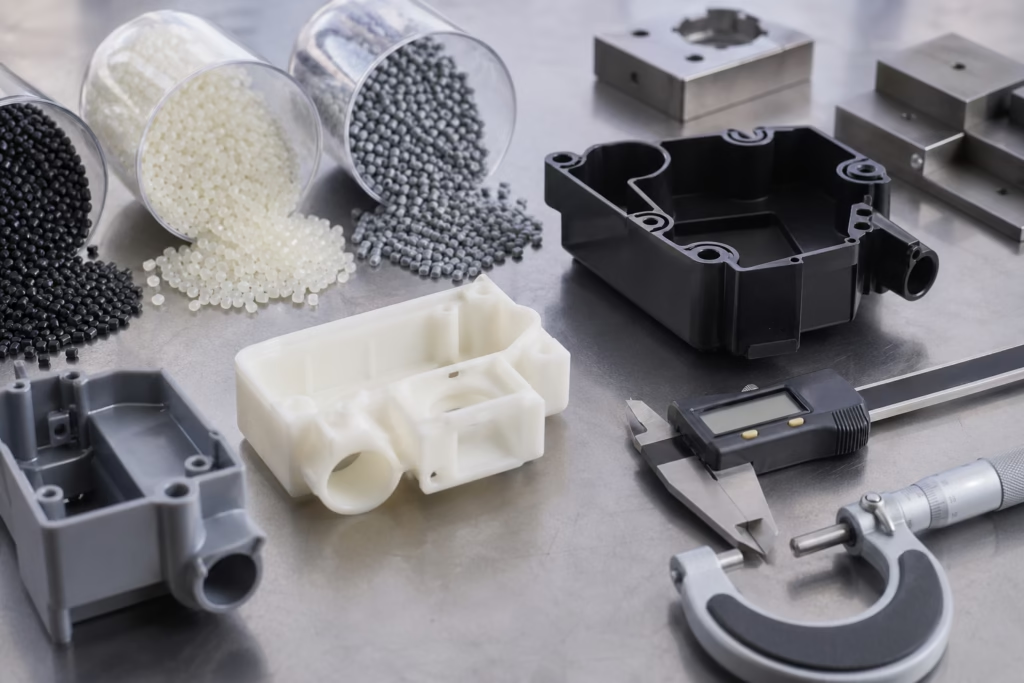
Operating humidity also changes the answer. A part used indoors in controlled conditions may have a very different material requirement from one used in warm, wet, or outdoor environments. The real issue is not average humidity alone, but the range of humidity the part will see throughout storage, shipping, assembly, and end use.
In practical material selection, PBT is often reviewed for housings and precision-fit parts because it combines useful stability with relatively low moisture uptake. That makes it a common candidate when dimensional predictability matters more than the highest possible impact resistance.
When a low moisture absorption plastic is the better choice
These materials are often the better option when any of the following apply:
- The part must hold a close fit after conditioning
- Assembly consistency is more important than peak dry strength
- The product will see seasonal or geographic humidity changes
- Sliding, locking, or mating surfaces depend on repeatable geometry
- Field failures would come from looseness, noise, drag, or misalignment rather than fracture alone
For higher heat or more demanding structural conditions, material choice may shift again. That is why resin families should be compared as systems, not as isolated properties.
Common mistakes that lead to warping, looseness, or failure
One of the most common mistakes is selecting a material by tensile strength only. Strength matters, but it does not guarantee dimensional stability. Another mistake is testing only dry-as-molded parts and assuming the same fit will remain after conditioning.
Other selection errors include ignoring wall thickness effects, overlooking post-mold shrinkage, and choosing a resin that is fine for general durability but too moisture-sensitive for precision interfaces. These issues often show up later as assembly variation, interference loss, or unexpected rework.
For comparison across nylon grades and stability-focused options, the article on PA6 vs PA66 vs PBT can help frame the trade-offs between toughness, moisture behavior, and fit stability.
Practical checklist for engineers and buyers
Before finalizing a material, review the following:
- What is the tolerance stack? If the fit is tight, moisture drift matters more.
- What is the humidity range? Consider storage, transit, and field conditions.
- Will the part slide, lock, seal, or align? Functional interfaces are more sensitive than cosmetic parts.
- Is long-term load involved? Creep and conditioning can interact.
- What is the acceptable change in dimensions? Define it before selecting the resin.
- Does the supplier understand processing and conditioning effects? Material data is most useful when paired with manufacturing experience.
If the design is especially sensitive, custom compounding may be a better route than forcing a standard grade to do a precision job it was not built for. In those cases, consultation around fillers, reinforcement, or resin modification can improve balance between strength, moisture response, and processability.
For deeper product and process coordination, a supplier with technical support can help align resin choice with tooling, conditioning, and application targets. That is often where manufacturer experience becomes more valuable than a simple material catalog.
Conclusion
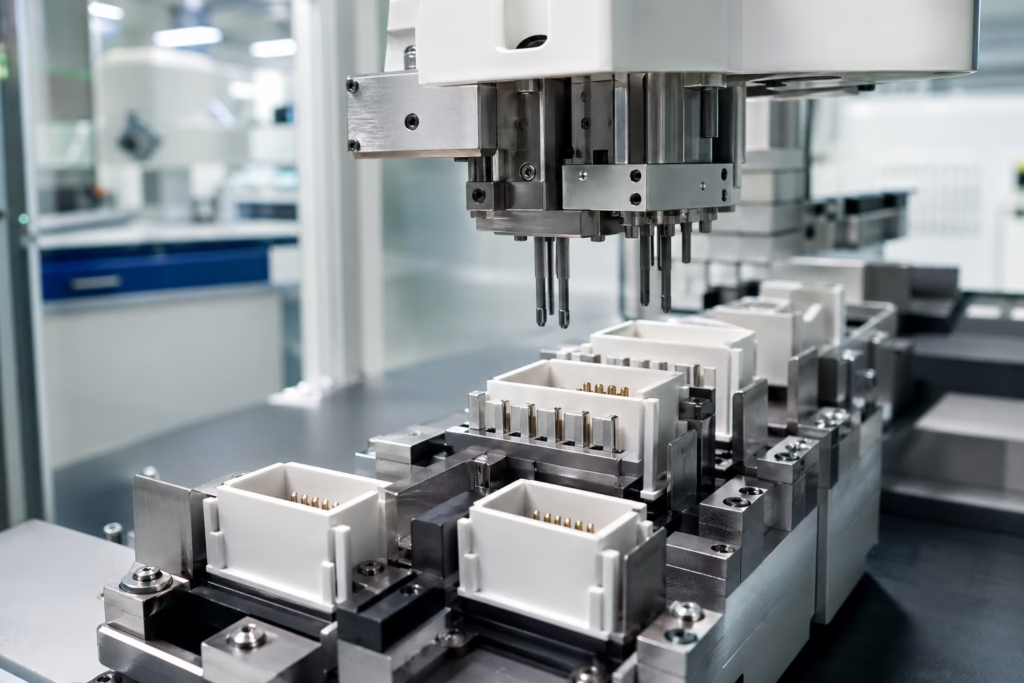
Choosing a low moisture absorption plastic for precision parts is not about finding the strongest material on paper. It is about selecting the resin that stays stable enough to preserve fit, function, and repeatability in the real environment. Nylon may still be the right answer in some cases, but nylon strength alone is not enough to judge precision performance.
When the application depends on stable dimensions, predictable assembly, and long-term reliability in humid conditions, the better decision is usually the one that balances strength with moisture response, tolerance control, and process consistency. That is the standard that should guide every precision part evaluation.
FAQ
What is a low moisture absorption plastic?
A low moisture absorption plastic is a resin that takes in less water from the environment, helping it hold size, stiffness, and fit more consistently in humid conditions.
Why is nylon not always the best choice for precision parts?
Nylon can be strong and tough, but it may change dimensions and stiffness after absorbing moisture, which can affect tight-tolerance parts.
Which plastics are often used when moisture stability matters?
POM, PBT, PET, PPS, and PEI are often considered when low moisture uptake and dimensional stability are important, depending on temperature and load needs.
How do I know if moisture will affect my part?
If the part has a tight fit, sliding interface, or critical alignment feature, moisture can matter even when the dimensional change seems small.
Should I test parts only in dry conditions?
No. Dry testing is useful, but conditioning and real-environment testing are important for predicting how the part will behave after exposure to humidity.
Can a supplier help choose the right grade?
Yes. A material supplier with processing and application knowledge can help match resin behavior to tolerance, environment, and production requirements.