
Selecting a flame retardant plastic compound is rarely a one-criteria decision. In practice, engineers have to balance flame performance, stiffness, impact resistance, heat behavior, process stability, and total part cost against the real end-use environment. A material that passes a target flame rating may still be the wrong choice if it warps, becomes brittle, absorbs too much moisture, or complicates molding.
For teams narrowing material options, Poly Maro’s technical support for material selection can be a useful starting point when the application needs a more structured trade-off review.
Why flame retardant selection is a balance problem
Flame retardancy is usually only one part of the specification. The more important question is whether the material can survive the full set of requirements: electrical safety, mechanical loading, heat exposure, assembly tolerances, cosmetics, and production consistency. In many projects, the final choice is less about finding the highest rating and more about finding the most suitable compromise.
A flame retardant system can improve safety behavior, but it can also change flow, crystallization, surface finish, and long-term aging. That is why the same rating can lead to very different real-world outcomes across different polymer families.
What usually drives the need for FR materials
Flame retardant plastics are typically selected because of one or more of these pressures: regulatory requirements, customer safety expectations, industry standards, internal product risk reduction, or use in enclosed electrical and electronic systems. In housings, terminals, connectors, and appliance parts, the material often needs to resist ignition and slow flame spread without introducing new processing or durability problems.
- Electrical and electronic safety requirements
- Heat exposure near components or power sources
- Household or public-use fire risk reduction
- Industry-specific certification targets
- Internal quality and warranty risk control
What UL94 V-0 means, and what it does not mean

UL94 V-0 is one of the most commonly requested flame classifications, but it is not a complete material performance summary. It describes how a plastic behaves in a controlled vertical burn test, not how it will perform in every product geometry, wall thickness, or installed condition. A part can meet the classification and still be unsuitable if it lacks the needed strength, processability, or heat resistance.
V-0 is also sometimes over-specified. If the real hazard is lower, or if the part is protected by enclosure design, spacing, or system-level safeguards, another rating or a different material strategy may be enough. For example, material choice may need to consider FR PC materials when transparency, heat resistance, and dimensional stability matter together rather than flame rating alone.
When a rating is useful and when it is not enough
Ratings are useful as screening tools, especially in procurement and early design. But final selection should also consider the part’s geometry, thickness, assembly stress, and exposure to heat or electrical load. In a thin-wall part, flow and mold fill can matter as much as the nominal flame class.
That is why material selection often starts with the application, not the rating label.
How flame retardant additives change plastic behavior
Flame retardant additives are not neutral. They can influence not only burning behavior but also mechanical properties, color, odor, surface quality, and aging resistance. The effect depends on the base resin, additive package, fiber reinforcement, and target flame level.
For procurement and design teams, the practical issue is not whether the material is flame retardant, but what was traded away to achieve that performance. A tougher part may lose some ductility, or a high-flow grade may reduce impact strength. That trade-off should be evaluated before committing to tooling.
| Performance area | Typical selection concern |
|---|---|
| Strength | FR systems may reduce tensile performance if the formulation is not balanced |
| Impact resistance | Some compounds become more brittle at lower temperatures |
| Heat resistance | Higher flame performance does not automatically mean higher thermal stability |
| Appearance | Additives may affect surface gloss, color consistency, or fiber visibility |
| Aging | Long-term heat and moisture exposure can change properties over time |
In applications where dimensional consistency matters, flame-retardant PA66 may be preferred over softer alternatives, especially when the part must keep stiffness under load and elevated temperature.
Processing matters as much as material performance
Even a strong material can become a poor manufacturing choice if it is difficult to mold consistently. Flame retardant plastic compounds may require tighter drying control, careful melt management, and more attention to shrinkage and warpage than non-FR grades. Small changes in processing can have outsized effects on appearance and part stability.
That is especially true in multi-cavity production, where a compound must fill uniformly and release cleanly across long runs. If the part is sensitive to tolerance drift, the material’s processing window may be more important than the headline flame rating.
For parts that need good balance between flame performance and moldability, FR PBT compounds are often considered because they can support stable molding behavior in many enclosure and connector applications, though the final result still depends on thickness, geometry, and package design.
What to watch during molding
- Drying sensitivity and moisture control
- Flow length and fill balance
- Sink, warp, and shrink behavior
- Surface quality and visible defects
- Cycle time stability and repeatability
The real cost drivers behind FR engineering plastic choices
Material price is only one part of cost. A flame retardant plastic compound can become expensive in practice if it increases scrap, lengthens cycle time, or requires more mold tuning. Cost also depends on resin base chemistry, additive system complexity, certification scope, and how much testing is needed for the end product.
Some teams compare only the resin quote and miss the downstream effects. For example, a grade that is slightly more expensive per kilogram may reduce rework, improve consistency, and lower total processing cost. In many cases, that is the more important number.
Poly Maro often sees selection decisions shift once buyers look at total part cost rather than resin price alone. This is one reason material comparison should include molding behavior and validation effort, not just a catalog specification.
Choosing by application, not by label
Different product categories place different demands on flame retardant plastic compounds. Consumer electronics often need compact parts with good cosmetics and reliable ignition resistance. Electrical enclosures may prioritize rigidity and dimensional stability. Automotive parts may face temperature cycling, vibration, and long service life. Appliance parts often need a balance of heat resistance, appearance, and processing efficiency.
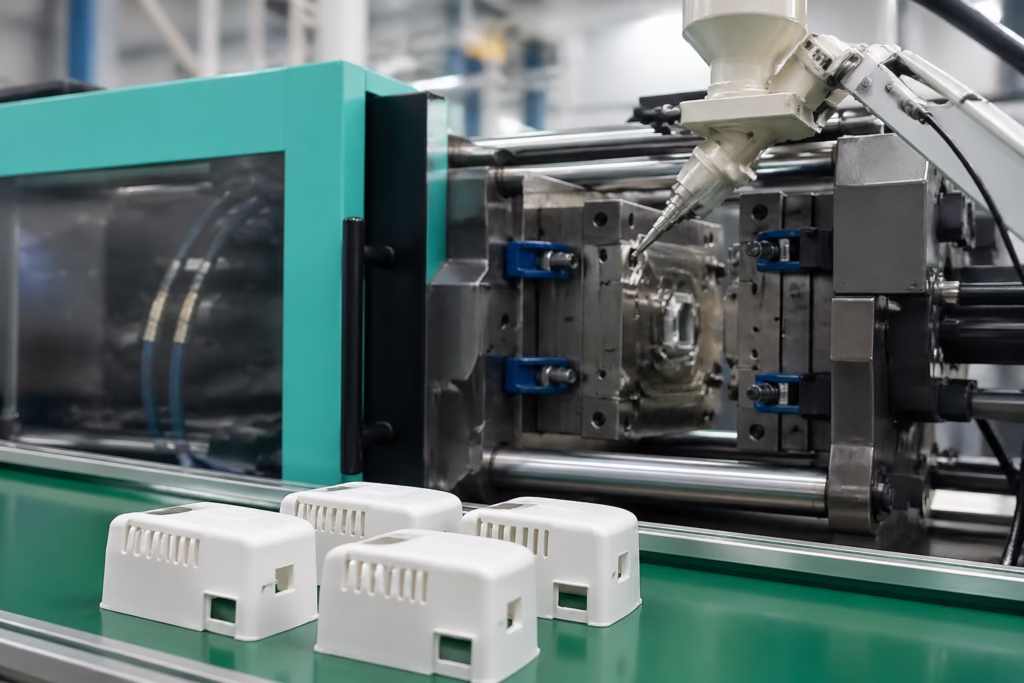
In housing applications where impact resistance and surface quality are important, flame-retardant ABS may be useful for some designs, while other parts may need a more heat-resistant engineering resin. The right answer depends on how much load the part carries and how close it sits to heat sources.
Typical decision differences by application
- Consumer electronics: thin-wall fill, cosmetic finish, and controlled ignition behavior
- Electrical enclosures: stiffness, insulation behavior, and dimensional stability
- Connectors: heat resistance, electrical performance, and precision molding
- Appliances: durability, heat exposure, and surface appearance
- Automotive parts: aging resistance, vibration tolerance, and long-term stability
- Industrial components: robustness, chemical exposure, and maintenance of properties over time
When V-0 is the right target, and when it may be too much
UL94 V-0 is appropriate when the product environment and safety expectation clearly justify that level of performance. It is often suitable for compact electrical parts, internal housings near energized components, and applications where ignition resistance is a core product requirement.
But V-0 may be more than necessary if the part is not exposed to meaningful ignition risk, if other design features already manage the hazard, or if the application can tolerate a different fire-performance strategy. In those cases, over-specifying can create avoidable cost, reduced toughness, or unnecessary processing challenges.
For some designs, the right choice may be a different resin family, a modified compound, or a structure that relies on component layout and enclosure design rather than maximum flame rating alone. The most efficient choice is often the one that meets the actual risk level without adding unneeded complexity.
What should be checked beyond UL94?
Flame performance is only one part of compliance. The validation set should match the product’s electrical, thermal, and regional market requirements. For many engineering programs, the decision is incomplete without related tests and material restrictions.
Common checks include glow wire behavior, CTI where electrical tracking matters, and substance compliance requirements such as RoHS and REACH when relevant to the market. Industry-specific rules may also apply, especially for electrical and automotive components. When a design uses a flame retardant plastic compound, it is wise to confirm the entire test package rather than relying on one label.
A practical selection checklist
- Confirm the real end-use temperature and loading conditions
- Define the necessary flame performance target
- Check mechanical requirements after molding
- Review shrinkage, warpage, and tolerances
- Verify electrical and compliance needs
- Compare total cost, not just resin price
- Validate processing behavior on production tooling
How to compare candidate materials effectively
A good comparison starts by ranking the application requirements. If flame resistance is only one of several critical demands, then the material should be judged on its full performance balance. This is where comparing two compounds by a single datasheet number can be misleading.
A practical method is to score each candidate across flame behavior, mechanical properties, processing stability, compliance burden, and lifecycle cost. If a material wins on flame rating but loses heavily on warpage or impact strength, it may not be the real best fit.
For example, flame-retardant PA66 may offer good stiffness and heat performance, but another resin may mold more easily or provide better dimensional control in a specific housing. The selection should follow the part requirements, not the habit of using the same material family for every project.
| Selection factor | Question to ask |
|---|---|
| Flame performance | Does the part truly need V-0 or another target? |
| Mechanical balance | Will the part stay strong enough after additives are introduced? |
| Processing fit | Can it run consistently on the intended mold and equipment? |
| Compliance | Are all required tests and material restrictions covered? |
| Total cost | What is the true cost after scrap, cycle time, and validation? |
Common selection mistakes to avoid
One common mistake is choosing the highest flame rating first and the rest of the design second. Another is assuming one material family can solve every application because it worked in a previous project. Both approaches can lead to unnecessary cost or poor manufacturability.
It is also risky to ignore thickness sensitivity, drying requirements, or the effect of reinforcement on surface appearance. In some cases, the material is technically suitable but the part design is not. A selection process that includes both material and geometry usually avoids expensive surprises later.
For teams comparing platform options, internal reference guides such as FR PC materials, flame-retardant PA66, FR PBT compounds, and flame-retardant ABS can help structure the shortlist by resin family before deeper validation begins.
Conclusion: choose for the application, not the label
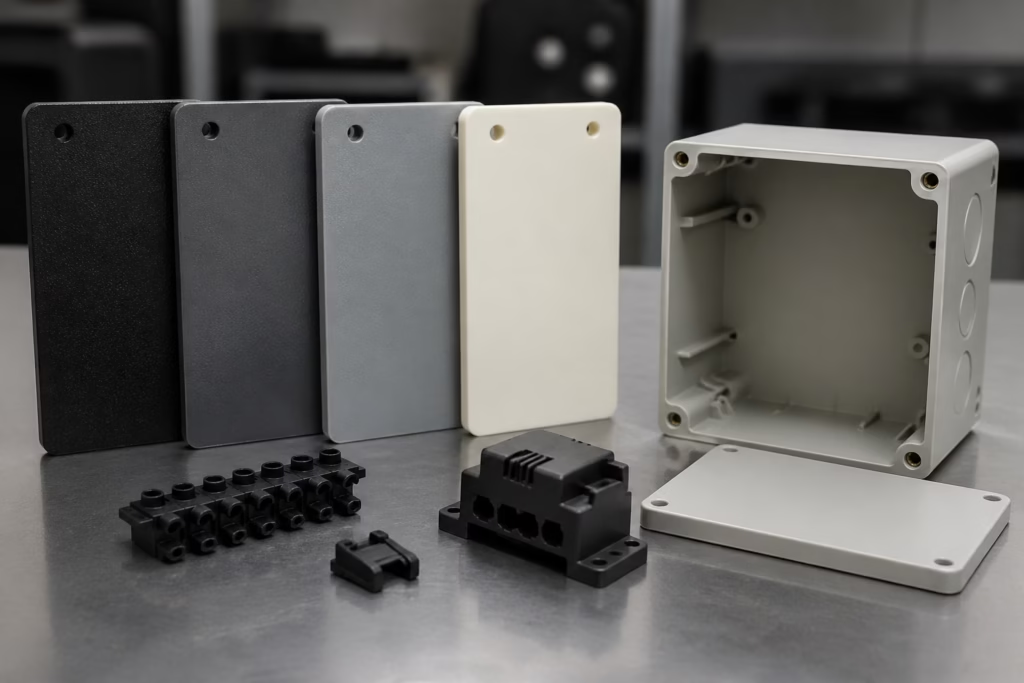
The best flame retardant plastic compound is not always the one with the highest flame rating. It is the one that meets the real safety need while still fitting the part’s mechanical, electrical, processing, and cost constraints. In practical terms, that means starting with the application, then narrowing the material set based on validated trade-offs.
If the project is demanding, the material choice should be treated as a system decision, not a single-number decision. That approach usually leads to better part performance, fewer production issues, and a more defensible cost structure over the life of the product.
FAQ
Is UL94 V-0 always required for electrical parts?
No. The required flame level depends on the part’s location, risk exposure, enclosure design, and industry requirements. Some electrical parts need V-0, while others can use a different strategy if the system design controls the hazard.
Does a higher flame rating always mean better overall performance?
Not necessarily. Higher flame performance can come with trade-offs in impact strength, flow, appearance, or cost. The better choice is the one that meets the application needs without creating new problems.
Why do some FR plastics warp or become brittle?
Flame retardant additives can alter crystallization, flow, and reinforcement balance. If the formulation is not matched to the part geometry and process, warpage or brittleness can appear during molding or use.
How should I compare two flame retardant compounds?
Compare them across flame target, mechanical properties, processing stability, compliance needs, and total cost. A single datasheet value rarely tells you which compound will work better in production.
Are FR engineering plastics more expensive to process?
They can be, if they require tighter drying, longer cycle times, or more mold tuning. However, a well-matched grade may reduce scrap and improve consistency, which can offset the higher resin price.
Can one material work for both housings and connectors?
Sometimes, but not always. Housings and connectors often have different requirements for rigidity, heat resistance, precision, and surface quality, so separate material choices are common.