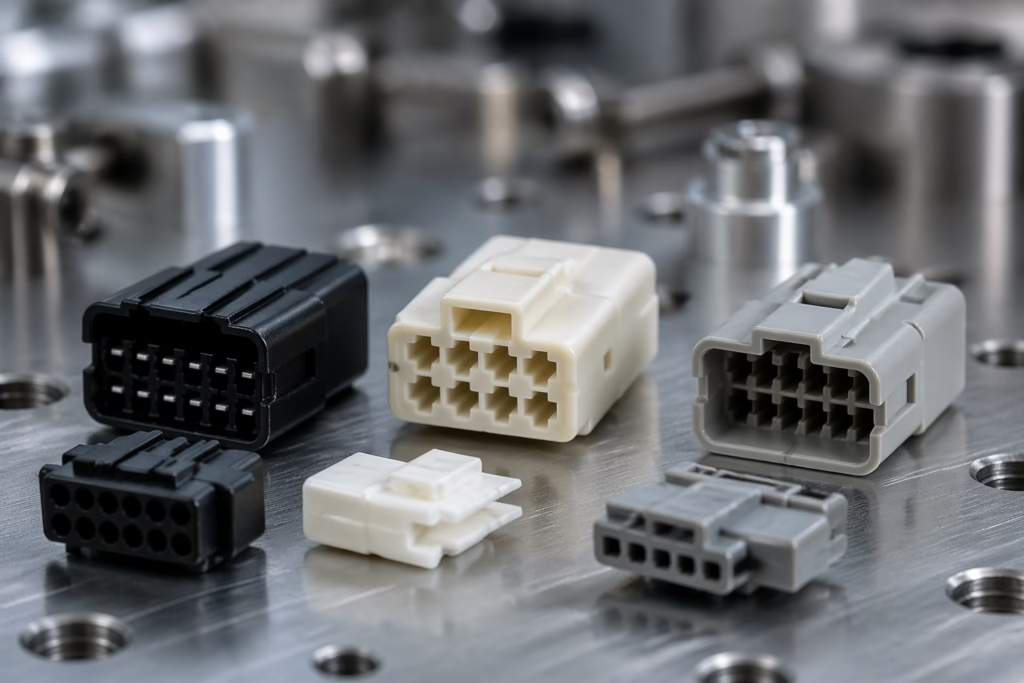
POM vs PA is one of the most common material choices in gears and motion parts because both can work well, but they fail in different ways. For gears, sliders, bushings, cams, and guide parts, the real question is usually not which polymer is “stronger” in a broad sense. It is whether your design should prioritize wear resistance, dimensional stability, or toughness under load.
For readers comparing material options, a useful next step is to review application guidance, since that page helps connect material selection with real end-use requirements in a manufacturer setting. That makes it easier to judge whether a part needs tighter dimensions, better sliding behavior, or a different resin system altogether.
Why POM vs PA is such a common choice for motion parts
Plastic gears and moving components are judged by how they behave over time, not just by how they look on a spec sheet. A gear can run quietly on day one and still fail later because its teeth wear down, the part absorbs moisture, or the housing creeps enough to change backlash. That is why POM vs PA comes up so often in engineering reviews.
In practical use, these materials often appear in compact mechanisms where metal is unnecessary or too heavy. Common examples include small gears, sliders, bushings, cams, guide blocks, latch parts, and low-noise transfer components. These parts usually need a balance of friction behavior, size stability, load handling, and cost control.
The hard part is that the “best” gear material plastic depends on the dominant failure mode. If the design is sensitive to size drift, POM often looks attractive. If the design needs more toughness or impact margin, PA may be the better starting point. The right choice depends on the motion pattern, the load profile, and the environment.
What usually makes plastic gears fail

Before comparing materials, it helps to understand how plastic motion parts actually fail. A lot of selection mistakes happen when teams focus on one property and ignore the failure mode that matters most.
Wear and tooth profile loss
Wear slowly changes tooth geometry, slider surfaces, and bearing contact areas. In gears, this can increase backlash, reduce smooth meshing, and create noise. In guide parts and sliders, wear can increase play and reduce positional accuracy.
Creep and deformation under long-term load
Plastic parts can deform when they carry load for long periods. Even if the part does not break, small deformation can change center distance, gear mesh, or alignment. That is a common reason motion systems lose precision over time.
Backlash growth and lost accuracy
Backlash often grows when wear, creep, or moisture swelling changes the effective dimensions of the assembly. Once backlash grows beyond the design range, noise usually increases and positioning becomes less consistent.
Heat, friction, and noise
Motion parts generate heat through friction. If friction is too high, wear rises and the material can soften faster under local stress. Noise also matters, especially in consumer products, because a low-friction material can reduce vibration and make the mechanism feel smoother.
Moisture-driven size change
Some plastics change dimensions when humidity rises. That is not just a storage issue; it can alter gear tooth spacing, shaft fit, and guide clearance in the finished product. For precision assemblies, this can be more damaging than visible surface wear.
POM characteristics for gears and moving parts
POM is often selected when low friction and dimensional stability are the priority. It is widely used in gear material plastic applications because it can run smoothly, maintain size well, and resist moisture-related dimensional change better than many other engineering plastics.
Why POM is strong in precision motion
POM typically offers a good combination of stiffness, wear resistance, and low friction. That makes it useful in compact gears, low-noise sliders, and parts that must stay close to their original dimensions. In many mechanisms, that stability is what keeps backlash under control.
Another advantage is that POM often behaves predictably during processing. For manufacturers and OEM teams, predictable molding behavior can reduce surprises in fit, tolerance control, and assembly. In many projects, that consistency is just as valuable as raw strength.
Where POM can be limited
POM is not a universal solution. Under higher temperature exposure or long-term heavy load, it may not be the best answer. Some chemical environments can also limit its use. If the design expects strong impact, repeated shock, or elevated heat for long periods, the margin may be too narrow for comfort.
Poly Maro often sees this trade-off in motion parts where the first prototype feels excellent, but the duty cycle is harsher than expected. That is why the operating profile matters more than the catalog description.
PA characteristics for gears and moving parts
PA, or nylon, is often chosen for its toughness and load tolerance. In gear systems and moving assemblies, it can handle shock and dynamic stress well, especially in grades that are reinforced or modified for engineering use.
Why PA is often chosen for load and impact
PA tends to offer better impact resistance than many unfilled plastics, and certain grades can support higher loads effectively. That makes it a practical choice for gears that see sudden engagement, parts that may experience shock, or components that need more mechanical margin.
In some applications, reinforced PA grades can also improve stiffness and load-bearing performance. That can be useful where the part must resist deflection more than it must preserve ultra-tight dimensional consistency.
Where PA creates risk
The main challenge with PA is moisture absorption. As it absorbs water, it can change size, feel softer, and shift its mechanical behavior. For gears and precision guides, that can affect backlash, fit, and noise. In a controlled environment, this may be manageable. In a humid or fluctuating environment, it becomes a bigger design risk.
PA can also be less dimensionally stable than POM in long-term precision motion. If the mechanism depends on tight clearances, that difference can matter more than the added toughness.
For projects comparing PA6 for moving parts with other resin options, PA6 for moving parts is a useful reference point because it helps frame where nylon fits in dynamic assemblies and where another material may be safer.
POM vs PA in real engineering criteria
At a selection table level, POM vs PA is usually a trade-off between stability and toughness. The best choice depends on which performance loss would hurt the product first.
| Criterion | POM | PA |
|---|---|---|
| Wear resistance | Typically strong in low-friction motion | Good, but often more sensitive to moisture and grade choice |
| Dimensional stability | Usually better for precision fit and backlash control | Can change more with humidity |
| Noise behavior | Often smoother and quieter in small motion parts | Can be good, but geometry and moisture matter more |
| Load and impact | Good, but not always the best for shock loads | Often stronger in toughness and impact resistance |
| Humidity sensitivity | Lower moisture absorption | Higher moisture absorption |
| Processing and molding | Often predictable for precision parts | Broadly usable, but grade selection is critical |
Wear resistance
If the main risk is surface wear, POM often has the edge in many small motion systems because it combines low friction with stable running behavior. That does not mean PA cannot wear well. It means the wear outcome in PA is more dependent on grade, environment, and mating surface design.
Dimensional stability
This is where POM often wins. If a gear must hold tolerance tightly, or if a slider must keep the same clearance across seasonal humidity changes, POM is often easier to control. PA can be used, but the design has to account for moisture-driven size change from the start.
Noise and vibration behavior
Low noise usually favors a stable, low-friction material with consistent geometry. POM often performs well here because it helps preserve smooth mesh and consistent contact. PA may still work, but if moisture changes the part size, noise can rise over time.
Load capacity and fatigue behavior
PA often has the advantage when the part sees shocks, impact, or repeated mechanical abuse. That is why it is frequently chosen for parts that need more toughness than precision. If the assembly is punishing the part rather than gently rotating it, PA can be the safer bet.
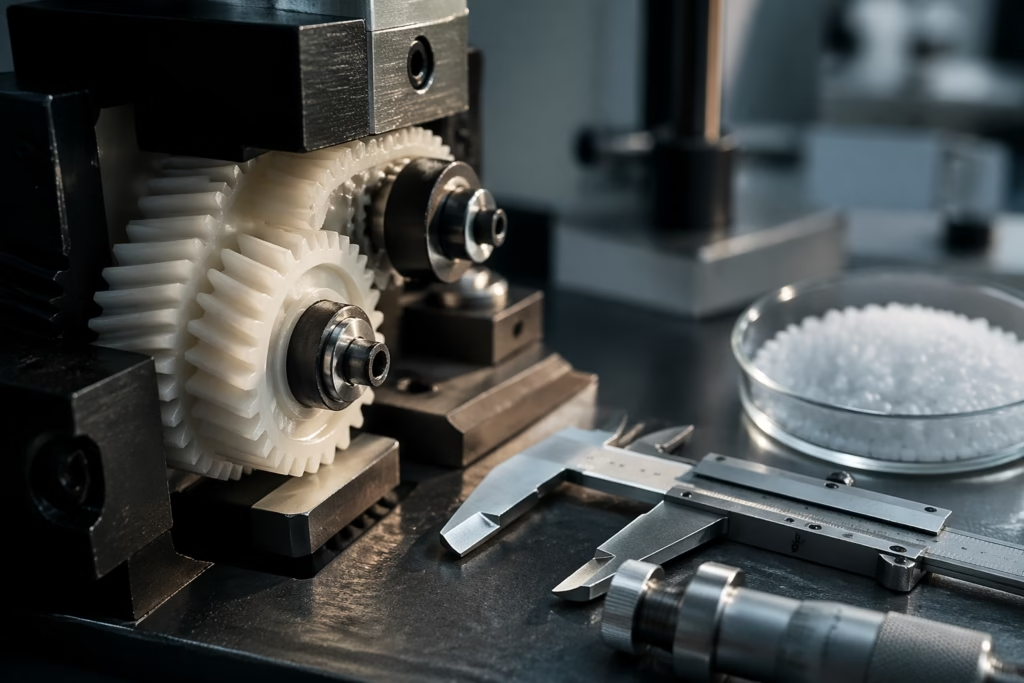
Environmental sensitivity
Humidity is the major separator. POM is generally easier to manage in changing ambient conditions, while PA needs more design care. Temperature and chemical exposure also matter, but the moisture effect is often what changes the decision first in real projects.
Machinability and molding considerations
Both materials can be molded into motion parts, but the real question is repeatability. A material that looks strong on paper may still create production issues if it is hard to hold tolerance consistently. For that reason, it is worth comparing material options with technical support for material selection early in the project, especially when the part has tight fit requirements or high-volume molding targets.
Which factor matters most in each scenario?
The answer changes depending on what would make the product fail first. That is the most useful way to decide between POM and PA.
When wear dominates the design risk
If the part is expected to slide or mesh smoothly for long periods, and the biggest problem would be surface wear or friction buildup, POM is often the more practical first choice. It is especially useful when the design must keep the same feel and noise level over time.
When dimensional accuracy dominates
If backlash control, center distance, or clearance retention is the top concern, POM usually gives the engineer a better starting point. This is common in precision gears, compact drives, and guide systems where even a small dimension shift can affect function.
When toughness matters more than stability
If the part may see shock loading, accidental overload, or rough handling, PA can outweigh POM’s stability advantage. In those cases, a tougher nylon grade may protect the product better, even if it requires more environmental control.
When the environment changes the answer
Hot, humid, or chemically aggressive conditions can move the decision away from the material that looked best in dry lab testing. This is where a simple material ranking becomes less useful than a full application review.
If the design is moving toward PA66 because higher stiffness or load handling is needed, PA66 material options can help frame what grade family is worth evaluating for stronger dynamic parts.
Selection guidance by application scenario
Precision gears and compact mechanisms
POM is often the safer choice when the gear must stay accurate, quiet, and smooth. It suits small drives, instrument components, and compact assemblies where tight clearance matters more than shock resistance.
Sliders and guide rails
POM usually performs well in sliders and guide parts because low friction and dimensional stability help maintain smooth movement. If the slider sees heavier impact or abrupt loading, PA may be worth testing, but the moisture effect should be checked carefully.
Low-noise consumer products
For home appliances, office devices, and consumer mechanisms, noise can be a major selection factor. POM often gives a better combination of quiet motion and stable fit, which is why it appears frequently in low-noise designs.
Parts exposed to humidity or temperature swings
If the product will move between dry storage, humid use, and changing temperature, dimensional stability becomes harder to ignore. In many of those cases, POM is easier to control. PA may still be used, but only if the design can tolerate moisture-driven change or the part geometry can absorb it.
Lightweight industrial components
For industrial parts that need more toughness or load margin, PA can be very effective. This is especially true when the part is not relying on ultra-tight motion accuracy and the environment is stable enough to manage moisture effects. For broader material families used in industrial components, engineering plastic materials provide a useful starting point when comparing alternatives beyond only POM and PA.
Practical checklist before you choose POM or PA
Before finalizing the material, walk through the problem in the same order the part will experience it in service.
- What is the load level, and is it steady or shock-based?
- How fast does the part move, and how many cycles will it see?
- Will the part run dry, or is lubrication expected?
- How tight are the dimensional tolerances?
- How much backlash growth can the design tolerate?
- Will humidity or water exposure change the fit?
- Is noise a performance requirement or just a comfort issue?
- What is the expected temperature range?
- Are there chemical exposures, cleaners, or lubricants to consider?
- Is the part molded once, or does the design need easy repeatability in mass production?
These questions usually reveal whether wear resistance or dimensional stability is the real priority. They also show when a reinforced grade, a modified compound, or even a different polymer family should be considered.
Red flags that suggest another grade may be better
If the part is under high heat, constant heavy load, repeated shock, or strong humidity change, a standard unfilled grade may not be enough. That does not automatically rule out POM or PA, but it does mean the selection should be widened before the design is locked.
At that stage, it is often more productive to compare the part against other engineering plastics, then narrow back down to the resin system that matches the failure mode best. In many programs, that prevents late-stage rework and unexpected field issues.
A simple rule for choosing between POM and PA
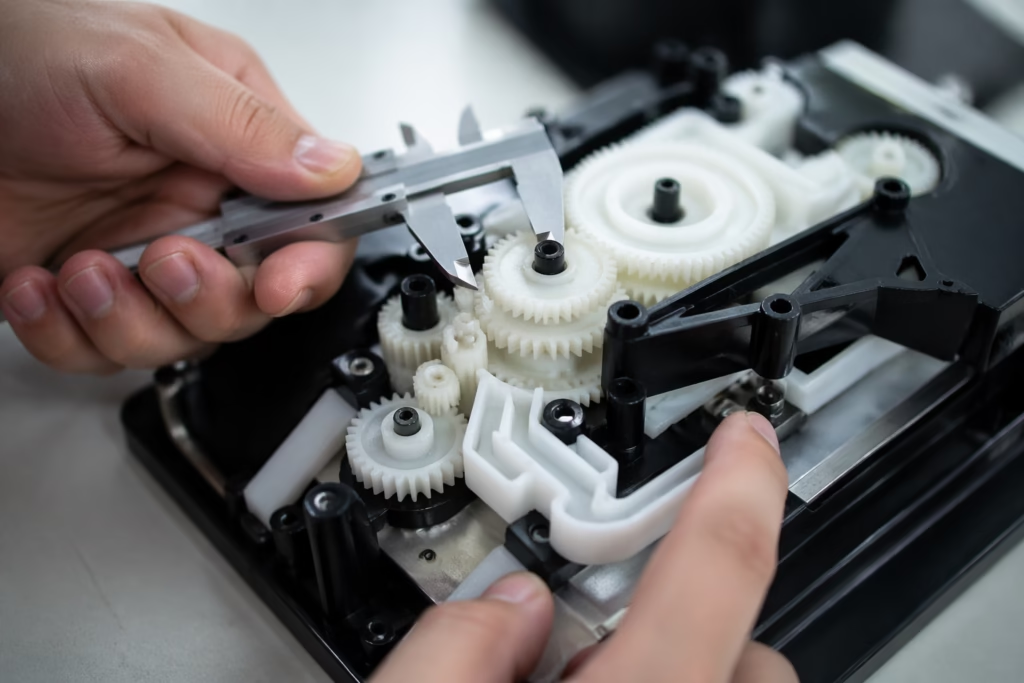
If you need the part to hold size, stay quiet, and keep friction low, POM is often the better starting point. If you need more toughness, shock resistance, or load margin, PA is often the better candidate, provided moisture can be managed.
The key is to choose based on the dominant failure mode, not on generic material reputation. A gear does not fail because it is “not strong enough” in a vague sense. It fails because wear, creep, size drift, heat, or impact pushes it past its operating window. Once you define that risk clearly, the POM vs PA decision becomes much easier.
For product teams planning the next project step, PBT material overview can also be useful when the design needs a different balance of stiffness, stability, and process behavior than either POM or PA can provide.
In practical terms, POM is usually the better fit for stable, low-friction precision motion. PA is usually the better fit for tougher, more load-oriented moving parts when the environment is controlled enough to keep moisture from becoming the main problem.
Frequently Asked Questions
Is POM or PA better for gears?
POM is often better for precision gears when low friction, quiet running, and dimensional stability are the main goals. PA can be better when the gear needs more toughness or impact resistance, but moisture effects must be managed carefully.
Which material wears better in moving parts?
POM often performs very well in low-friction motion because it keeps its dimensions stable and runs smoothly. PA can also wear well, but its performance is more sensitive to grade choice and environmental conditions.
Why does PA change size more than POM?
PA absorbs more moisture than POM, and that moisture can change its dimensions and mechanical behavior. In precision parts, that can affect fit, backlash, and long-term consistency.
When should I choose PA instead of POM?
Choose PA when toughness, impact resistance, or load handling matters more than ultra-tight dimensional stability. It is often a stronger choice for rougher service conditions if humidity is under control.
Is POM quieter than PA in gears?
POM is often quieter in small gears and sliders because it usually keeps a steadier fit and lower friction profile. PA can be quiet too, but its noise behavior may change more as moisture and temperature shift.
Can reinforced PA replace POM in precision motion parts?
Sometimes, but not always. Reinforced PA can improve stiffness and load support, yet it may still be harder to control in humid environments. Precision motion parts should be tested for backlash, fit, and noise before replacement.