
When a project stalls over resin choice, the issue is rarely only about price or only about performance. In most teams, the real problem is a different definition of “good enough.” Procurement may see supplier risk, MOQ, and lead time, while engineering is focused on heat resistance, shrinkage, warpage, impact strength, and long-term reliability. That is why a plastic material selection team conflict can persist even when both sides are trying to protect the same program.
For teams that need more than a stock-grade recommendation, custom plastic compounding support can help translate competing priorities into one workable specification. At Poly Maro, we often help teams compare resin families, narrow reinforcement or flame-retardant options, and decide whether a standard grade is sufficient or a modified formulation is needed. That kind of shared technical starting point reduces late-stage surprises during sampling, trial molding, and volume purchasing.
Why purchasing and engineering often disagree on engineering plastic selection
Purchasing and engineering usually optimize for different risks. Purchasing is asked to control cost, lock in supply, and reduce commercial exposure. Engineering is asked to keep the part functional under load, heat, chemical exposure, electrical stress, and dimensional limits. Both goals are valid, but they can conflict when the team has no shared decision framework.
The most productive way to resolve the plastic material selection team conflict is not to ask which department is “right.” Instead, the team should decide what failure would cost the business most. A resin that is slightly more expensive may still be the lower-risk choice if it reduces scrap, mold maintenance, assembly rework, warranty claims, or field failure. Likewise, a premium material can be a poor choice if its performance margin is unnecessary and it drives avoidable cost or sourcing complexity. This is why a cross-functional approval process matters as much as the resin itself.
What each function is usually trying to protect
| Function | Primary concern | Typical questions |
|---|---|---|
| Purchasing | Total supply risk and commercial control | What is the price, MOQ, and lead time? How stable is the supplier? Can we dual-source? |
| Engineering | Part performance and manufacturing fit | Will the material meet strength, heat, flame, dimensional, and process targets? |
| Quality | Consistency and approval control | Will batch variation affect color, warpage, or assembly repeatability? |
| Production | Stable processing and yield | Does it dry properly? Does it mold cleanly? Will cycle time and scrap remain acceptable? |
When these questions are surfaced early, the team can rank them instead of debating them emotionally after a sample fails or a quote comes back higher than expected.
The 6 most common conflict points in plastic material selection team conflict

1) Lowest price versus total cost of ownership
The first disagreement is usually price. Purchasing sees a lower resin quote and wants to capture immediate savings. Engineering may oppose that choice if the lower-cost material raises scrap, increases cycle time, or creates dimensional instability. The better framework is total cost of ownership, not resin price alone.
A material that costs less per kilogram can still be more expensive per finished part if it causes poor flow, higher moisture sensitivity, extra drying time, lower impact performance, or wider shrinkage variation. In injection molding, those process penalties can add up fast. If a resin requires tighter molding windows or raises rejection rates, the “cheap” option is often the expensive one.
This is where teams should look at the part, the tool, and the process together. If the application is safety- or reliability-sensitive, it is also worth comparing the supplier’s qualification evidence and compliance documentation. For a useful external benchmark on engineered material evaluation, UL Solutions’ overview of compliance and qualification checks for engineered plastics is a good reference point when the discussion includes safety, certification, or material approval evidence.
2) Stable processing and supply availability versus performance specs
The second conflict appears when engineering specifies a high-performance material that is difficult to source consistently. Purchasing may push back if the grade has long lead times, limited producers, high MOQ, or a higher risk of allocation. Engineering may resist changing the spec because the part was designed around a certain modulus, heat deflection temperature, or flame-retardant level.
Our view as a manufacturer is that a material is only “good” if it can be supplied repeatedly in a way your plant can process. A technically strong resin that is unstable in supply can cause more downtime than a slightly lower-performance grade with excellent continuity. For buyers, this means asking not only whether the grade exists, but whether the supplier can repeat the same formulation window, color control, drying behavior, and batch consistency across orders.
This is also the point where the team should ask whether a modified formulation can bridge the gap. For example, a reinforced or impact-modified grade may provide enough performance while improving processability or supply flexibility. In many projects, the debate is not between “performance” and “availability,” but between one rigid material choice and a better-aligned formulation path.
3) Design performance targets versus manufacturability and molding reality
Engineering often defines the desired mechanical and thermal performance first, then assumes the part will mold within tolerance if the resin data sheet looks acceptable. Production teams know that the real world is more complicated. Wall thickness changes, gate location, rib design, drying control, and tool temperature all influence whether the part actually meets the target.
It is common for a design team to specify a high modulus material while overlooking that the same choice may increase warpage or shrinkage sensitivity. In some parts, the issue is not absolute strength but dimensional stability over the life of the product. In others, the part must survive assembly loads, heat aging, or snap-fit stress without cracking. This is exactly why teams should not treat datasheet numbers as a substitute for trial molding.
We recommend reading performance data together with process data. One practical starting point is how procurement and engineers should read TDS and SDS differently. A technical data sheet helps define properties, but it does not guarantee that the material will process the same way in every mold or press. Purchasing also needs the SDS and compliance documents to understand safety, handling, and downstream qualification requirements.
4) One material platform for procurement simplicity versus application-specific optimization
Procurement teams often prefer fewer material platforms. Standardizing on one family can simplify approvals, reduce inventory complexity, and improve leverage with suppliers. Engineering may disagree when one material is being stretched across very different applications, such as housings, structural clips, gears, or terminal components.
Standardization is helpful only when the parts share meaningful performance requirements. If one part needs flame retardancy and another needs high wear resistance, forcing both into the same platform can create hidden cost in over-specification, processing difficulty, or lower functional margin. This is why we often advise teams to separate “commercial standardization” from “functional standardization.” The first is a supply strategy; the second is a material-performance strategy.
There are cases where a single family truly works across multiple parts, but that should be proven rather than assumed. For teams weighing this issue, custom plastic compound versus standard grade is a useful lens. A standard grade can be the right answer when the requirement is ordinary and the process window is broad. A custom compound becomes more compelling when the part must balance heat, impact, creep, appearance, and dimensional stability at the same time.
5) Fast sourcing and short lead time versus validation and sample testing
When a project is behind schedule, purchasing may want the fastest available resin decision. Engineering may insist on samples, bench testing, and trial molding before approval. Both positions are understandable. The risk is that a rushed approval locks in a material that looks acceptable on paper but fails in production or in the field.
A practical validation sequence is usually faster than a correction sequence. The team should verify drying needs, melt behavior, mold filling, warpage tendency, surface quality, and any critical mechanical or thermal properties before bulk approval. If the part is mission-critical, short-term schedule pressure should never replace a minimal validation plan.
We have seen many teams save time by agreeing on a building a practical material testing checklist before sample validation. Even a concise checklist can prevent wasted loops by defining which properties are “must pass,” which are “watch items,” and which are only informative. That clarity helps both procurement and engineering avoid arguing about results after the sample already arrives.
6) Existing approved material versus better modified resin alternatives
The sixth conflict happens when a project inherits an approved material from a prior design or legacy platform. Purchasing likes it because the supply chain is already established. Engineering may want to switch because the old material no longer meets current requirements, has excessive warpage, or leaves too little safety margin.
Legacy approval can be valuable, but it should not become a permanent ceiling. Material technology changes. A newer modified resin may provide better impact resistance, heat resistance, electrical insulation, creep resistance, or dimensional stability without a major cost penalty. The challenge is to evaluate the new option without falling into the trap of assuming that “new” automatically means “better.”
This is where a balanced review matters. If the legacy grade is still adequate, changing it may create unnecessary revalidation work. If it is barely adequate, the cost of staying put can be higher than the cost of qualifying a better compound. That is why the team should compare the existing approved resin against a realistic alternative, not against a hypothetical ideal material.

What purchasing focuses on, and what engineering focuses on
When teams clarify their priorities, many arguments become straightforward trade-offs rather than personality clashes. Purchasing typically focuses on price, MOQ, lead time, supplier stability, delivery reliability, and batch consistency. Engineering typically focuses on tensile strength, flexural modulus, impact strength, heat deflection temperature, shrinkage, warpage, flame retardancy, chemical resistance, and the ability to mold the part reliably.
The difficulty is that these are not separate worlds. A resin with excellent performance but poor consistency can create manufacturing risk. A resin with easy sourcing but weak thermal performance can create product risk. The best decision is the one that meets the application with the smallest overall risk package.
At Poly Maro, our material development approach starts by asking which risk is most expensive: assembly failure, field failure, lost time, mold instability, or supply interruption. That answer usually determines whether a stock grade, a reinforced grade, a flame-retardant grade, or a custom compound is the most rational choice.
How to build a unified material selection standard for both teams
The most reliable way to reduce a plastic material selection team conflict is to replace open-ended debate with a shared scorecard. The scorecard should combine application need, process reality, supply risk, and total cost. When both teams use the same criteria, the decision becomes easier to defend later if a problem arises.
A shared evaluation matrix
| Evaluation area | What engineering checks | What purchasing checks | Decision question |
|---|---|---|---|
| Application requirement | Strength, heat, flame, wear, insulation | Commercial fit to target cost | Does the resin meet the actual end-use need? |
| Processing condition | Drying, flow, warpage, cycle time | Availability of consistent supply | Can the plant produce it repeatably? |
| Risk level | Part failure, tolerance drift, aging | Supplier continuity, MOQ, backup source | What is the cost of a failure or delay? |
| Cost-performance balance | Performance margin versus requirement | Unit price and total landed cost | Is the added performance worth the extra cost? |
A scorecard works best when every criterion has a weighting agreed before the quote arrives. If the team waits until after the numbers are in, the discussion often becomes tactical rather than objective. A simple weighted score is usually enough to reveal whether the disagreement is real or just a different emphasis on the same facts.
How to use datasheets, samples, and trial molding results together
Material data sheets are necessary, but they are not enough. Datasheets tell the team what the material is supposed to do under standard test conditions. Samples and molded parts tell the team what the material actually does in the real part geometry and process window. Trial molding then reveals whether the grade is stable enough for production.
The most common mistake is to approve a material because a single property looks strong. For example, a high strength resin may still be unsuitable if it absorbs moisture quickly or warps under heat. Another common mistake is to reject a resin because the first sample had poor finish, when the real cause was insufficient drying or an aggressive molding condition. Good team alignment requires separating material issues from process issues.
In practice, the team should review three questions together: Does the datasheet support the target? Do the molded samples confirm the expected behavior? Do the production conditions match the sample conditions closely enough to trust the result? That three-step check prevents many repeat disputes.
Supplier qualification questions both teams should ask before approval
Purchasing and engineering often ask different supplier questions, but the best qualification process uses both sets. Before approving a material, ask whether the supplier can maintain formulation consistency, provide stable lead times, support technical samples, and explain process windows clearly. Also ask whether the supplier can address reinforcement, color, flame-retardant, or impact-modification requirements without drifting away from the target properties.
A practical supplier review should also include the question of compliance evidence. Depending on the application, teams may need flame, electrical, or safety-related documentation to support customer approval. For those conversations, it helps to review compliance and qualification checks for engineered plastics alongside internal test plans so the team does not separate technical approval from compliance approval.
Questions both teams can agree on
- Can the material be supplied consistently across the expected purchase window?
- What drying conditions, melt temperatures, and mold conditions are recommended?
- What are the key risks for shrinkage, warpage, or moisture sensitivity?
- Is the supplier able to support custom compounding if the standard grade is not enough?
- How will the supplier handle lot-to-lot consistency and documentation?
Common mistakes that cause repeated disputes during material sourcing
One common mistake is writing the specification too early and too narrowly. If the team locks in a resin family before defining the actual part risk, the spec can force a bad fit. Another mistake is treating purchasing and engineering as if they should optimize the same variable. They should not. They should optimize the same business outcome through different lenses.
Another frequent issue is over-specification. Teams sometimes ask for the highest possible mechanical or thermal values even when the part does not need them. That can create higher cost, harder processing, or lower flexibility in sourcing. If a part needs reliable performance rather than maximum performance, a more balanced material is usually the right answer. This is why it helps to understand why chasing the highest-performance material can backfire before the final resin selection is made.
Finally, teams often underestimate how much molding behavior affects approval. A resin that looks great in a brochure but requires narrow drying control or shows unstable shrinkage can create recurring friction between departments. Aligning early on processing conditions, test criteria, and acceptable variation avoids those arguments later.
A practical workflow for agreeing on the final resin choice before mass production
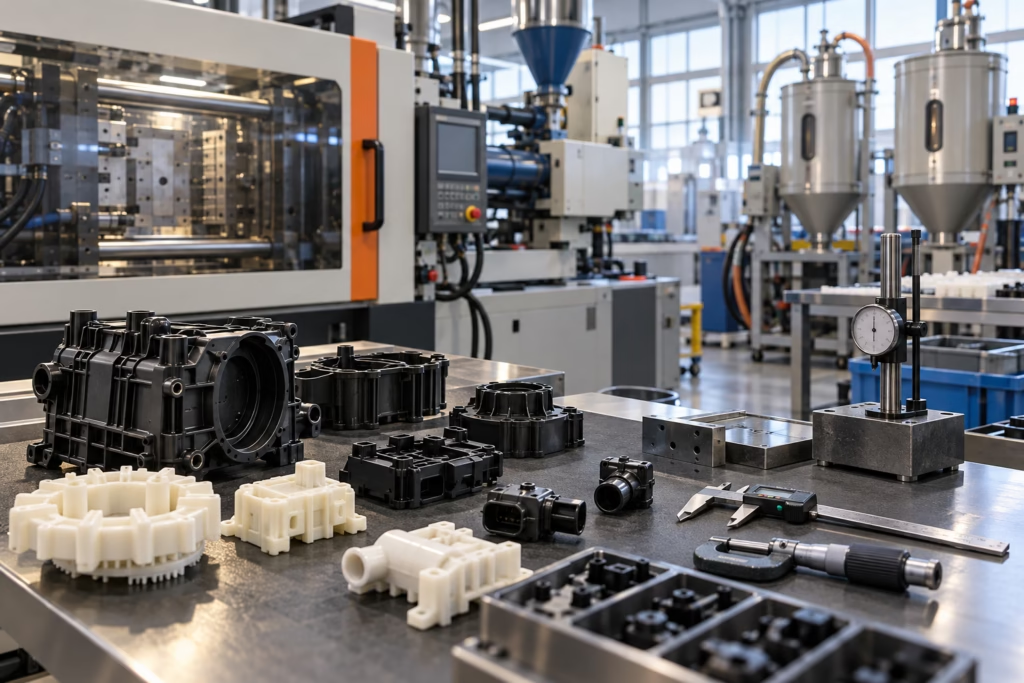
We recommend a simple workflow that both purchasing and engineering can support. First, define the part’s must-have requirements: temperature exposure, loading, electrical needs, flame rating, appearance, dimensional tolerance, and expected service life. Second, identify the production constraints: molding method, cycle time, drying capability, expected annual volume, and supply window. Third, shortlist materials that satisfy both sets of constraints.
After that, request samples and run a focused validation plan. Then compare the results against a weighted scorecard that includes total cost, process stability, and supply continuity. If the top option fails only because of a solvable process issue, adjust the process. If it fails because the resin is fundamentally misaligned, adjust the formulation. This is where a custom compound may be justified over a standard resin, especially when the application needs a tighter balance of properties than off-the-shelf grades can provide.
The most successful teams treat resin choice as a joint manufacturing decision, not a departmental win. When purchasing and engineering agree on the decision framework first, they spend less time debating the quote and more time protecting the launch.
How Poly Maro supports joint material decisions
Poly Maro’s role in this process is to help teams reduce uncertainty before they commit to mass production. That means discussing resin family selection, reinforcement and additive options, process window expectations, and the likely trade-offs between standard grades and custom compounds. When the discussion is framed around part function, supply stability, and molding reality, the final choice becomes easier to justify across departments.
For teams that want a broader view of material options and application fit, it can also help to review Poly Maro plastic material solutions and compare them with the end-use demands. If the application is specific, the team should look at the use case directly rather than relying on general assumptions about resin families. That is often the fastest route to a practical decision.
FAQ
How can purchasing and engineering agree faster on a plastic material?
Start with a shared evaluation matrix that ranks application performance, processing behavior, supply risk, and total cost. When both teams use the same criteria, they can discuss trade-offs instead of defending separate priorities.
What is the biggest mistake in material approval?
The biggest mistake is approving a resin from datasheet numbers alone. Real approval should also include drying behavior, molding stability, sample results, and supply continuity so the material works in production, not just on paper.
When should a team choose a custom compound instead of a standard grade?
A custom compound makes sense when the part needs a specific balance of strength, heat resistance, impact, flame retardancy, dimensional stability, or appearance that a standard grade cannot reliably provide.
How much should lead time influence resin choice?
Lead time should matter, but it should not override core performance requirements. A fast source is valuable only if it can also supply consistent quality and support the actual molding process.
What should both teams ask a supplier before approval?
Both teams should ask about consistency, MOQ, lead time, drying conditions, processing window, documentation, and whether the supplier can support samples and technical follow-up through validation.
Can the same resin be used for both procurement simplicity and engineering performance?
Sometimes yes, but only if the part requirements are similar enough. If different parts need different levels of heat resistance, impact strength, or flame performance, forcing one resin across all applications can create hidden cost and risk.