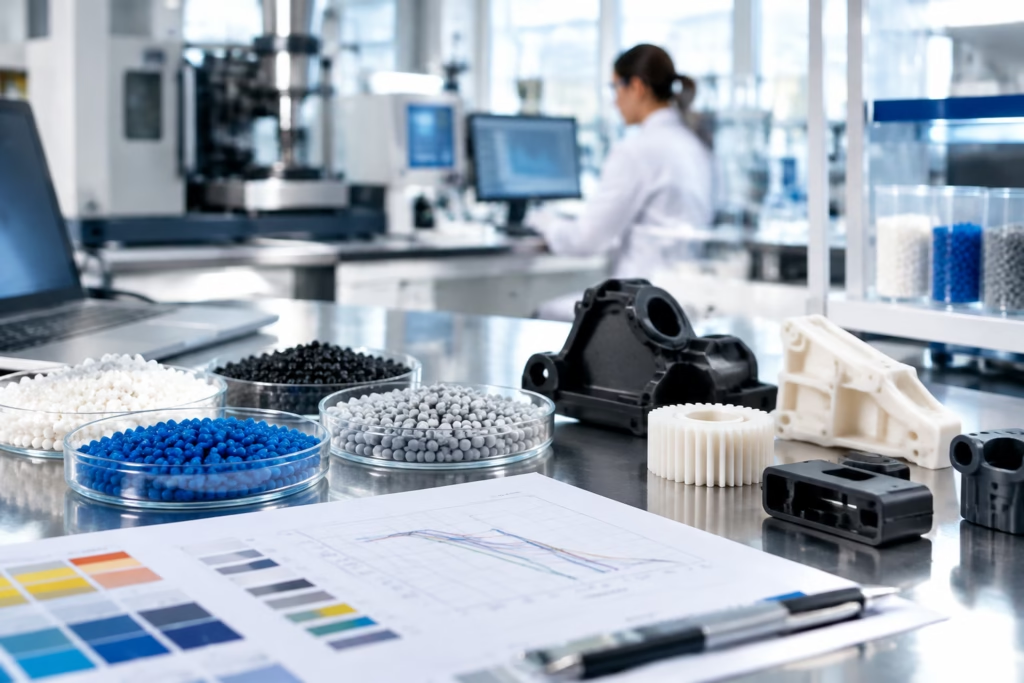
Robotics platforms and low-altitude economy drones are changing what engineers expect from structural plastics. In 2026, the core challenge is not simply making a part lighter; it is finding lightweight drone materials that can also hold stiffness, resist impact, manage heat, stay dimensionally stable, and process consistently at production scale. For OEMs, this means the best material is often not a standard resin grade, but a modified compound tuned for the exact load case, environment, and molding window.
metal replacement plastic compound solutions for lighter structures are often relevant when a project is moving from aluminum or die-cast parts toward polymer structures. At Poly Maro, we see this decision most often when an engineer needs lower mass without sacrificing bracket rigidity, housing accuracy, vibration control, or assembly reliability. In those projects, resin family selection, reinforcement design, impact tuning, and process stability all matter as much as the nominal density value.
Why robotics and low-altitude economy are creating new demand in 2026
The growth of service robots, inspection robots, logistics drones, and compact airborne platforms is pushing parts designers to rethink every gram. These systems need longer flight time, lower motor load, better handling efficiency, and reduced wear on moving assemblies. A lighter frame or shell can improve energy efficiency, but only if the material still meets the functional requirement of the part.
That is why lightweight drone materials are now judged against a broader performance picture. A drone arm, gear housing, sensor bracket, or battery enclosure may need a different balance of stiffness, toughness, heat resistance, and electrical insulation than a consumer product shell. Robotics adds another layer: repetitive motion, local stress concentration, vibration, and frequent handling can expose weak formulations quickly.
For manufacturers, the market opportunity is not just in selling plastic pellets. It is in delivering application-oriented compounds that reduce redesign risk. A good material answer can shorten development time, improve first-pass molding success, and reduce the trial-and-error cost that often appears when teams move from concept to pilot production.
What lightweight drone materials must solve
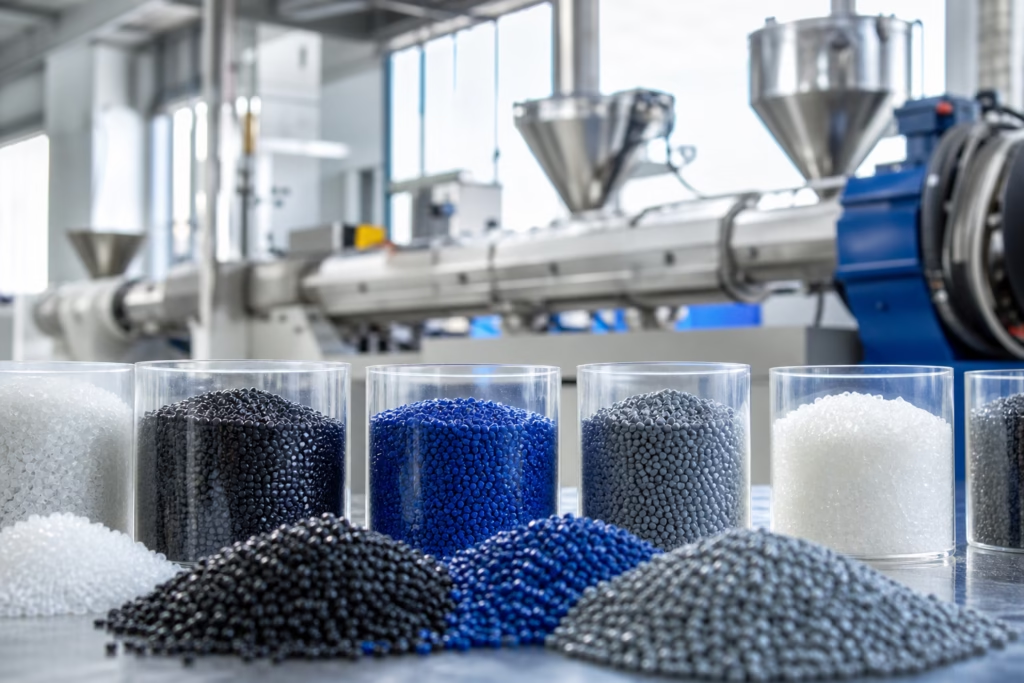
Weight reduction is only the starting point. In practice, materials for drones and robotics parts need to solve five problems at the same time:
- Structural strength: the part must carry static and dynamic loads without excess deformation.
- Vibration control: the material must help reduce resonance, looseness, and noise in moving assemblies.
- Impact resistance: landing shocks, collisions, and handling drops should not cause brittle failure.
- Thermal reliability: motors, electronics, and sunlight can raise local temperatures.
- Processability: the compound must mold or extrude with stable flow, predictable shrinkage, and acceptable cycle time.
When any one of these requirements is ignored, the project may still pass on paper but fail in production. For example, a very stiff but brittle compound may crack at screw bosses. A tough but soft compound may drift out of tolerance. A heat-resistant resin may be more expensive than the part can absorb if the design does not actually need that level of thermal margin.
This is why we recommend evaluating the part as a system. The same resin may work for an internal bracket but be unsuitable for an outdoor arm cover. The right answer depends on load path, wall thickness, exposure conditions, assembly tolerance, and production method.
Material selection priorities for robotics and drone components
From a manufacturer’s perspective, selection should start with the use case rather than the resin family. We usually organize the decision into the following order:
- Mechanical requirement: stiffness, impact, tensile strength, flexural modulus, wear, or creep resistance.
- Environmental exposure: heat, UV, moisture, chemicals, or outdoor weathering.
- Electrical requirement: insulation, anti-static behavior, or flame retardancy.
- Processing route: injection molding, extrusion, or overmolding.
- Production economics: MOQ, cycle time, mold complexity, scrap risk, and supply stability.
In many robotics and drone components, the smartest decision is to use a standard engineering polymer as the base and then modify it for the actual duty profile. That may mean glass fiber reinforcement for stiffness, impact modification for crash resistance, mineral filling for dimensional control, or a flame-retardant package for electronics housings.
Engineering plastics vs. general plastics
General plastics can be attractive for low cost or easy processing, but they often reach their limit when the part must be thin, loaded, or exposed to heat. Engineering plastics usually offer better strength, temperature resistance, and dimensional stability, while modified compounds can narrow the gap between cost and performance.
That is where high-performance modified plastics create real value. Instead of choosing between a cheap resin that fails early and an expensive resin that is overqualified, a tailored compound can target the exact gap. This is especially important in robotics, where part geometry is often compact and design margins are tight.
For readers comparing resin families, our PA66 resin options for higher strength and thermal performance are one example of how a base polymer can support demanding structural parts when heat and load are both concerns. PA66 is not the answer for every part, but it is often evaluated when designers need a stronger, more heat-tolerant alternative to softer or lower-temperature materials.
High-performance modified plastic options for lightweight design
Modified plastics matter because they change the performance curve of a base polymer. In drone and robotics applications, the most common modifications are reinforcement, impact tuning, heat stabilization, weather stabilization, and conductive or insulating functional packages.
| Modification type | Main benefit | Typical trade-off | Best-fit parts |
|---|---|---|---|
| Glass fiber reinforcement | Higher stiffness and better load holding | Can increase anisotropy and reduce surface quality | Frames, brackets, housings |
| Carbon fiber reinforcement | High stiffness-to-weight potential | Cost and processing complexity rise | Light structural parts, arms |
| Mineral filling | Dimensional stability and lower shrinkage | May reduce impact strength | Precision shells, mounts |
| Impact modification | Improved drop and crash resistance | Can reduce stiffness slightly | Protective covers, clips |
| Heat stabilization | Better elevated-temperature performance | May increase formulation cost | Motor-adjacent housings |
| Flame-retardant package | Improved safety margin for electronics | May affect flow or toughness | Battery-related enclosures, control modules |
Carbon fiber reinforced plastics, glass fiber reinforced plastics, and mineral-filled plastics
When stiffness is the main driver, reinforcement is usually the first lever. Carbon fiber reinforced materials can provide a very attractive stiffness-to-weight profile, but they are not always the default choice because cost, abrasion on tooling, and surface appearance can become limiting factors. Glass fiber reinforced plastics are usually easier to deploy at scale and remain a practical solution for many structural housings and mounting parts.
glass fiber reinforced resin solutions for stiffness-critical parts are often the most economical route when a project needs better rigidity, lower warpage, and stronger load support without moving into premium carbon-fiber pricing. Mineral-filled compounds are another important option when the key issue is shrinkage control, slot accuracy, or flatness in thin-wall molded parts.
The selection question is simple: do you need the highest stiffness possible, or the best balance of stiffness, processing stability, and cost? In many drone and robotics applications, the answer is the second one. A slightly lower modulus material that molds more cleanly may produce a better final assembly than a more rigid grade that warps or induces stress during cooling.
Impact-modified and toughness-enhanced materials
Crash resistance matters more than many product teams expect. Drones face takeoff and landing shocks, and robots often experience knocks, drops, and cyclic impacts during operation or transport. For those parts, brittleness is a hidden cost because it can show up only after assembly or during field use.
That is why we often recommend considering impact-modified plastic compounds for tougher lightweight components when the part includes snap fits, clips, protective edges, or other stress concentrators. The goal is not merely to make the material soft. It is to preserve enough toughness that the design can survive real-world abuse without losing the dimensional discipline required for assembly.
Impact tuning is especially valuable when the design uses thin walls. Thin sections can save weight, but they also make the part less forgiving. A toughness-enhanced compound can reduce crack risk while keeping the geometry compact.
Key polymer families to evaluate
For lightweight drone materials and robotics parts, the polymer family matters, but it should be viewed as the starting point for modification rather than the final answer. The most common families include PA6, PA66, PA12, PP, ABS, PC, PC/ABS, PBT, TPU, and PPS.
| Polymer family | Strengths | Watch points | Typical fit |
|---|---|---|---|
| PA6 | Good balance of toughness and processability | Moisture absorption can affect dimensions | General structural parts |
| PA66 | Higher heat and mechanical performance | Drying and shrinkage need control | Brackets, load-bearing parts |
| PA12 | Low moisture uptake and stable dimensions | Usually higher cost than commodity grades | Precision parts, outdoor components |
| PP | Lightweight and cost-effective | Lower stiffness unless reinforced | Noncritical shells, covers |
| ABS | Good balance of appearance and impact | Heat resistance is moderate | Enclosures, cosmetic parts |
| PC | High impact and transparency options | Stress sensitivity and moisture control | Protective covers, viewing parts |
| PC/ABS | Balanced toughness and processability | Not ideal for high heat zones | Housings, covers |
| PBT | Good electrical insulation and dimensional stability | Hydrolysis and impact tuning may matter | Electrical parts, connectors |
| TPU | Elasticity and abrasion resistance | Not a structural replacement for rigid parts | Protective elements, vibration damping |
| PPS | Excellent heat and chemical resistance | Higher cost and stricter processing demands | High-temperature functional parts |
For moisture-sensitive projects or precision parts that must remain stable in service, PA12 material options for low moisture uptake and stable dimensions are often worth a close look. PA12 is frequently considered when a project needs consistent geometry in changing humidity conditions or when the part must resist long-term dimensional drift.
How to compare strength-to-weight ratio, stiffness, toughness, and processing stability
Many teams compare materials by reading a datasheet line by line, but the practical question is how those numbers behave in the actual part. A resin with higher tensile strength is not automatically better if it warps the mold, flashes at thin ribs, or requires a process window too narrow for stable production.
We recommend a comparison framework like this:
- Strength-to-weight ratio: useful for frames, arms, and load-supporting brackets.
- Stiffness: critical for precision alignment, sensor mounting, and gear positioning.
- Toughness: essential for crash-prone or handling-sensitive components.
- Processing stability: determines whether the part can be molded repeatedly without drift.
- Surface and assembly behavior: affects fit, screw retention, snap fit performance, and final appearance.
In many cases, a reinforced grade can improve stiffness but lower toughness. The best material choice is therefore not the one with the highest single metric. It is the one that preserves a balanced property set under real part geometry and actual processing conditions.
For flight-critical or robotics hardware where qualification discipline matters, it is wise to treat material selection as a controlled engineering process. Standards such as flight hardware qualification and supplier validation show why process control, material traceability, and consistency matter for demanding hardware, even when the final application is not aerospace itself. The lesson transfers directly to drone and robotics sourcing: you need confidence in the resin, the formulation, and the way it is produced batch after batch.
Dimensional stability, warpage control, and shrinkage management
Precision matters in robotics and drone assemblies because small errors can become visible in the final system. A slightly warped housing may misalign a fastener. A bracket with uneven shrinkage may create stress during assembly. A gear cover that moves out of tolerance can interfere with moving components.
Dimensional stability is affected by resin family, reinforcement, wall thickness, gate design, cooling balance, and post-mold conditioning. Reinforced compounds usually help reduce shrinkage, but they may also introduce anisotropic behavior. That means the material can shrink differently in different directions, which must be accounted for in tool design.
For engineering teams, the key is to validate not only nominal dimensions but also repeatability. A material that makes one good sample is not enough if the final part varies across a production run. This is where compounding consistency becomes a sourcing issue rather than just a design issue.
Moisture absorption, creep resistance, and long-term reliability
Some lightweight materials perform well immediately after molding but change over time. Polyamides can absorb moisture, which may alter stiffness, dimensions, and feel. That is not necessarily a flaw; it is a behavior that must be designed around. In many cases, the moisture-conditioned state is the real service state, not the dry-as-molded state.
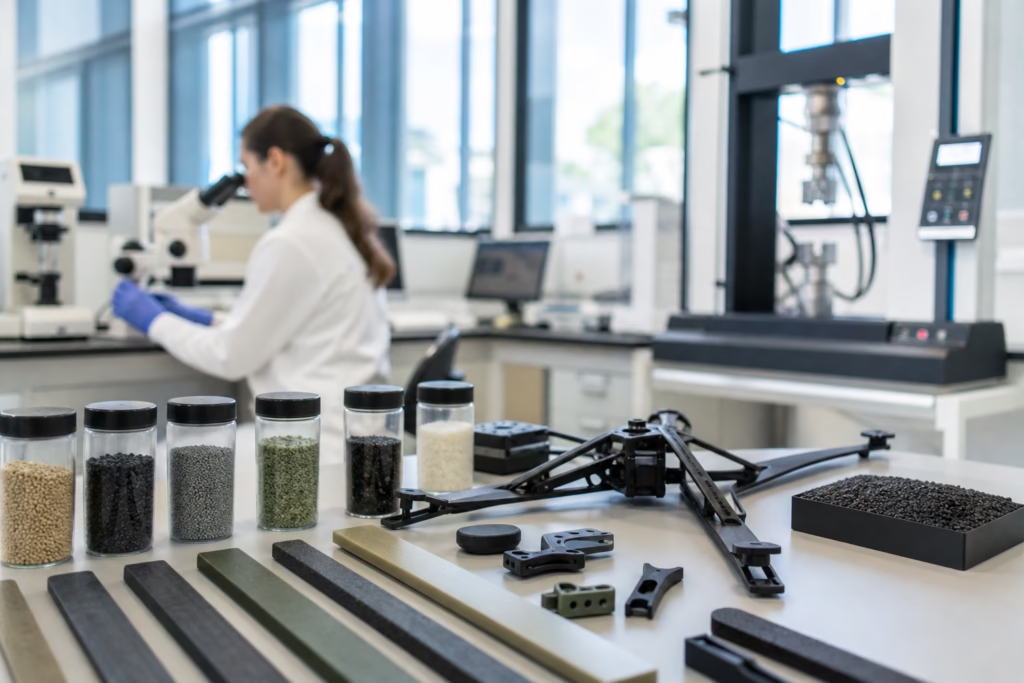
Creep resistance is another important factor for drones and robots because parts often carry continuous load. A bracket or mount may look fine at first but slowly relax under heat and stress. If the part is holding alignment or supporting a motor, even small creep can become a functional problem.
For this reason, material selection should include the expected service environment. A part used indoors in a stable climate may tolerate one resin family, while an outdoor robot or delivery drone may need a more stable formulation with lower moisture sensitivity and better long-term retention of shape.
Injection molding and extrusion considerations
Most lightweight structural parts in robotics and drones are made by injection molding, but extrusion also appears in profiles, protective sections, and support elements. In both processes, the compound must flow well enough to fill the tool or die without excessive pressure, burning, or surface defects.
Processing behavior becomes even more important when the part is thin-walled or reinforcement-filled. High-viscosity compounds can improve strength in some cases, but they may also demand higher molding temperatures or more careful gate design. Drying conditions are equally important for moisture-sensitive polymers such as polyamides and polyesters.
Typical processing checks include:
- drying time and temperature
- melt temperature window
- mold temperature balance
- gate and vent adequacy
- shrinkage prediction
- surface appearance after demolding
- fit of inserts, ribs, and screw bosses
When geometry is sensitive, the processor and material supplier should review both resin data and mold design together. A resin that looks excellent on paper can still create issues if the flow length is too long or if the wall thickness changes abruptly.
Application examples in drone and robotics hardware
The same material family can serve different functions depending on modification and geometry. Common application areas include:
- Frames and arms: stiffness-focused reinforced materials with good load transfer.
- Shells and covers: impact-modified or balanced engineering plastics for protection and appearance.
- Brackets and mounts: low-warpage compounds with better dimensional stability.
- Connectors and terminal parts: heat-resistant, insulating, and sometimes flame-retardant materials.
- Gears and wear components: tougher formulations with attention to creep and abrasion.
- Battery and electronic housings: insulating, heat-resistant, and safety-conscious compounds.
- Protective pads and damping parts: elastomeric or semi-flexible materials such as TPU.
When a project requires both high stiffness and controlled dimensions, the choice often becomes a reinforced engineering plastic rather than a standard resin. When crash tolerance matters more, toughness-enhanced or hybrid formulations may be a better fit. The best answer depends on whether the part is load-bearing, protective, cosmetic, or safety-related.
How to decide whether a standard resin is enough or a customized modified compound is better
A standard resin may be sufficient when the part is low load, noncritical, and easy to mold. But once the part starts affecting flight time, alignment, vibration, or safety, a customized compound becomes more attractive. The decision usually changes when one or more of the following is true:
- the part is thin-walled and warpage-sensitive
- the part is subject to repeated impact or vibration
- the part must survive outdoor heat and humidity
- the part must hold close tolerances after assembly
- the part must combine electrical, thermal, and mechanical requirements
At Poly Maro, we typically advise teams to view customization as a risk-reduction tool rather than a premium add-on. A tailored compound can reduce rework, improve molding stability, and align the material with the actual part function. That is especially useful when the project is moving quickly and the product team cannot afford multiple tooling revisions.
Supplier evaluation checklist for high-performance plastic pellet sourcing
For OEM and ODM buyers, the material itself is only one part of the sourcing decision. The supplier must also be able to maintain consistency, explain formulation choices, and support sample validation. A strong supplier conversation should cover:
- resin base and modification strategy
- target mechanical and thermal properties
- drying and processing guidance
- color or appearance requirements
- tolerance and warpage sensitivity
- batch-to-batch consistency control
- MOQ and lead time planning
- application-specific testing support
Do not hesitate to ask how the supplier verifies production stability. For drone and robotics parts, a one-time sample is not enough. The real question is whether the compound can be reproduced with the same behavior when scaled to production quantity.
Sample testing, datasheet verification, and mass-production consistency
Datasheets are essential, but they are only the starting point. A part that passes a standard mechanical test can still fail due to melt behavior, shrinkage spread, weld line weakness, or conditioning sensitivity. That is why sample testing should include both lab verification and real molding evaluation.
Good sample verification usually includes dimensional checks, appearance review, assembly fit, load testing, heat exposure, and environmental conditioning when relevant. If the application is outdoor or flight-related, the team should also look at vibration behavior and long-term property retention.
Consistency matters just as much as initial performance. The best production plan is one where the compound, process window, and part design all support repeatability. That is the difference between a promising prototype and a dependable commercial platform.
Cost-performance trade-offs, MOQ planning, and lead time
Lightweight material selection is rarely a pure technical decision. Procurement and production planning matter because a highly customized compound may have a better performance profile but require more planning around MOQ, lead time, and inventory strategy.
The cost-performance question should be framed in terms of total part value, not only resin price. A lower-cost resin that causes warpage, rejects, or post-processing may end up more expensive than a better compound. Likewise, an over-specified material may tie up budget without improving function.
The practical approach is to match the material to the product stage:
- Prototype stage: prioritize rapid validation and processing clarity.
- Pilot stage: prioritize repeatability and early QC data.
- Production stage: prioritize stable supply, agreed specs, and consistent lot behavior.
For fast-moving robotics and drone projects, this staged approach helps teams reduce sourcing risk while keeping the design flexible enough to adapt as the application matures.
Common mistakes in lightweight material selection
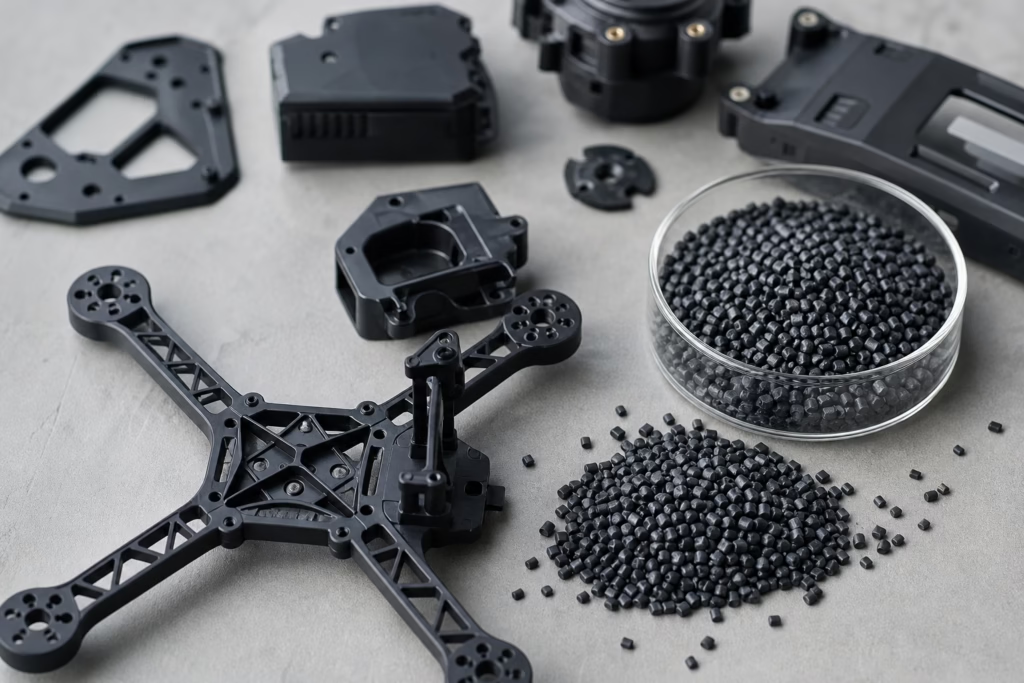
Several mistakes appear repeatedly in this market:
- choosing the lightest material instead of the best system-level material
- ignoring moisture effects on dimensional stability
- overlooking reinforcement direction and warpage behavior
- underestimating impact loads during landing or handling
- specifying heat resistance without confirming local temperature exposure
- failing to verify molding behavior at production thickness
- assuming one sample reflects bulk consistency
These mistakes are avoidable when engineers and buyers align early. If the material supplier understands the part geometry, use environment, and manufacturing process, the final selection is usually faster and more reliable.
How Poly Maro supports emerging robotics and drone projects
As a manufacturer of plastic pellets and modified engineering plastics, Poly Maro supports projects that need more than catalog selection. We work with customers to tune formulations for stiffness, impact, heat resistance, dimensional stability, and processability. That often includes reinforcement design, moisture-sensitive resin selection, and application-specific validation support.
For new robotics and low-altitude economy programs, the most valuable material partner is one that can help translate a performance target into a practical compound. That means understanding not only the polymer family but also the tool, the molding window, the production quantity, and the long-term field environment.
In 2026, the opportunity is clear: the market needs lighter structures, but it also needs dependable hardware. The winning lightweight drone materials are those that reduce mass without creating new problems in assembly, operation, or sourcing.
Frequently Asked Questions
What makes lightweight drone materials different from general engineering plastics?
Lightweight drone materials are selected with a tighter balance of stiffness, impact resistance, dimensional stability, and processability. General engineering plastics may work for basic housings, but drone parts often face vibration, thin-wall design, and outdoor exposure, so the material needs to support both weight reduction and reliability.
When should a design team choose a reinforced compound?
Reinforced compounds are a strong option when the part needs more stiffness, better load carrying, or lower warpage. They are commonly used for frames, brackets, and structural housings, especially when the geometry is thin or the assembly needs stable dimensions.
How important is moisture absorption in drone and robotics parts?
Moisture absorption can be very important, especially for polyamide-based parts. It can affect dimensions, stiffness, and long-term behavior. If the part will operate in changing humidity or needs tight tolerances, the moisture profile should be part of the selection process.
Can a flame-retardant grade also be lightweight?
Yes, but the design team should verify whether the flame-retardant package affects flow, toughness, or surface finish. For electronics housings and battery-related parts, flame retardancy may be necessary, but it should still be balanced against weight, processing, and assembly requirements.
How do we know if a standard resin is enough for the project?
If the part is not load-bearing, does not face high heat, and has generous dimensional tolerance, a standard resin may be enough. But if the part is thin, stressed, vibration-prone, or safety-related, a customized modified compound is often the safer choice.
What should buyers ask before placing an OEM or ODM material order?
Buyers should ask about resin base, property targets, drying conditions, production consistency, MOQ, lead time, and sample validation support. It is also wise to confirm how the supplier controls batch variation and whether the material can be scaled without changing its molding behavior.