
In engineering plastics, weight reduction is rarely just a matter of choosing the lowest-density resin. A lightweight plastic compound has to meet stiffness, creep, impact, heat, and process requirements at the same time, which is why real design decisions depend on performance-to-weight ratio rather than density alone.
For teams comparing resin systems, the starting point is often the product family rather than the material name. Poly Maro’s lightweight plastic compounds are a useful example of how formulation, reinforcement, and processing fit all shape the final result.
Why lightweighting matters in engineering design
Lightweighting is usually driven by one or more practical goals: easier handling, lower shipping cost, faster moving parts, reduced inertia, or better efficiency in assemblies. In many products, a lower mass part also helps reduce noise, improves ergonomics, or opens more room for compact packaging.
The key point is that weight reduction only matters if the part still performs its job. A lighter housing that warps, a bracket that creeps under load, or a gear that wears too quickly creates more cost than the grams saved. That is why engineers need to define the true target first: less mass, lower cost in use, improved mechanical efficiency, or a combination of these.
Why density alone is not enough
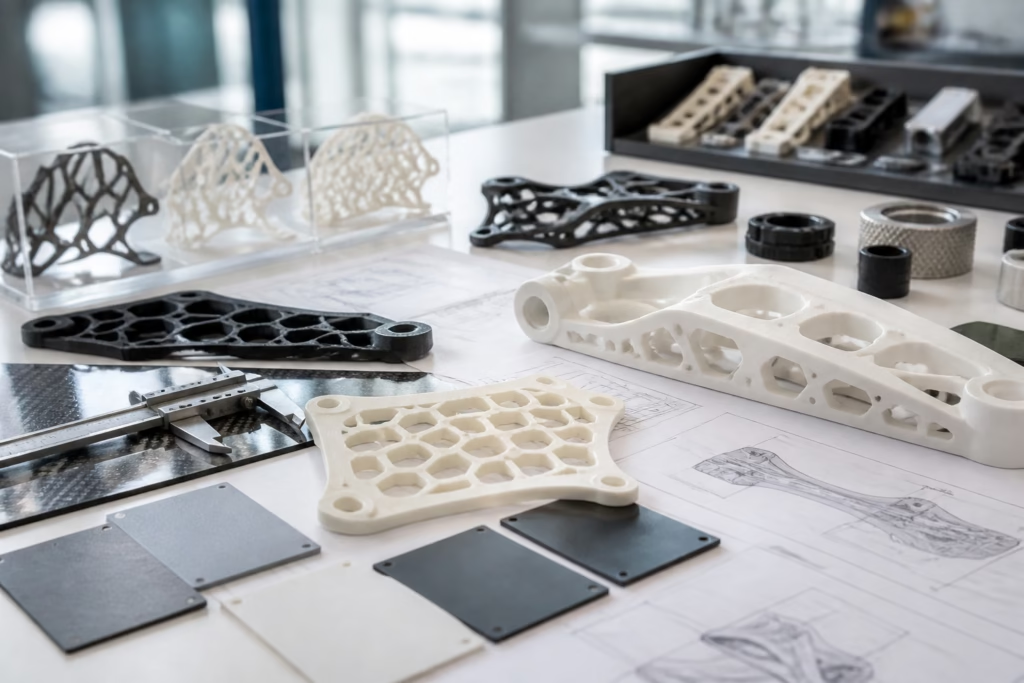
Density is easy to compare, but it can be misleading. Two materials with similar density may behave very differently in stiffness, impact resistance, and long-term deformation. A lower-density resin may also need thicker walls or more ribs to achieve the same functional strength, which can erase the expected weight savings.
For structural parts, the right question is not only “Which resin is lighter?” but “Which design-material combination delivers the required performance with the least total mass?” That shift matters because a lightweight plastic compound must be evaluated as part of the whole part design, not as a standalone property number.
In practice, a material with slightly higher density can sometimes produce a lighter finished component if it allows thinner walls, better load distribution, or less overdesign. That is one reason experienced buyers and engineers often compare the final part concept before comparing raw material data sheets.
The trade-offs behind lightweight material selection
Lightweighting always involves trade-offs. Reducing weight usually means balancing stiffness, creep resistance, impact strength, heat resistance, and cost. The challenge is not to maximize all of them equally, but to identify which property is most critical for the application.
| Selection factor | Why it matters | Typical design implication |
|---|---|---|
| Density | Directly affects part mass | Useful for comparing raw weight, but not enough alone |
| Stiffness | Controls deflection and shape retention | May require reinforcement or geometry changes |
| Creep resistance | Important under long-term load | Lower creep often matters more than initial strength |
| Impact resistance | Protects against drops and sudden loads | Often needed in housings and consumer-facing parts |
| Processing cost | Influences total manufacturing economics | Lower material cost may not mean lower part cost |
These trade-offs are especially important when working with reinforced or filled systems. A formulation that improves stiffness may also increase tool wear, raise viscosity, or make processing more sensitive. That is why a cost-performance review should include molding behavior, scrap risk, and cycle time, not just resin price.
For teams evaluating resin families, the comparison often becomes more practical when structured around application. A guide such as custom plastic compounds helps clarify when a standard grade is enough and when a tailored compound is more efficient overall.
How structure changes performance
Geometry can be just as important as resin selection. Wall thickness, ribs, bosses, radii, and load paths all affect how a lightweight part behaves. In many cases, a smarter design can reduce mass without sacrificing function, while a poorly designed part can fail even with a high-performance material.
Wall thickness and ribs
Thinner walls reduce mass, but they also reduce stiffness. Ribs are often used to regain rigidity without adding too much material. However, rib design must be balanced against sink marks, molding flow, and stress concentration. The best lightweight designs use ribs to support structure, not to compensate for a weak base design.
Reinforcement and orientation
Reinforced compounds can provide a strong stiffness-to-weight advantage, but their performance depends on fiber type, loading direction, and part geometry. A reinforced lightweight plastic compound may be ideal for brackets or frames, yet less suitable for highly detailed parts that need fine surface quality or stable flow into thin sections.
That is where a manufacturer perspective helps. At Poly Maro, material selection is often treated as a system question: resin choice, reinforcement level, mold design, and expected load condition all influence the final result rather than any single property by itself.
Material comparison framework for lightweight engineering plastics
Different engineering plastics offer different balances of weight, stiffness, toughness, and processing cost. The most efficient choice depends on whether the part needs dimensional stability, sliding behavior, chemical exposure resistance, or impact protection.
For example, PP-based systems often support cost-sensitive lightweight designs, while PA-based systems are frequently used when strength and wear resistance matter more. POM can be useful for motion-related components where low friction and dimensional stability are important, while heat-resistant compounds are considered when service temperature is part of the lightweighting problem. In many cases, a targeted comparison such as PP vs PA for structural parts makes the trade-offs easier to judge.
The correct choice is rarely about one resin being universally better. It is about matching the material’s behavior to the load pattern, environment, and manufacturing process.
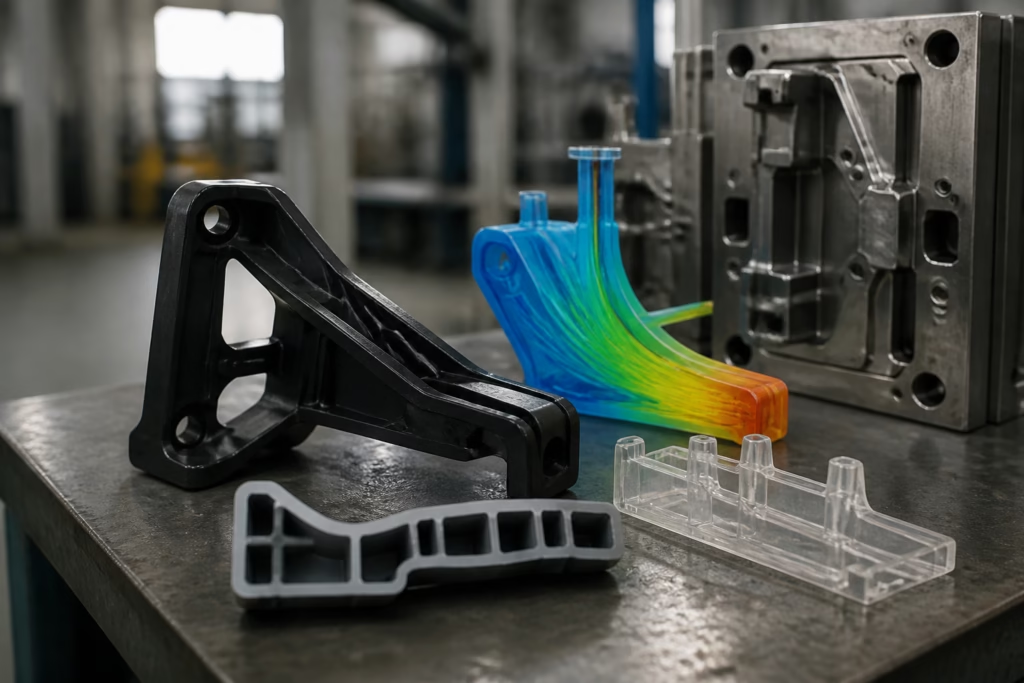
If the application includes gears, sliders, or rotating interfaces, friction and wear can matter as much as density. In those cases, material choices for gears and motion parts help frame the selection around function rather than weight alone.
When lower density can fail in load-bearing parts
One common mistake is assuming that a lower-density plastic automatically produces a better lightweight result. In load-bearing parts, the material may need higher thickness to resist deflection, which can offset the original density advantage. Another risk is creep: a part may look acceptable at first, then slowly deform under continuous stress.
This issue shows up often in brackets, clips, support frames, and mounted housings. If the part must hold a load for long periods, long-term stiffness is often more important than initial strength. A lightweight design that works in short testing but fails in service can create warranty and assembly problems later.
Heat also changes the picture. Materials that seem suitable at room temperature may soften or lose stiffness under elevated service conditions. When the design environment includes thermal exposure, reviewing heat-resistant plastic compounds can help prevent false savings from a material that is too light for the real application.
Application-based selection advice
For housings and covers, impact resistance, surface appearance, and moldability often matter more than the absolute minimum density. A slightly heavier compound may be the better option if it reduces cracking, improves snap-fit reliability, or allows a thinner and more stable wall design.
For structural parts, stiffness-to-weight ratio is usually the main concern. Reinforced materials can be effective here, but they must be matched to the load direction and assembly method. If the part sees fastening loads, creep resistance and boss design deserve as much attention as tensile strength.
For long-term load conditions, material selection should prioritize dimensional stability and creep behavior. A lighter resin that relaxes under load may create misalignment, sealing issues, or loss of preload over time. In these cases, the safer option is often a compound with a more favorable balance of rigidity and durability, even if its raw density is not the lowest.
Practical selection checklist before finalizing a compound
Before choosing a lightweight plastic compound, it helps to answer a few practical questions:
- What is the real target: lower part mass, lower cost, better handling, or improved system efficiency?
- Will the part carry a continuous load, a shock load, or both?
- How much stiffness is needed to control deflection and maintain fit?
- Will creep, heat, moisture, or chemicals affect long-term behavior?
- Can geometry changes reduce weight before changing material?
- Does the process prefer high flow, low shrinkage, or tighter dimensional stability?
- Will reinforcement improve the part, or will it create molding and surface trade-offs?
These questions often reveal whether the project needs a standard resin, a reinforced grade, or a custom formulation. For teams that need manufacturing-aligned support, the final decision is usually stronger when design and processing are reviewed together with technical support rather than separately.
Conclusion
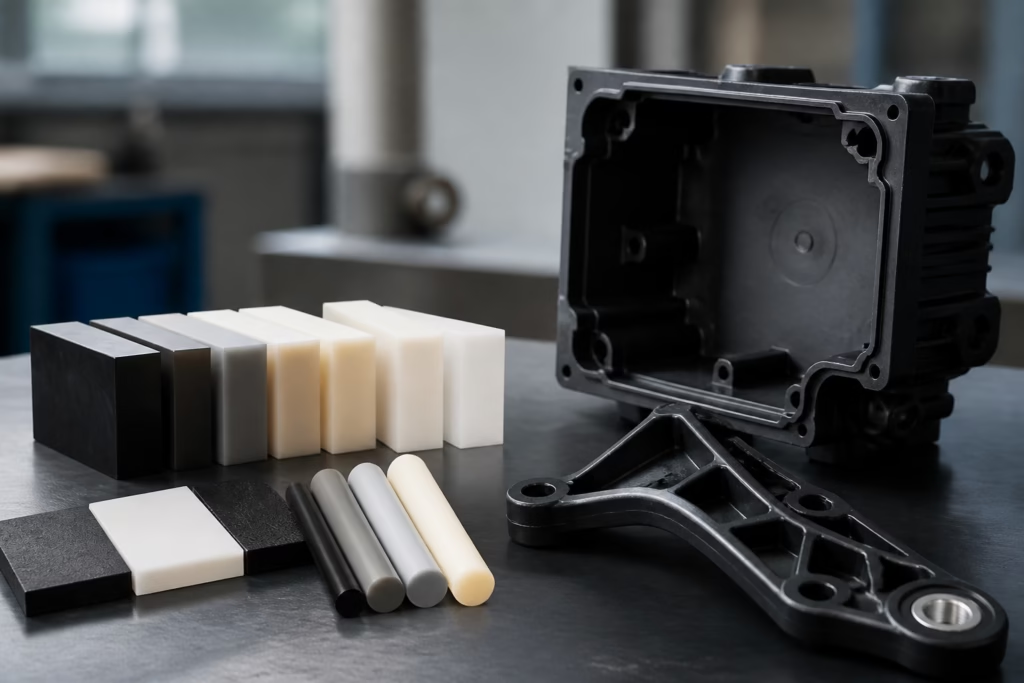
Lightweighting in engineering plastics is not simply a density contest. The best result comes from balancing mass reduction with stiffness, creep resistance, impact behavior, heat performance, and processing cost. In many real parts, the winning solution is the one that delivers the best performance-to-weight ratio, not the lowest raw density.
When engineers evaluate the full part, the mold, and the service environment together, the selection becomes much clearer. That is the most reliable way to choose a lightweight plastic compound that saves weight without creating hidden problems later.
FAQ
Is the lowest-density plastic always the lightest finished part? No. A lower-density resin may need thicker walls or more reinforcement to meet stiffness and load requirements, which can reduce or eliminate the final weight advantage.
What matters more than density in lightweight design? Stiffness-to-weight ratio, creep resistance, impact performance, and processing behavior are often more important than density alone, especially for structural parts.
Can ribs replace heavier materials? Sometimes. Good rib design can improve stiffness without much extra mass, but ribs must be designed carefully to avoid sink marks, stress concentration, and flow issues.
When should reinforcement be considered? Reinforcement is useful when the part needs better rigidity or dimensional stability, but it should be checked against flow, surface finish, tool wear, and cost.
Why can a lighter material fail under long-term load? Some materials creep under continuous stress, so a part that looks strong initially may slowly deform in service and lose fit or function.
How should teams compare lightweight plastic options? Compare the full part performance, not just resin density. The best choice depends on geometry, load type, environment, processing, and cost-per-part.