
Choosing between conductive, antistatic, and ESD plastic compounds is less about terminology and more about the function the part must perform in service. A housing, tray, cover, or internal component may need charge dissipation, surface protection, shielding, or a true conductive path to ground, and those are not the same requirement.
If you need a deeper selection check before defining the material, Poly Maro offers technical support that can help align the material system with the actual application conditions.
Start with the Function, Not the Label
The most common selection mistake is starting with the word “ESD” and assuming it covers every electrostatic problem. In practice, the right material depends on what must happen to the charge after it appears. If the goal is to reduce surface buildup, an antistatic solution may be enough. If the part must safely dissipate charge more consistently, an ESD plastic material is usually more appropriate. If the part must carry current or provide a grounding path, a conductive plastic compound is the better fit.
That difference matters because the same part can face very different risks. A tray for electronics handling may only need charge control during transport. A housing around sensitive components may need more stable electrostatic protection. A part connected to grounding hardware may need a defined conductive path instead of only surface dissipation.
For readers comparing resin options across projects, it helps to review the broader plastic compound products portfolio alongside the functional requirement, rather than choosing by name alone.
What the Main Terms Mean in Practice

Antistatic plastic is generally used to reduce static charge accumulation on the surface. It helps limit dust attraction and lowers the chance of nuisance static buildup, but it does not automatically mean the material can safely and consistently protect sensitive electronics.
ESD plastic is chosen when controlled electrostatic discharge behavior is needed. In many applications, this means the material helps manage charge more predictably over the surface or through the bulk, depending on the formulation and the part design.
Conductive plastic compound goes a step further by enabling electrical conduction through the material itself or through a designed conductive network. That can be useful when the part must connect to grounding points, support shielding structures, or help create a controlled discharge route.
In simple terms: antistatic reduces buildup, ESD helps manage discharge, and conductive materials support a stronger electrical path. The right choice depends on whether the part needs surface protection, charge control, shielding, or grounding.
How Conductive Fillers Change Performance
Most conductive and ESD materials achieve their function by adding fillers that create a conductive network inside the resin. The filler choice strongly affects conductivity, appearance, processing behavior, and mechanical balance.
Carbon black is a common option for many ESD and conductive formulations because it is practical and cost-effective. Carbon fiber can improve conductivity and stiffness, but it may affect surface finish and part anisotropy. Graphene is often discussed for its conductive potential, though actual performance depends heavily on dispersion and formulation quality. Metal powders can provide strong conductivity, but they may raise weight, affect corrosion behavior, or complicate processing.
In actual project work, the filler is only one part of the answer. The polymer base, filler loading, molding method, and part geometry all influence whether the final result meets the intended use. That is why a manufacturer such as Poly Maro usually evaluates the resin system and the part function together instead of treating conductivity as a standalone number.
For parts that must stay within a specific design family, it is also useful to confirm how the material behaves across different application scenarios, because the same formulation may perform differently in trays, housings, fixtures, or structural components.
Performance Trade-Offs You Should Expect
No conductive or ESD material is perfect across every dimension. Increasing conductivity often affects appearance, surface smoothness, and sometimes mechanical performance. Higher filler loading may improve electrical function, but it can also make the material harder to process, increase tool wear, or reduce impact strength.
For procurement and engineering teams, the right question is not “Which material is most conductive?” but “Which material meets the electrical requirement without creating avoidable compromises?” A part that looks excellent but cannot maintain charge decay may be a poor choice. A highly conductive part that is too brittle or too expensive may also be unsuitable.
| Material type | Main function | Typical trade-off |
|---|---|---|
| Antistatic plastic | Reduces charge buildup | May not provide consistent protection for sensitive electronics |
| ESD plastic | Manages static discharge more predictably | Needs validation under real use conditions |
| Conductive plastic compound | Provides a conductive path or grounding support | Can affect finish, cost, and processing ease |
When Antistatic Is Enough, and When It Is Not
Antistatic materials are often enough for packaging, handling aids, or parts where the goal is mainly to reduce dust attraction and prevent easy charge accumulation. They are useful when the part is not expected to act as part of the electrical protection architecture.
If the part touches sensitive electronics, sits near charge-sensitive assemblies, or must discharge in a controlled way, antistatic performance may be too limited. In those cases, moving to a more defined ESD material is usually the safer decision.
For ESD housing or cover designs, the material choice should also match the substrate family. For example, if you are comparing enclosure options, a functional grade such as ESD-grade ABS may be more suitable when you need a balance of processability, dimensional stability, and electrostatic control.

When Shielding Matters
Shielding becomes important when the part must block or reduce the transfer of electrostatic effects or electromagnetic influence into a protected area. Not every ESD part needs shielding. Some parts only need to dissipate charge safely before it becomes a problem.
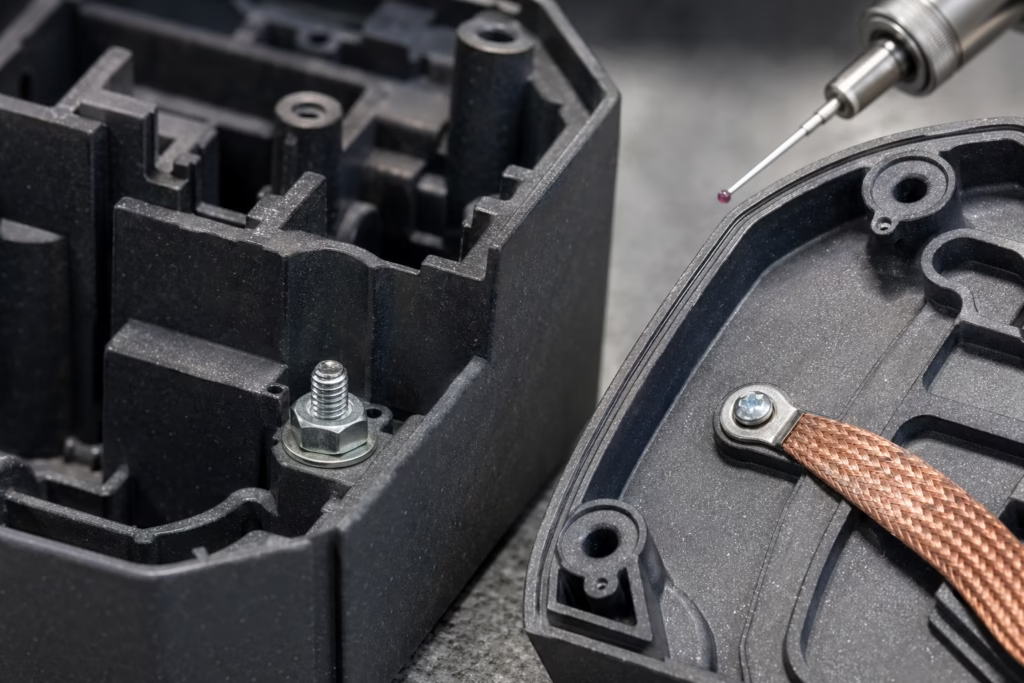
Shielding is more likely to matter in enclosures, instrument covers, sensitive device carriers, and structures that protect internal components from external interference. In these cases, the selection must consider whether the material itself can contribute to shielding or whether the design needs additional grounding, geometry control, or conductive layers.
If the requirement is closer to a true conductive enclosure or a part with a more defined electrical route, a material family such as conductive PC grades may be worth reviewing, especially where heat resistance and dimensional stability are also part of the brief.
Common Selection Mistakes
One common mistake is choosing by keyword instead of by function. Another is over-specifying conductivity when the part only needs surface charge dissipation. A third mistake is assuming that a low resistance number automatically means better end-use performance.
It is also easy to confuse surface protection with grounding. A material that reduces charge on the outside may not provide a reliable current path through the part. Likewise, a material designed for electrical conductivity may not automatically deliver the handling properties needed for clean production or stable appearance.
These errors usually create avoidable redesigns. A material that looks good on paper can still fail if the part geometry, fastening method, humidity conditions, or processing method changes the actual electrical behavior.
How to Validate the Material Before Full Production
Validation should reflect the real application, not only the datasheet. Resistance testing can help determine whether the part sits in the expected electrical range. Charge decay testing is useful when the goal is to reduce static buildup quickly. Shielding effectiveness tests may be necessary when the design must protect sensitive electronics from outside influence.
It is also worth confirming how the part performs after processing, storage, and handling. Some materials are more sensitive to moisture, contamination, or surface wear than others. For procurement teams, the key is to ask whether the material can keep its intended function after molding and during normal use.
A Simple Selection Framework
When deciding between conductive, antistatic, and ESD plastic compounds, start with these questions:
- Does the part only need to reduce static buildup?
- Does it need predictable electrostatic discharge behavior?
- Does it need a true conductive path or grounding support?
- Is shielding required, or is charge dissipation enough?
- Will appearance, stiffness, impact strength, or cost influence the final decision?
If the answer centers on simple surface protection, antistatic may be sufficient. If the part must safely manage discharge around electronics, an ESD material is usually the more appropriate choice. If the design needs a route for current flow, grounding, or stronger conductive behavior, a conductive plastic compound is the correct starting point.
For teams developing new parts or revising an existing specification, it is often useful to compare the material choice against the full set of application scenarios before locking in the grade. That helps avoid mismatches between lab performance and production reality.
Conclusion
Conductive, antistatic, and ESD plastics are related, but they do not solve the same problem. A good selection process begins with the function the part must perform, then checks electrical behavior, processing fit, and long-term stability. When that sequence is followed, it becomes much easier to choose a material that works in production and still meets the real application need.
FAQ
What is the main difference between conductive, antistatic, and ESD plastics?
Antistatic plastics reduce surface charge buildup, ESD plastics manage electrostatic discharge more predictably, and conductive plastics provide a stronger electrical path for grounding or shielding-related functions.
Is a conductive plastic compound always better than an antistatic grade?
No. A conductive plastic compound is only better when the part truly needs conductivity or a grounding path. If the requirement is only to reduce static buildup, antistatic material may be more practical and easier to process.
How do I know if my part needs shielding?
Shielding matters when external electrostatic or electromagnetic influence could affect the component inside. If the part only needs to prevent charge buildup on the surface, shielding may not be necessary.
What tests should I ask for before ordering?
Ask for resistance testing, charge decay testing when relevant, and shielding effectiveness testing if the application requires it. It is also important to verify performance after molding, not just on paper.
Why do fillers affect both electrical and mechanical performance?
Fillers create the conductive network, but they also change stiffness, impact resistance, appearance, and processing behavior. The formulation has to balance electrical function with the needs of the finished part.
Can the same material work for electronics trays and enclosures?
Sometimes, but not always. Trays may only need antistatic control, while enclosures may need ESD behavior, dimensional stability, or shielding support. The functional requirement should guide the grade choice.