
For brand owners and procurement teams, PCR plastic resin sourcing is no longer a simple recycled-content exercise. It is now a materials decision that has to balance decarbonization targets, certification proof, process stability, and end-use performance. The most useful sourcing strategy is not just asking for recycled pellets, but asking which resin family, which recycled-content route, and which verification package can support the part you actually need to mold or extrude.
When a project needs verified recycled content with controlled performance, custom plastic compounding support for low-carbon resin development can help narrow the gap between sustainability targets and production realities. At Poly Maro, we work from the application backward: the part requirement, the processing window, the appearance target, the regulatory need, and the sustainability objective. That is the right sequence for PCR projects because recycled resin quality is never judged by one label alone; it is judged by whether the material can be qualified, processed, and delivered consistently at scale.
Why global brands are pushing PCR adoption in plastic materials
Global brands are under pressure from multiple directions. They are being asked to reduce Scope 3 emissions, increase recycled content, improve circularity claims, and show traceable progress year after year. For plastics, the easiest place to start is often post-consumer recycled content, because many finished goods and packaging categories can incorporate PCR without redesigning the entire product.
But procurement teams quickly discover that sustainability goals do not automatically translate into stable production. One PCR lot may run well, while another may show different color, odor, melt flow, or impact behavior. That is why PCR plastic resin sourcing has become a qualification exercise, not just a purchasing task. Brand requirements are increasingly tied to evidence: recycled-content documentation, chain-of-custody control, batch consistency, and process performance in real manufacturing conditions.
From a manufacturer’s perspective, the best PCR strategy is the one that survives three filters at once: the sustainability team can defend it, the quality team can verify it, and the factory can actually run it without excessive scrap.
What PCR plastic resin means in practical sourcing terms
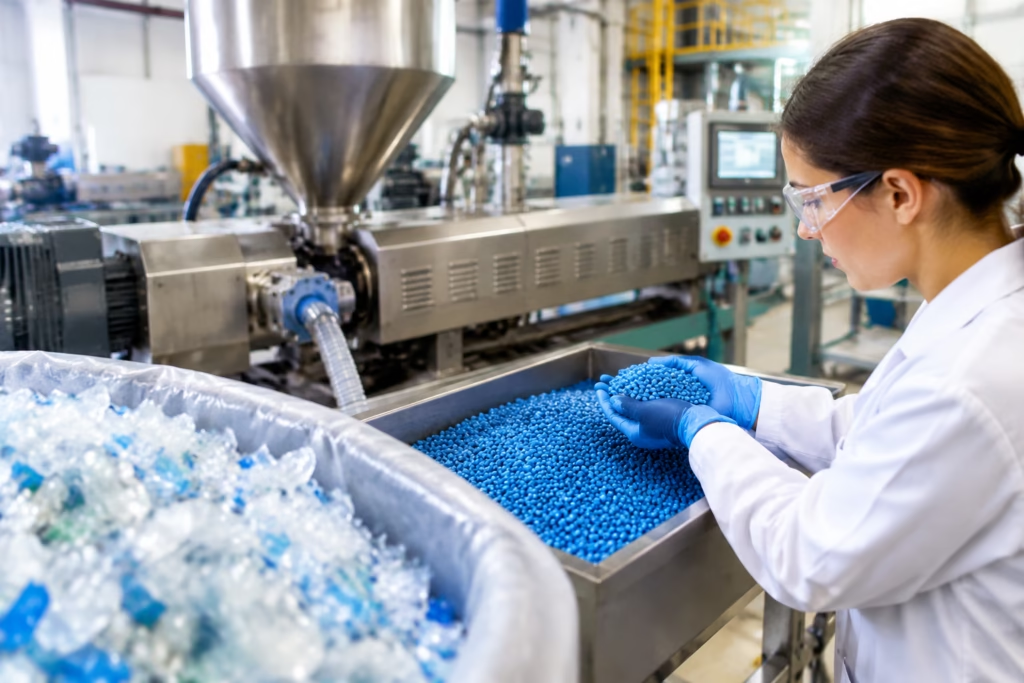
PCR means post-consumer recycled material, which is recovered after a product has already been used by consumers, sorted, processed, cleaned, and reintroduced into a polymer stream. In sourcing conversations, PCR can refer to resin pellets made from recycled feedstock, compounded blends that contain recycled and virgin components, or modified compounds designed to recover performance after recycling.
Common PCR sourcing scenarios
- Appearance-sensitive housings where some color variation is acceptable but not excessive.
- Structural consumer parts where recycled content must be paired with impact and dimensional stability control.
- Industrial or appliance components where recycled content is useful, but heat resistance and process consistency still matter.
- Non-visible internal parts where sustainability targets are the primary driver and surface aesthetics are secondary.
Buyers should be careful not to assume all PCR resins behave the same. Feedstock origin, sorting quality, contamination level, cleaning method, and compounding design all affect the final pellet. For this reason, PCR sourcing should always be tied to an end-use specification rather than a general recycled-content percentage alone.
Where GRS certified pellets fit in PCR sourcing
GRS certified pellets are used when buyers need a third-party framework to support recycled-content claims and supply-chain traceability. The GRS framework is especially valuable because it is not limited to the recycled-content statement itself. It also addresses chain of custody, environmental practices, social criteria, and restricted substances expectations. In practice, this matters because a buyer is not only asking, “Is there recycled content?” but also, “Can that content be traced and verified through the supply chain?”
For a clear explanation of the scope and verification logic, the What GRS certification actually verifies standard is useful because it shows why third-party certification is stronger than a supplier declaration alone. For PCR programs, this distinction is important. A pellet can be described as recycled, but without chain-of-custody documentation and credible certification controls, the claim may not be robust enough for brand reporting or customer audits.
We recommend that buyers ask for the following when evaluating GRS certified pellets:
- valid certificate scope and issuing body
- clear linkage between shipment lots and certified production records
- statement of recycled-content percentage by grade
- test or declaration package for restricted substances where relevant
- traceability documents that support audit requests
GRS does not replace application testing. It verifies sourcing and chain-of-custody expectations, but you still need to confirm processing behavior, mechanical performance, color stability, and mass-production fit.
How PCR materials support ESG and carbon-reduction commitments
For many brands, the business case for PCR begins with emissions reduction. Recycled content can lower embodied-carbon intensity versus virgin resin, depending on resin family, collection system, processing route, and transport impacts. Procurement teams increasingly want to quantify this effect instead of relying only on a general sustainability narrative.
The U.S. EPA’s How PCR content supports embodied-carbon reduction goals resource is helpful because it frames recycled-content purchasing in terms of carbon estimation and materials decision-making. That kind of logic is useful in supplier discussions: if a PCR option helps reduce embodied carbon, the team should still ask how much recycled content is actually present, what assumptions are used in the calculation, and how that value will be reported internally.
From our development experience, the strongest ESG programs are not built on a single recycled-content claim. They are built on four controls:
- verified recycled-content sourcing
- material performance qualification
- stable production yield
- documented reporting that can survive audit and customer review
That is why the best PCR plastic resin sourcing program is usually a combined technical and procurement workflow. Sustainability teams define the target, engineers define the performance window, and the supplier helps close the gap with compounding and validation.
Why PC modified compounds are a strong option for eco-oriented engineering applications
For applications that need recycled content but cannot tolerate the variability of a purely recycled stream, PC modified compounds are often a practical solution. Polycarbonate-based compounds can be tuned for impact resistance, heat resistance, dimensional stability, and appearance, making them a good fit for housings, structural parts, electrical accessories, and selected consumer electronics components.
If your product needs a cleaner performance balance, it may be worth it to review PC material options for recycled-content applications before deciding on a recycled-only route. A PC-based compound can sometimes provide better process stability and part consistency than an untreated recycled feedstock, especially when the project requires tighter tolerances or better surface quality.
In some cases, a blend strategy is even more effective. A PCR component can be incorporated into a modified compound so the part supports sustainability goals without giving up all of its functional properties. This is particularly useful when the part must still survive drop impact, repeated assembly, heat exposure, or dimensional demands.
When PC modified compounds are worth considering
- The part must balance sustainability with structural performance.
- The product has tight appearance or dimensional requirements.
- The production line needs more stable molding behavior than a variable PCR stream can provide.
- The application needs a qualified base resin that can accept additives or reinforcement.
At Poly Maro, this is one of the most common decision points we see: whether to use a higher-PCR-content material, a performance-stabilized blend, or an engineered PC-based compound that better matches production reality.
Key property requirements to check before choosing PCR resin
One of the biggest sourcing mistakes is approving recycled content before checking the part’s actual property targets. PCR materials should be evaluated by the same logic used for virgin engineering resins, but with extra attention to lot variation and process window sensitivity.
| Property | Why It Matters | What Buyers Should Ask |
|---|---|---|
| Strength and impact | Determines durability under load, drop, or assembly stress | Does the material retain enough toughness after recycled-content blending? |
| Heat resistance | Controls performance near motors, lights, power supplies, or warm enclosures | Will the part deform or creep at operating temperature? |
| Flow | Affects mold filling, weld line strength, and cycle stability | Is the melt flow stable from lot to lot? |
| Appearance | Important for visible housings and consumer products | How much color shift, gloss change, or specking is acceptable? |
| Dimensional stability | Controls shrinkage, warpage, and assembly fit | Can the resin hold tolerance in your mold geometry? |
If the application is sensitive, ask for sample parts, not just a data sheet. PCR resin can look acceptable on paper but still show different shrinkage or warpage in a real tool. This is especially true for parts with ribs, clips, bosses, thin walls, or large flat surfaces.
Processing challenges in PCR pellets and how to control them
Processing is where many recycled-content projects succeed or fail. A PCR pellet can meet the recycled-content requirement and still create production problems if moisture, contamination, or flow instability is not controlled.
Common processing risks
- Moisture: Some resin families require careful drying before molding, and recycled streams can be more variable in water absorption or storage condition.
- Odor: Recycled feedstock may carry residual odor that is acceptable in some applications but not in consumer-facing products.
- Color variation: Mixed feedstock can affect base color, tint strength, and consistency from batch to batch.
- MFI instability: Inconsistent melt flow can change filling behavior and cycle time.
- Warpage: Variability in shrinkage or cooling response can create fit issues.
For engineers, the practical question is not whether these issues exist, but how much variation is tolerable in the actual part. The answer depends on part geometry, wall thickness, mold design, drying setup, and the acceptable yield loss in production.
When a product is highly visible or dimensionally tight, it can be useful to evaluate PC/ABS resin solutions for balanced performance and sustainability targets. PC/ABS can provide a useful middle ground when a project needs better impact and appearance balance than a pure recycled stream can consistently deliver.
How to balance recycled content with performance
There is no single correct recycled-content ratio. The right answer depends on the application, the brand target, and the manufacturing process. Some projects can accept a high PCR percentage with moderate aesthetic variation. Others need a lower PCR fraction combined with a modified engineering compound to keep product performance and line efficiency acceptable.
Three practical material strategies
| Strategy | Best Use Case | Trade-Off |
|---|---|---|
| Pure PCR resin | Non-critical parts, internal components, or applications with flexible appearance requirements | Higher variability in flow, appearance, and odor |
| PCR blend | Projects that need recycled content but also need tighter process control | Recycled-content percentage may be lower than the ideal ESG target |
| Eco-enhanced modified compound | Performance-sensitive parts that still need sustainability progress | More material development effort and qualification time |
From our perspective, the best balance is the one that keeps the line stable and the part in spec. A recycled-content target that causes high scrap or customer complaints is not a real sustainability win. A smaller PCR share with strong part yield can often create a better total outcome.
If a project needs additional toughness, it may also be worth to compare impact-modified plastic options for PCR-based product development. Impact modification is often the simplest way to recover durability when recycled feedstock reduces the margin of safety.
Quality and compliance checks buyers should require
Verification is where many procurement teams save themselves later trouble. A good PCR supplier should be able to show not only what the material is, but how the claim is supported.
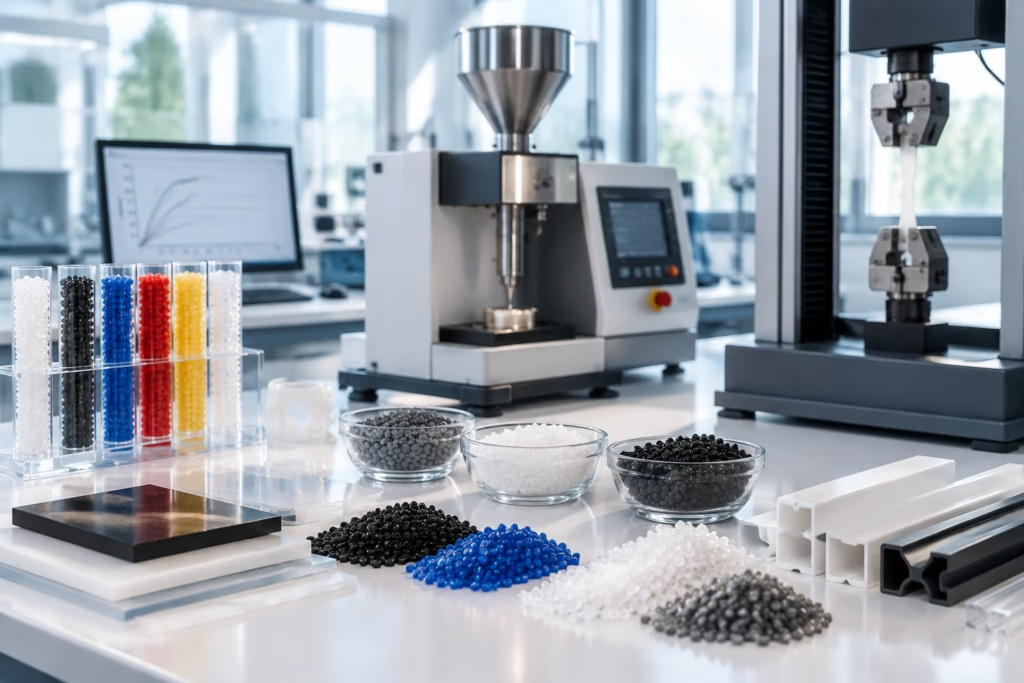
For a structured review, use technical support for PCR resin sourcing and material qualification to align material documentation, part performance goals, and validation steps before order placement. This is especially important when different departments are involved: procurement may focus on price and recycled-content percentage, while engineering focuses on dimensional fit and process stability.
What to verify before approving a supplier
- recycled-content claim and basis of calculation
- certificate scope and validity for GRS or equivalent system where required
- lot traceability and shipment identification
- test data for key mechanical and thermal properties
- color and appearance tolerance agreement
- drying instructions and processing window
- packaging method and contamination control
If the supplier cannot explain how the recycled-content claim is maintained through production and shipment, the project is exposed to audit risk. If the supplier cannot explain how the resin behaves in molding, the project is exposed to manufacturing risk. You need both sides.
Supplier evaluation checklist for PCR plastic resin sourcing
When comparing suppliers, it helps to score them using the same structure every time. This keeps the discussion objective and makes it easier to compare recycled-content options across different resin families.
- Certification strength: Are claims supported by valid third-party certification and traceable documents?
- Application fit: Does the supplier understand the actual end use and its tolerance requirements?
- Consistency: Can they hold melt flow, color, and mechanical properties within an acceptable range?
- Processing support: Will they provide drying, molding, and troubleshooting guidance?
- Sample discipline: Do they send representative samples with clear labeling and documentation?
- Production readiness: Can they support forecast volume, lead time, and packaging requirements?
At Poly Maro, we always encourage buyers to compare not only the pellet itself but also the development discipline behind it. A supplier that understands compounding, validation, and application behavior will usually reduce more risk than one that only offers recycled content as a commodity claim.
How to match PCR material selection to the end application
The right material choice depends on the part family. Different products have different tolerance for recycled-content variation, so the selection logic should follow the application rather than the slogan.
Electronics and electrical parts
These parts often need a careful balance of appearance, thermal stability, insulation behavior, and dimensional consistency. Recycled content may be feasible in housings, covers, and certain structural parts if the resin is qualified properly. For connectors or tighter electrical components, recycled-content use must be reviewed carefully because fit, flash control, and stability are usually critical.
Appliance components
Appliance parts often allow more room for PCR use, especially in non-visible or semi-structural components. But the operating environment can be harsher than buyers assume. Heat, vibration, cleaning chemicals, and repeated use can expose weaknesses in poorly controlled recycled resin.
Consumer goods
Consumer products are often where the sustainability message is most visible. However, these parts are also highly exposed to perception issues. Odor, surface texture, and color uniformity matter as much as mechanical performance. A PCR grade that saves carbon but fails visual expectations may still be rejected by the market.
Industrial parts
For industrial applications, the priority often shifts toward durability, chemical resistance, and production reliability. If the part is hidden inside a machine, recycled content may be easier to introduce. If the part is a load-bearing or safety-related component, material qualification becomes much stricter.
Sample validation and mass production risk control
Sample approval should never be treated as a formality. Recycled materials can behave differently in small trials versus full production, especially if the mold geometry or processing conditions are sensitive.
A practical validation plan should include:
- drying study before the first molding trial
- shot-to-shot flow observation
- part inspection for warpage, sink, flash, and color shift
- basic mechanical verification where applicable
- long-run stability check, not only short sample shots
If the project is important, test more than one lot. A single successful sample does not prove repeatability. The goal is to reduce the chance that a qualified sample becomes a production problem later.
We also recommend confirming packaging, storage, and re-drying expectations before the purchase order is issued. PCR pellets and modified compounds can lose consistency if they absorb moisture in transit or sit too long in poor storage conditions.
Cost-performance trade-offs buyers should expect
Many teams begin with a price comparison, but the full cost picture includes yield, scrap, customer risk, and qualification effort. A lower-cost PCR resin that causes process instability may end up more expensive than a better-controlled modified compound.
| Cost Factor | Why It Matters | What to Check |
|---|---|---|
| Unit price | Direct material budget impact | Is the price based on real recycled-content performance or only on percentage? |
| MOQ | Inventory and cash-flow impact | Can the supplier support pilot and ramp-up volumes? |
| Lead time | Launch planning and continuity risk | Are raw material and certification documents ready before schedule lock? |
| Yield | Scrap and rework affect real cost | Will the material process cleanly at your mold settings? |
| Sustainability value | Supports customer and ESG objectives | Can the claim be defended in reporting and audit? |
In many projects, the smartest decision is not the cheapest pellet. It is the pellet that supports a stable line, a defendable claim, and a product that meets the customer’s expectations the first time.
Common mistakes buyers make when sourcing PCR resin
We see the same errors repeatedly in sourcing projects. The good news is that most of them are avoidable.
- Buying by recycled-content percentage alone: High PCR content does not guarantee usable performance.
- Skipping lot verification: One sample lot is not enough to prove repeatability.
- Ignoring processing conditions: Drying and molding windows often determine success or failure.
- Assuming certification covers performance: Certification supports claims, not part function.
- Underestimating appearance sensitivity: Color, gloss, and odor can trigger rejection even when the resin performs mechanically.
- Not defining acceptance criteria early: If the target is vague, the supplier cannot optimize the material correctly.
To avoid these issues, involve procurement, engineering, quality, and sustainability teams early. The best PCR projects have one shared approval sheet, not four separate assumptions.
How Poly Maro supports PCR and eco-enhanced PC modified pellet development
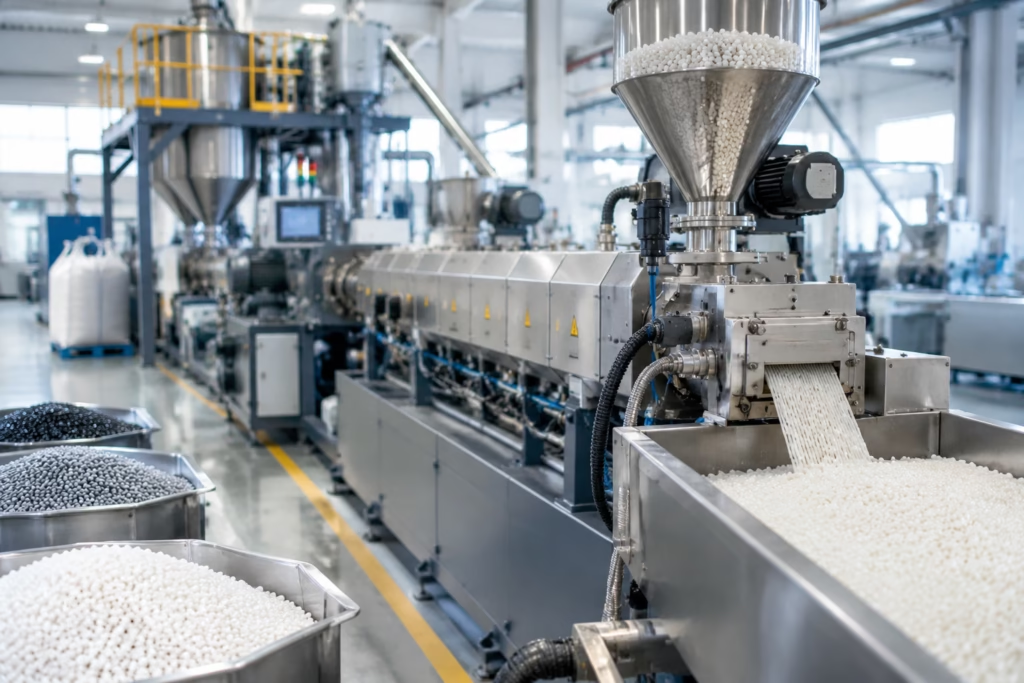
Poly Maro works with buyers and engineers who need more than a recycled-content claim. We support formulation planning, compounding decisions, processing guidance, and sample validation for projects where sustainability and manufacturability must move together.
Depending on the part, we may recommend a recycled-content blend, a modified engineering resin, or a more application-specific approach that preserves performance while improving environmental positioning. In some cases, the right answer is to use an engineered compound rather than a purely recycled pellet, especially when the part has strict heat, impact, or dimensional requirements.
That is why many teams ask us to review PC material options for recycled-content applications again during the final sourcing stage, after they have seen prototype results. Material selection often becomes clearer once the mold is running and the actual risk profile is visible.
Conclusion
PCR plastic resin sourcing works best when sustainability goals are matched with material reality. GRS certified pellets are valuable because they support traceability and third-party verification, but they still need to be validated for flow, appearance, toughness, heat resistance, and production stability. For demanding parts, eco-enhanced PC modified compounds can offer a more reliable path to recycled-content progress without sacrificing end-use function.
If your team is comparing recycled resin options, the best approach is to define the part requirement first, then choose the resin family, certification level, and modification route that can actually support production. That is how you reduce sourcing risk, protect quality, and make carbon-reduction commitments operational instead of theoretical.
Frequently Asked Questions
What is the most important first step in PCR plastic resin sourcing?
The first step is defining the actual part requirement before comparing recycled-content percentages. You need to know the performance target, appearance tolerance, processing method, and any certification requirement so the supplier can recommend a resin that fits the application rather than just the sustainability headline.
Do GRS certified pellets automatically mean the resin will perform well?
No. GRS certification helps verify recycled-content claims and chain-of-custody controls, but it does not guarantee that the pellet will mold well or meet your mechanical targets. You still need to check drying behavior, flow, strength, impact, heat resistance, and batch consistency.
When should a buyer choose a PC modified compound instead of a pure PCR resin?
A PC modified compound is often a better choice when the product needs better impact resistance, appearance control, or dimensional stability than a pure recycled stream can reliably provide. It is especially useful for housings, appliance components, and other engineering parts with tighter performance demands.
What process issues are most common with recycled plastic pellets?
The most common issues are moisture sensitivity, odor, color variation, melt flow instability, and warpage. These issues do not appear in every project, but they are common enough that drying conditions, mold design, and validation trials should be reviewed before mass production.
How do procurement teams verify recycled-content claims?
They should ask for valid certification documents, lot traceability, recycled-content declarations, and any supporting test or compliance records. Good suppliers can explain how the claim is controlled from production through shipment and how it maps to the specific order being purchased.
What should be confirmed before placing a mass-production PO?
Before the PO, confirm sample approval, acceptance criteria, lead time, MOQ, packaging, storage needs, drying instructions, and the expected consistency across future lots. This reduces the chance that a successful sample becomes a costly production problem later.