
Successful plastic compound sample evaluation starts long before the first pellets are shipped. In our experience, the most common reason samples miss the mark is not that the material is poor, but that the request brief is incomplete: the end-use environment is unclear, the part geometry is missing, or the supplier is asked to “send something similar” without enough technical context. When the sample is defined correctly, evaluation becomes faster, comparison is easier, and the final material decision is less likely to depend on trial-and-error.
For teams working through custom resin development, the difference between a useful sample and a wasted one is often how well the project brief translates business needs into polymer requirements. If your project needs custom plastic compounding support, the right starting point is a precise request package that aligns application, performance, processing, and sourcing constraints. For projects that need tailored formulation support, custom plastic compounding support can help connect your target part performance with the right resin family, reinforcement strategy, and validation path from the first sample round.
Why sample evaluation fails when the project brief is incomplete
We see the same pattern repeatedly in plastic compound sample evaluation: the buyer wants a fast response, but the supplier receives only a partial description of the part. That usually leads to a sample that is technically plausible but not production-ready for the real application. A compound may look strong in a generic lab test and still fail because the part needs better flow into thin walls, lower warpage, better heat aging, or a different balance of stiffness and impact.
Another common issue is that the project team mixes up “material approval” with “part approval.” A resin can appear acceptable in a test bar but still create problems in the molded part because of shrinkage behavior, anisotropy, gate sensitivity, weld line weakness, or drying control. The more clearly the sample request describes the actual molding and end-use conditions, the more useful the sample result becomes for procurement and engineering decisions.
The role of sample evaluation in engineering plastic development and procurement

Sample evaluation is not only a technical step; it is also a sourcing filter. For buyers, the goal is to reduce uncertainty before committing to MOQ, tooling adjustments, or production planning. For engineers, the goal is to verify that the compound fits the intended performance window without introducing unnecessary processing risk. For us as a material manufacturer, the sample stage is where formulation choices are aligned with real production constraints instead of hypothetical targets.
That is why a good sample request should cover both performance and manufacturability. A compound may need heat resistance, but if it processes too narrowly or requires excessive drying, it may not suit the processor’s equipment. A material may deliver impact strength, but if it warps or crystallizes unevenly, it may create scrap. A well-prepared request lets both sides evaluate the same thing: whether the material can succeed in the intended process, part geometry, and application environment.
When a project includes elevated-temperature exposure, it helps to specify the real thermal target instead of a vague “high heat” requirement. In such cases, our heat-resistant plastic compound options for demanding parts are typically evaluated not only for heat performance, but also for flow, shrinkage, and long-term dimensional stability under the expected load and assembly conditions.
What to confirm first before requesting samples
Before you ask any supplier to prepare samples, confirm the three fundamentals: what the part must do, where it will be used, and how it will be processed. These three points create the framework for every later decision. If the part is structural, the compound must balance stiffness and impact. If it is electrical, insulation and tracking resistance may matter more. If it is outdoors, UV and weather resistance may become critical. If it is a precision housing, low warpage and stable shrinkage may matter more than pure tensile strength.
From a compounding perspective, this early clarity saves time because it narrows the resin family and modification path. It also prevents mismatched expectations during the sample phase, when one team expects a production-grade compound while another thinks the request is only for exploratory testing.
1. Define the required performance goals
The first detail to confirm is the performance target. Ask which properties actually determine success in the final part. The common options include strength, heat resistance, impact resistance, flame retardancy, electrical performance, wear resistance, or a combination of several. Many sample requests fail because they ask for a “strong” material without defining whether strength means tensile strength, flexural modulus, impact strength, creep resistance, or load-bearing stability.
For example, a bracket may need stiffness more than toughness, while a snap-fit housing may need impact toughness more than absolute rigidity. A connector body may require flame retardancy and insulation, while a gear housing may need wear resistance and dimensional control. The sample request should name the primary and secondary performance goals in order of priority, because most engineering plastics involve trade-offs. A compound cannot maximize every property at once without compromise.
When the part is expected to absorb impact during assembly or use, it is helpful to state that upfront. A supplier can then compare standard formulations against modified options more efficiently. In projects where toughness is a top concern, our impact-modified plastic compound solutions for prototype testing are often used to tune the balance between stiffness, crack resistance, and processability before moving to final validation.
Practical way to write this requirement
- List the top two to three properties that matter most.
- State whether the priority is absolute performance, balanced performance, or cost-performance ratio.
- Identify any property that cannot be compromised, even if other properties improve.
2. Clarify part function and end-use scenario
A compound only makes sense when evaluated in the context of the part’s real function. Confirm whether the component carries load, snaps repeatedly, seals against moisture, insulates electricity, supports a moving part, or faces chemical contact. Also define the environment: indoor or outdoor, hot or cold, dry or humid, static or vibrating, and whether it will encounter oils, cleaning agents, fuels, or other chemicals.
This step matters because the same resin family can behave very differently across applications. A material that works well in a dry indoor housing may become less reliable in a humid electrical part. A compound that is suitable for a non-load-bearing cover may be insufficient for a structural clip. If the sample evaluation does not reflect real service conditions, the result can be misleading even if the lab data looks strong.
For outdoor or heat-stressed applications, end-use scenario often determines whether the sample should focus on thermal stability, hydrolysis resistance, or weather resistance. If the application is a structural sample or reinforcement-heavy part, the supplier should know that early so the formulation is not optimized in the wrong direction.
When structural reinforcement is likely to matter, it is useful to discuss sample strategy with a supplier that can prepare targeted formulations. Our glass fiber reinforced plastic compound options for structural samples are typically considered when the part needs better stiffness, lower creep, or stronger load support, provided the design can accept the corresponding effects on surface finish and shrinkage.
3. Provide complete part geometry and structural information
Geometry is one of the most overlooked details in plastic compound sample evaluation. A supplier can only estimate flow, shrinkage, and warpage if the request includes wall thickness, rib design, bosses, inserts, undercuts, gate location, and critical dimensions. Ideally, the brief should include a 2D drawing, a 3D model, or at minimum a part sketch with dimensions and tolerances.
Why does this matter so much? Because many compounds perform well in generic test specimens but behave differently in actual geometry. Thick and thin sections cool at different rates. Ribs and bosses can create sink marks or residual stress. Long flow paths can expose viscosity differences. Tight tolerances may make even small shrinkage changes unacceptable. If the supplier does not know which dimensions are critical, the sample may be judged on the wrong basis.
A strong sample request should also identify the cosmetic side of the part. Is surface gloss important? Are weld lines acceptable? Is color uniformity important? Do screw bosses need to resist stress whitening? These details determine whether the supplier should prioritize flowability, low warpage, or appearance control in the formulation.
4. Specify the base resin family and preferred material direction
Even when a project is open to alternatives, it helps to give the supplier a starting point. State whether the preferred direction is PA6, PA66, PBT, PC, ABS, POM, TPU, or another engineering plastic family. If you already know the application requirements, mention why that family is being considered. That gives the compounding team a useful starting benchmark rather than forcing them to guess the intended balance of heat resistance, toughness, chemical resistance, or processability.
For example, a PA family may be chosen for mechanical performance and wear behavior, while PBT may be considered for electrical housings and dimensional consistency. PC may be used where impact and transparency matter. POM may be suitable for gears or moving parts. TPU may be used where flexibility and abrasion resistance are important. However, the final choice depends on the part and processing window, not just the resin label.
From a manufacturer’s perspective, the base resin family is not merely a preference; it determines drying sensitivity, crystallization behavior, temperature window, and the kinds of modification that are practical. For this reason, project briefs should distinguish between “must use this resin family” and “open to a functionally equivalent alternative.” That distinction can dramatically improve the usefulness of the first samples.
When working from our website as a starting point for resin selection and formulation support, Poly Maro reflects the kind of manufacturer perspective that matters here: material development, compounding logic, and application fit should be aligned from the beginning, not negotiated after sample failure.
5. State reinforcement or modification needs clearly
Most engineering plastic samples become useful only after the modification path is defined. Confirm whether the project needs glass fiber reinforcement, mineral filling, impact modification, flame retardancy, anti-static behavior, conductive properties, or low-warpage control. If the part has multiple conflicting needs, rank them by importance so the formulation can be built around the real priority.
Reinforcement improves stiffness and heat-deflection resistance, but it can also increase shrinkage anisotropy and surface roughness. Flame retardancy may be necessary for electrical parts, but it can affect mechanical properties, colorability, or processing window. Anti-static or conductive properties may be critical in electronics, but they also introduce different validation requirements. Low-warpage formulations can improve dimensional stability, yet they may not deliver the same stiffness as heavily reinforced compounds. These are not problems; they are design choices that must be made intentionally.
When a project is likely to need a reinforcement strategy, it is better to ask for a targeted sample than a generic one. The supplier can then align the filler type, loading level, and formulation balance with the part’s actual demands. That is often the fastest way to reduce repeated revisions and avoid evaluating a sample that was never meant for the final use case.
6. Describe processing conditions in detail
Processing conditions are part of the material request, not an afterthought. Confirm whether the part will be injection molded, extruded, or otherwise processed, and describe the machine capability, expected molding temperature window, drying requirements, cycle time target, and flow expectations. If the project is intended for a high-speed line, a narrow process window may be a serious risk. If the part is large and thin-walled, flowability becomes much more important than in a thick, simple component.
At our side, processing information helps determine whether the first sample should emphasize stability, easy mold filling, reduced viscosity, or better drying tolerance. For polyamide-based compounds, moisture control can significantly affect performance and molding behavior. For filled or reinforced materials, screw design and shear sensitivity may also matter. In other words, the sample should not only “look right” on paper; it should be practical for the customer’s actual production environment.
When a project combines heat exposure with strict molding requirements, we often advise customers to treat processing and performance together rather than separately. That is one reason some teams begin with a material note or technical support discussion before requesting physical samples. If you need help translating part requirements into a practical request, technical support for project brief and sample validation can shorten the gap between the specification sheet and the material that can actually run on the line.
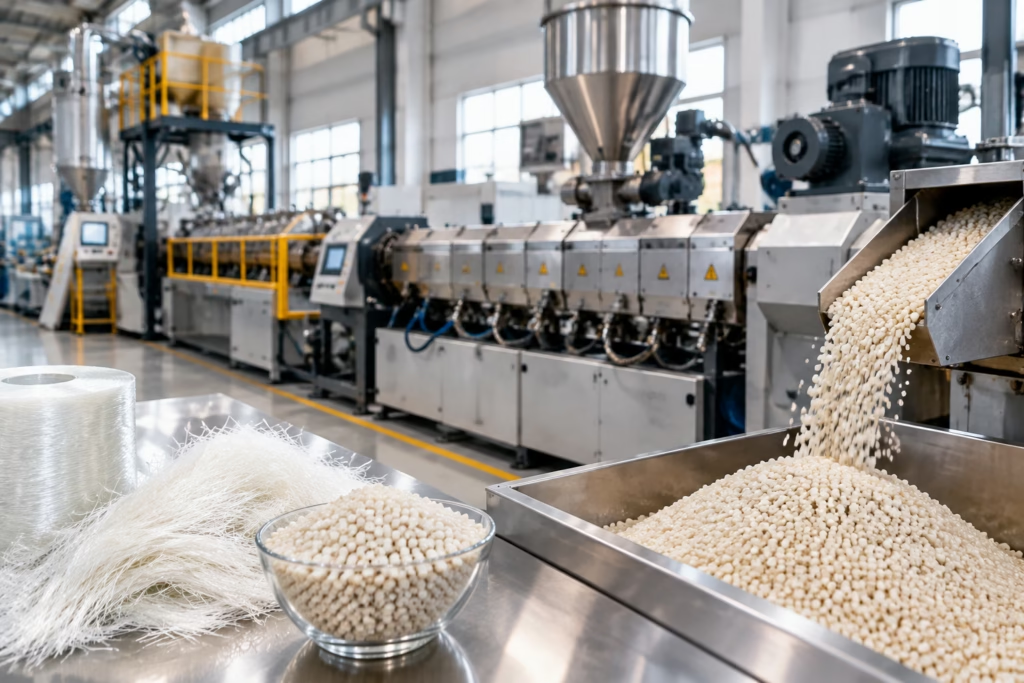
7. Set acceptance criteria and test standards
A sample is only useful if everyone agrees on how it will be judged. The request should define acceptance criteria for mechanical, thermal, flame, electrical, dimensional, appearance, and aging performance as relevant to the application. If the part needs a minimum impact value, specify the test condition. If heat resistance matters, identify the test temperature or the expected service temperature. If flame retardancy is required, state the target classification or standard. If dimensions are critical, define the tolerance and measurement method.
This is one of the most important steps in plastic compound sample evaluation because it prevents subjective evaluation. “Looks okay” is not enough. A material should be judged against a clear benchmark that reflects the part’s actual use. Even if the final approval decision remains internal, the supplier should know what is being measured and why.
The more precise the acceptance criteria, the easier it is to compare different sample rounds and determine whether a failure is caused by formulation, molding conditions, or design constraints. That is why project teams should not wait until the sample arrives to define the pass-fail criteria.
A useful acceptance criteria framework
| Category | What to define | Why it matters |
|---|---|---|
| Mechanical | Strength, stiffness, impact, creep, wear | Confirms load-bearing suitability |
| Thermal | Service temperature, heat aging, HDT target | Checks performance in real use |
| Electrical | Insulation, anti-static, conductivity | Supports electronics and electrical safety |
| Dimensional | Shrinkage, warpage, tolerance limits | Protects assembly fit and yield |
| Appearance | Color, gloss, weld line tolerance, surface finish | Reduces cosmetic rejects |
8. Define sample request details clearly
Once the technical target is set, define the practical sample request details. State the quantity needed, color requirement, target batch consistency, trial mold conditions, and whether you need prototype-grade or production-grade samples. A request for one small lab batch may be enough for screening, but not for full fit-function validation. A project moving toward sourcing approval may need a more stable lot with consistent processing behavior.
It is also important to identify whether the sample should be made under standard production conditions or under special trial conditions. If the sample is processed on a different machine, at a different temperature, or with a different screw configuration, the result may not represent mass production. Likewise, a prototype sample may be acceptable for early design iteration but not for final procurement approval.
Be explicit about color as well. Natural resin, black, white, and custom color can behave differently in terms of heat absorption, appearance, and pigment interaction. If color consistency is important, say so early, because color matching can affect lead time and the number of iterations required.
9. Plan how the sample will be evaluated on the actual part
A smart sample plan moves beyond coupon testing. It should explain how the part will be checked for appearance, processing stability, shrinkage, warpage, mechanical behavior, and fit/function under the actual assembly conditions. If possible, evaluate the sample in the real mold and with the real process window, because that is where hidden weaknesses usually appear.
For example, a sample may pass a simple stiffness check but still fail when assembled because a boss cracks, a clip loses retention, or a long housing bends after cooling. A sample may fill well in a test bar but show sink marks in a thick section. A sample may measure well immediately after molding but drift after conditioning or heat aging. The evaluation plan should therefore include both immediate observations and post-conditioning checks when relevant.
This is also the stage where first-pass sample judgment can become more objective. Teams should record what was measured, under what conditions, and which results mattered most. Without that discipline, sample evaluation becomes a memory-based discussion instead of a technical decision process.
For projects that focus on dimensional control, it helps to compare sample behavior against a structured checklist. Our how to evaluate dimensional stability in plastics resource is useful when a project must balance shrinkage, warpage, and long-term part consistency rather than relying on a single room-temperature measurement.
10. Clarify sourcing and project constraints
Technical fit is only half of the sample question. The other half is sourcing reality. Confirm lead time, MOQ, target cost, documentation needs, and whether custom compounding is allowed within the project budget and schedule. A material that performs well but cannot be delivered consistently or in the required commercial structure is not a real solution.
From a manufacturer’s point of view, the best sample request is one that tells us not only what the part needs, but also what constraints the buyer is working within. If a project has a strict launch date, the sample strategy may need to prioritize fast screening. If the annual volume is moderate, the formulation should match the economic scale. If the project needs technical data sheets, traceability, or repeat lots, those requirements should be included early.
For engineering teams, this sourcing view matters because the sample stage often determines whether the final supply path will be stable. An otherwise good formulation may need adjustment if the procurement team needs shorter lead time, the processor needs easier drying, or the application needs tighter batch consistency. Sample evaluation should therefore include commercial fit, not only laboratory fit.
A practical sample request checklist for faster supplier response
To make plastic compound sample evaluation easier on both sides, summarize the project in a structured request. The goal is not to write a long essay, but to give the supplier enough detail to propose a relevant formulation and sample plan on the first round.
- Application and part function
- Primary performance targets and non-negotiable requirements
- End-use environment, including temperature, load, chemicals, and outdoor exposure
- Part drawing, geometry, wall thickness, tolerances, and critical dimensions
- Preferred resin family and acceptable alternatives
- Required modification type, such as reinforcement or impact modification
- Processing method, drying need, and molding or extrusion conditions
- Acceptance criteria, test standards, and evaluation method
- Sample quantity, color, and whether prototype or production-grade samples are needed
- Lead time, MOQ, cost target, and documentation requirements
If your project is centered on structural stiffness and dimensional control, it may also be useful to compare the request against a reinforcement-oriented material option before sending the sample brief. In those cases, glass fiber reinforced plastic compound options for structural samples can serve as a practical reference point for how reinforcement choice may affect stiffness, shrinkage, and processing behavior.
Common mistakes that cause mismatched samples or repeated revisions
Several mistakes appear again and again in sample projects. The first is asking for a sample before the target performance is defined. The second is sending only a resin name without part geometry or processing details. The third is evaluating a sample only on appearance while ignoring warpage, shrinkage, or assembly fit. The fourth is assuming that a lab specimen proves production success. The fifth is not telling the supplier whether the sample is for exploratory testing or for near-final approval.
Another common issue is requesting a “standard” material when the real need is a modified one. If the part needs heat resistance, impact improvement, or reinforcement, the sample should be designed accordingly rather than forcing the project through a generic grade. Likewise, if the processor has a narrow production window, the sample should be evaluated under that same window. Otherwise the evaluation may produce false confidence.
When customers need help avoiding these errors, we usually recommend looking at the material choice in relation to the actual application and production plan. That is where a structured supplier conversation becomes more valuable than a broad material search, because it reduces the chance of repeated sample rounds and delayed approvals.
How to turn sample results into a stable mass-production material decision

The final decision should not depend on a single data point. Once the samples are molded and tested, compare them against the original brief, the processing conditions, and the actual part performance. Ask whether the material solved the core problem without creating a new one. Did stiffness improve but warpage increase? Did impact improve but drying become more sensitive? Did heat resistance improve but surface quality fall below the required level? These trade-offs are normal, and they must be reviewed honestly.
A production-ready decision usually requires a repeatable formulation, stable process window, and realistic supply structure. If the sample succeeds technically but cannot be reproduced consistently, it is not yet ready for mass production. If the sample performs well in one setup but not another, the project may need process adjustment or formulation refinement. The best outcome is a material that works not only once, but reliably across lots and production runs.
That is why we treat the sample stage as the bridge between part design and manufacturing stability. A well-written request shortens the route from concept to approval, and a well-evaluated sample reduces risk when the project moves into production.
Conclusion
Before requesting samples for a plastic compounding project, the most important step is to make the brief complete enough for technical decision-making. Define the performance target, part function, geometry, resin family, modification needs, processing conditions, acceptance criteria, sample details, evaluation method, and sourcing constraints. When these ten details are clear, plastic compound sample evaluation becomes faster, more relevant, and much more likely to lead to a production-ready material choice.
At Poly Maro, we believe the best sample program is one that helps engineers, buyers, and processors move from uncertainty to confidence with fewer revisions. A clear brief saves time, lowers risk, and creates a better foundation for stable sourcing and mass production.
FAQs
What is the biggest reason sample requests fail in plastic compounding projects?
The most common reason is an incomplete project brief. When the supplier does not know the part function, performance target, geometry, processing method, or acceptance criteria, the sample may be technically reasonable but still unsuitable for the real application.
Should I ask for a standard grade or a custom compound first?
That depends on the application. If the part has basic requirements and low risk, a standard grade may be a useful starting point. If the part needs specific heat, impact, flame, reinforcement, or dimensional performance, a custom compound is often the better path from the start.
How much detail should I give about the part geometry?
Give enough detail for the supplier to assess flow, shrinkage, and warpage risk. At minimum, include wall thickness, ribs, bosses, critical dimensions, tolerances, and any cosmetic or assembly-sensitive areas. A drawing or 3D file is much better than a verbal description.
Why does processing information matter so much in sample evaluation?
Because a material that performs well in the lab may still be difficult to dry, mold, or extrude on real equipment. Processing temperature, drying sensitivity, cycle time, and flow behavior all affect whether the sample can be used in production without excessive scrap or instability.
How do I know whether a sample is ready for mass production?
It is ready only when it meets the required performance targets, runs consistently in the intended process, and produces parts that pass fit, function, and dimensional checks. A successful lab result alone is not enough if the lot-to-lot behavior or process window is unstable.
What should I include if I want the supplier to respond faster?
Include the application, target properties, part drawing, resin preference, modification needs, processing method, sample quantity, color, acceptance criteria, lead time, and MOQ expectations. The more complete the request, the fewer back-and-forth rounds are usually needed.