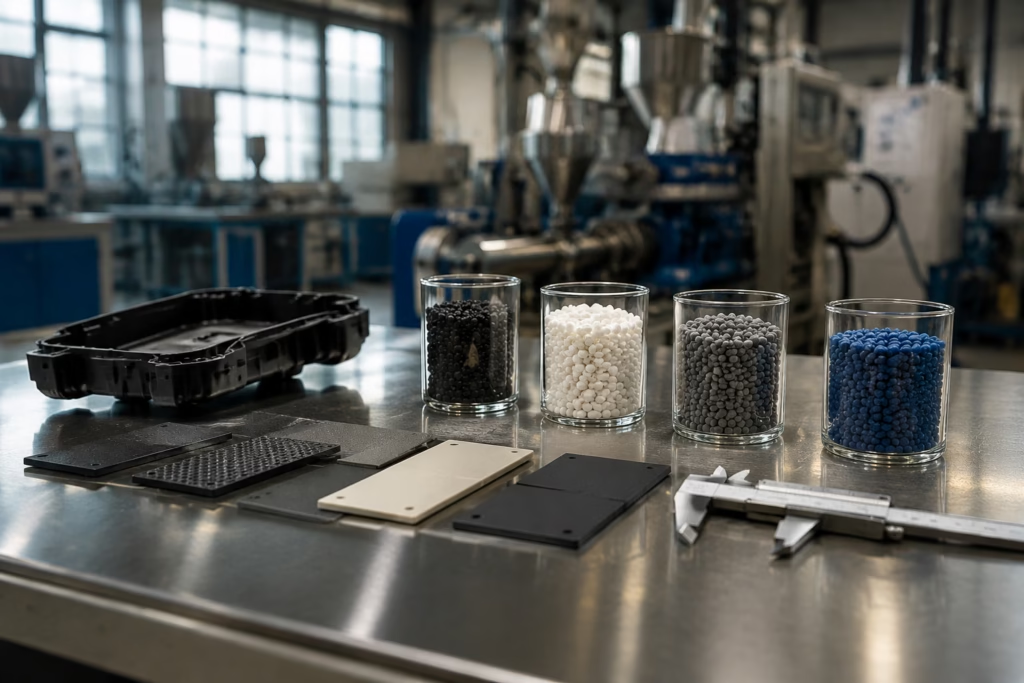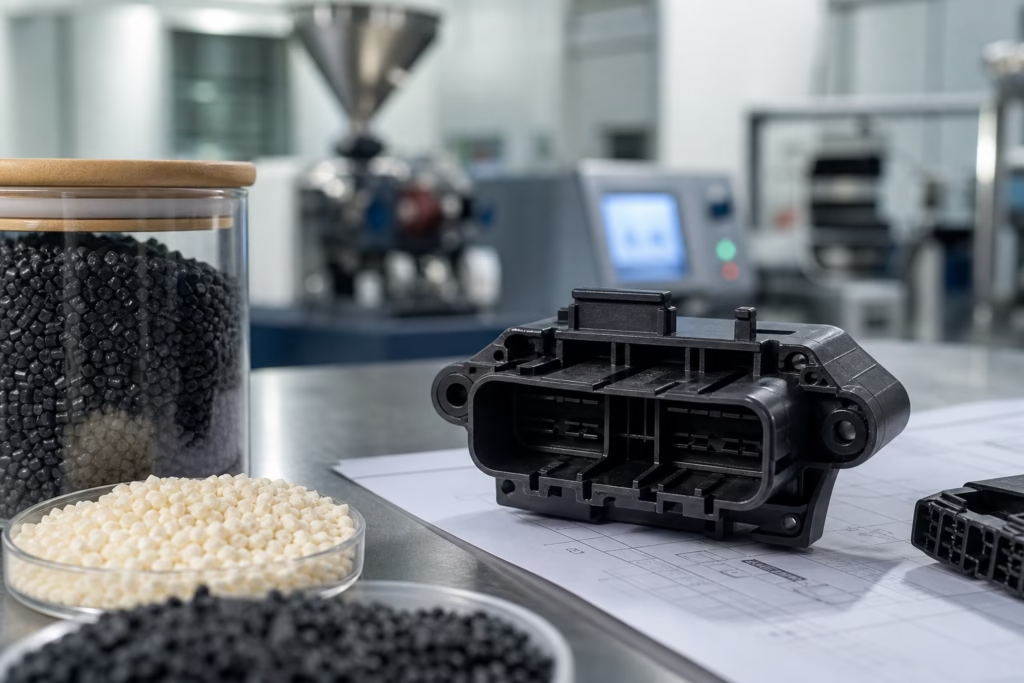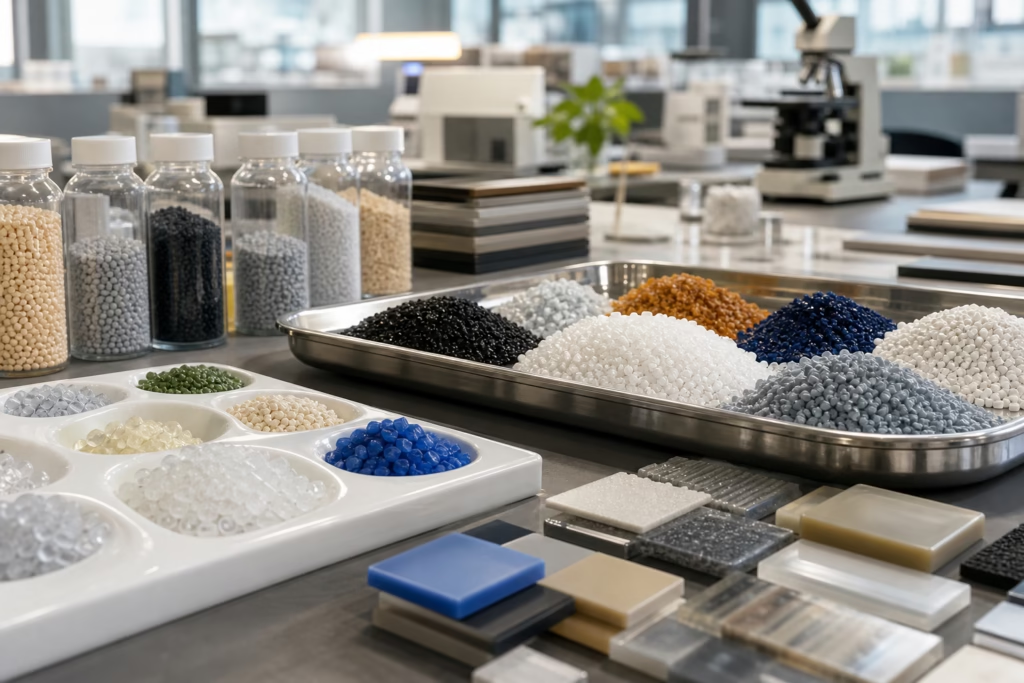
Choosing office furniture plastic components is never only a matter of picking a resin with a decent datasheet. In chairs, armrests, bases, connectors, covers, and decorative trims, the real challenge is balancing load, appearance, long-term durability, and cost without over-engineering the part. A component that looks fine in a sample room can still fail in production if it creeps, warps, scratches easily, or loses fit after repeated use.
For teams that need a more structural direction early in the project, our metal replacement options for structural furniture parts are a useful starting point when the goal is to reduce weight, control part complexity, and keep enough stiffness for practical office use. At Poly Maro, we approach these projects by matching resin family, reinforcement level, surface requirement, and processing window to the real part function, then validating the choice for molding stability, assembly fit, and batch consistency before scale-up.
Why office furniture plastic components need different priorities by part type
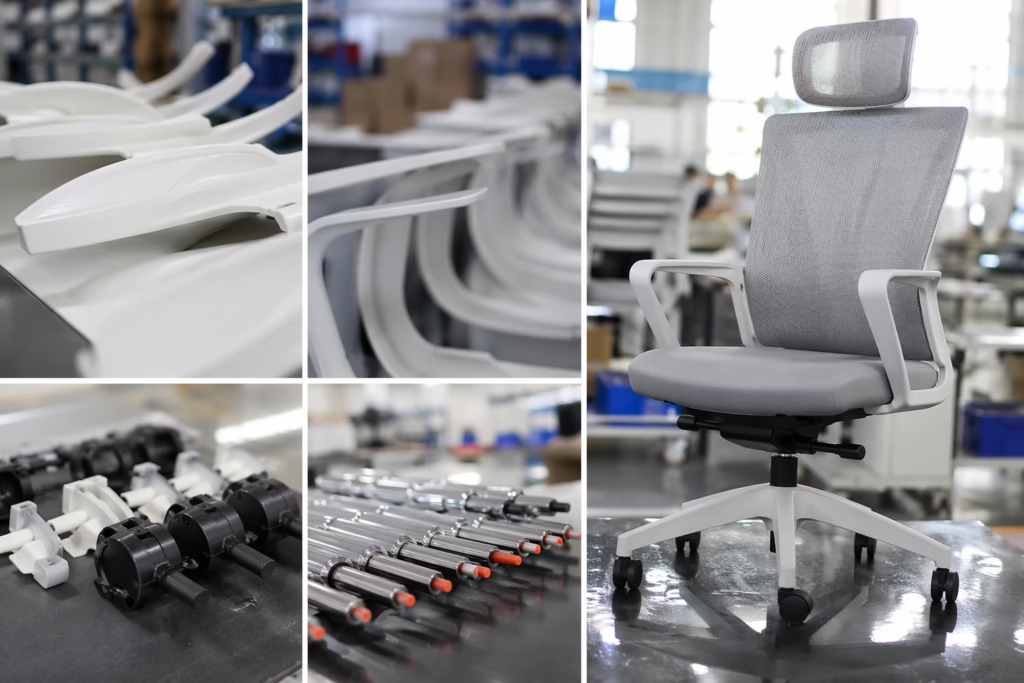
Office furniture is a mixed-use environment. A single product may contain load-bearing supports, moving interfaces, hidden connectors, and highly visible surfaces. Those parts do not share the same performance priorities, even if they are all made from plastic. A chair base needs stiffness and fatigue resistance. A connector needs dimensional accuracy and stable fit. A cover or trim needs appearance retention, scratch resistance, and color consistency.
This is why a one-grade-fits-all approach often creates avoidable problems. A resin that is attractive and easy to mold may be too soft for a bracket. A stiff reinforced compound may be excellent for support but too rough or too visible for an exposed trim. The first step in material selection is to classify the component by function, then decide what must not fail in use.
Part classification that helps narrow the resin choice
- Load-bearing supports: chair bases, seat support frames, brackets, leg reinforcements, structural interfaces.
- Connectors and retention parts: clips, latches, sleeves, fastener housings, joint elements.
- Decorative functional parts: armrest covers, trims, side panels, caps, exposed shells, visible housings.
- Motion or wear-contact parts: pivots, guides, sliding interfaces, adjustment pieces, repeat-use touch points.
Once the part class is clear, the material discussion becomes practical. For example, if a base structure sees repeated load and a high level of stress concentration, a reinforced engineering plastic may make more sense than a general-purpose resin. If a visible cover only needs shape retention and a clean surface, appearance and flow behavior may be more important than maximum stiffness.
What performance requirements matter most in office furniture plastics
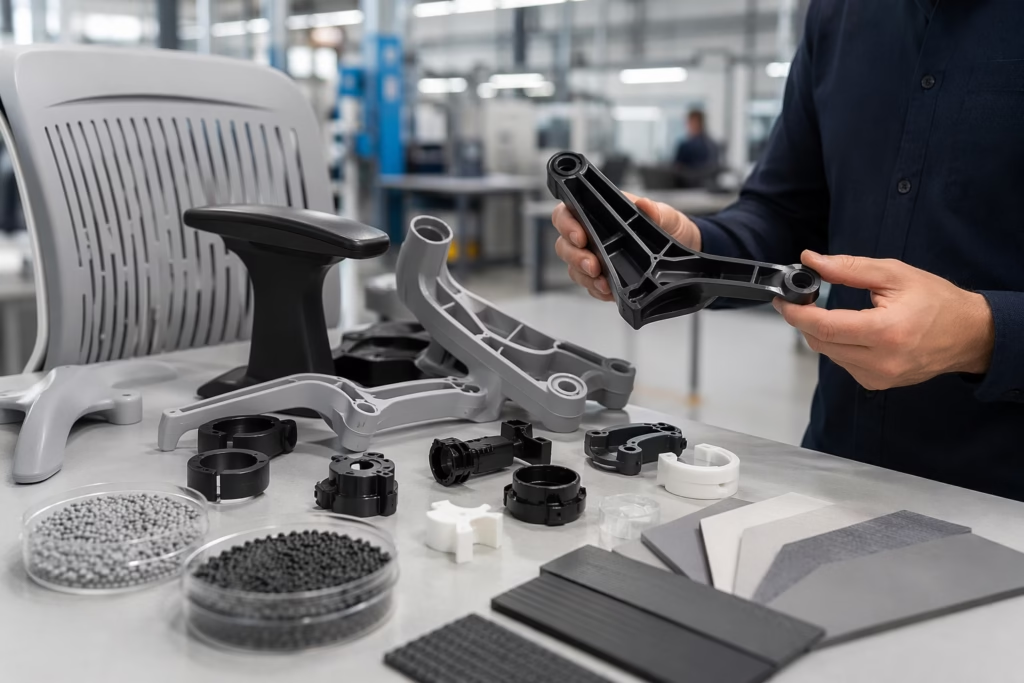
From our compounding and application support experience, office furniture plastic components are usually judged by five recurring requirements: strength, stiffness, impact resistance, appearance, and long-term durability. Each one influences the others.
| Requirement | What it means in furniture use | Typical risk if under-designed |
|---|---|---|
| Strength | Ability to carry load without cracking or yielding | Breakage at joints, fasteners, or thin sections |
| Stiffness | Resistance to deflection under load | Sagging, loosened fit, poor user feel |
| Impact resistance | Tolerance for knocks, drops, and misuse | Brittle cracking, edge failure, shipping damage |
| Appearance | Surface quality, gloss, color, texture retention | Visible defects, poor perceived quality, scratches |
| Durability | Resistance to creep, fatigue, wear, and aging | Loosening, deformation, noise, premature replacement |
For office furniture, durability is often underestimated. A chair does not fail only when it breaks suddenly. It may slowly deform, loosen, or lose surface quality. In procurement terms, that creates warranty risk. In design terms, it means the part was selected for initial strength but not for life-cycle performance.
For long-term load performance, it is useful to consider creep resistance testing for load-bearing plastic parts because many furniture failures come from sustained stress rather than a single overload. This matters especially for arm supports, structural brackets, and joint interfaces where a part can appear strong at first but gradually lose shape under continuous force.
Common failure risks in office furniture plastic components
When a furniture program fails, it usually fails in a predictable way. The issue is not always material selection alone. Sometimes the part design, wall thickness, gate location, or assembly method amplifies the material’s weakness. Still, certain failure modes appear again and again in office furniture plastics.
Cracking and brittle failure
Cracking often comes from a combination of high stress, sharp corners, low impact resistance, or poor weld-line strength. It is common in thin brackets, snap-fit features, and parts that receive user abuse. If the part is visible, cracking is also a brand problem because it communicates fragility.
Creep and loosening
Creep is the slow deformation that occurs under continuous load. In seating and support components, creep can loosen joints, reduce clamping force, or create visible sagging. This risk is especially important when the part is loaded in a warm indoor environment over months or years.
Warpage and poor fit
Warpage makes assembly difficult, creates visible gaps, and can lead to squeaks or uneven stress distribution. It is often linked to unbalanced shrinkage, uneven wall thickness, fiber orientation, or poor cooling design. For precision interfaces, even small dimensional shifts can affect final fit.
Discoloration and surface wear
Visible surfaces in office furniture are handled frequently. Color shift, gloss loss, and scratch marks can make a product look older than it is. That is why decorative and touch surfaces need a different validation path from hidden structural parts.
Material selection logic for structural furniture plastic parts
For load-bearing or semi-structural parts, the primary question is not “Which resin is strongest?” but “Which material gives the required stiffness, toughness, and dimensional stability at the right processing cost?” In office furniture plastic components, over-specifying a material can raise cost and processing difficulty without adding meaningful value. Under-specifying it can create hidden warranty risk.
When the part carries real load, reinforced engineering plastics are often the most practical choice. At Poly Maro, we usually evaluate the load case, wall design, assembly method, and expected service life before recommending reinforcement type or modification path. That is because the right compound for a hidden support may be very different from the right compound for a visible shell.
Glass fiber reinforcement is often chosen when stiffness and creep resistance are priorities. Mineral-filled grades may improve dimensional control and reduce shrinkage sensitivity. Impact-modified grades help when the geometry is thin, the part is exposed to drops or knocks, or the design includes snap-fit features. Flame-retardant grades may be required where the furniture part is part of an electrical or office-electronics assembly.
For structural furniture parts, our glass fiber reinforced resin solutions for load-bearing supports are typically considered when the design needs higher stiffness and better load retention, but the engineer must also account for surface appearance, fiber orientation, and mold flow. Reinforcement improves mechanical performance, yet it can also increase anisotropy and make warpage more likely if the mold is not well balanced.
Material options for chair components: how to compare PP, ABS, PA, PBT, and PC/ABS
Chair components are a good example of why resin family selection matters. The right grade depends on whether the part is structural, cosmetic, moving, or clip-based. The five families below appear often in office furniture applications, but each serves a different function.
| Material family | Typical strengths | Main caution | Best fit in office furniture |
|---|---|---|---|
| PP | Low density, good chemical resistance, economical processing | Lower stiffness unless modified or reinforced | Light-duty covers, concealed parts, some utility components |
| ABS | Good appearance, easy molding, balanced impact resistance | Heat and creep resistance are limited compared with engineering resins | Decorative housings, trims, moderate-load parts |
| PA | Higher strength and wear resistance, strong structural potential | Moisture sensitivity and dimensional change must be managed | Brackets, supports, moving parts, load-bearing interfaces |
| PBT | Stable dimensions, good electrical properties, reliable molding behavior | Requires appropriate design for impact and heat conditions | Clips, connectors, stable retention parts, housings |
| PC/ABS | Excellent appearance balance, better toughness than pure ABS | Not always the first choice for high structural load | Visible housings, armrest shells, trim with better impact performance |
For highly visible parts, PC/ABS resin options for visible housings and trim are often evaluated when a project needs a smoother appearance, improved impact response, and a cleaner balance between rigidity and aesthetics than standard ABS. In furniture, that combination can be useful for covers and exposed shells that are handled often but do not carry the main structural load.
For stable clips and connector-style parts, PBT material options for stable clips and connectors can be attractive because PBT typically supports good dimensional control and reliable fit. That is valuable where retention force, repeated assembly, and geometry accuracy matter more than high visible gloss.
How reinforcement changes performance in office furniture plastic components
Reinforcement and modification are not just about making a part “stronger.” They change the balance among stiffness, toughness, processability, surface quality, and dimensional stability. In practical furniture design, that means the same base resin can behave very differently once it is filled or modified.
Glass fiber reinforcement
Glass fiber usually increases stiffness and reduces creep, making it valuable for supports, brackets, and structural connectors. However, it can also create surface roughness, visible fiber print-through, and anisotropic shrinkage. Designers should not assume a glass-filled material will look as good as an unfilled one, especially on large visible surfaces.
Mineral filling
Mineral-filled compounds can improve dimensional stability and reduce shrink sensitivity. They may be useful when flatness and fit are critical and the part does not need extreme impact toughness. For precision covers or housings, this can be a practical compromise.
Impact modification
Impact-modified compounds are useful when office furniture parts need to survive knocks, packaging stress, and repeated user contact. They are especially relevant for chair components with snap fits, clip structures, or thin corners. Our impact-modified plastic compounds for tougher chair components are often considered when the design needs better toughness without moving to a much more expensive or difficult material family.
Flame-retardant grades
Some office furniture products include electrical features, power management elements, or customer-driven fire safety requirements. In those cases, flame-retardant modification may be necessary. The key is to confirm whether the FR package affects flow, impact strength, or surface quality in ways that matter to the part.
Balancing appearance and structural performance in visible parts
Visible office furniture plastic components carry a dual burden. They must look good under normal lighting and still survive handling, cleaning, and repeated use. That means appearance is not a separate issue from engineering; it is part of product durability.
Surface quality depends on resin choice, mold polish, gate placement, venting, and cooling balance. A technically strong material can still look poor if the process leaves flow lines, sink marks, weld lines, or gloss variation. Conversely, a cosmetic resin can still disappoint if it is too soft, scratches easily, or shows stress whitening near clips.
For these parts, scratch and mar resistance are often underestimated. A decorative armrest cover or exposed housing may not fail structurally, but if it marks quickly the product can appear old, even when the underlying structure is still functional. In that sense, appearance retention is part of long-term quality.
We usually advise buyers to evaluate visible surfaces under realistic use conditions, not only in a lab sample under ideal lighting. That means checking color consistency, texture uniformity, scratch sensitivity, and the way the surface responds after assembly and handling.
For visible surfaces, scratch resistance testing for visible plastic furniture parts is a useful reference point because it matches the reality that touch surfaces are judged by frequent contact, not just by initial appearance after molding.
Durability factors that matter in office furniture applications
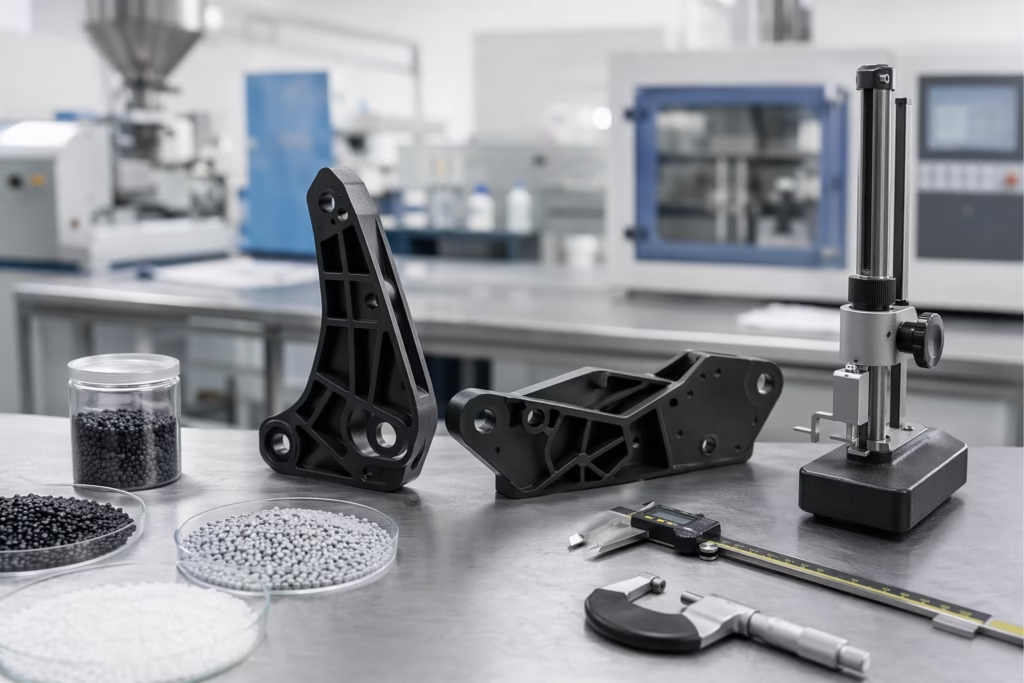
Durability in office furniture is broader than impact resistance. A part may survive a drop test and still fail after months of use if it creeps, wears, or loses fit. From a manufacturing standpoint, the most important durability factors usually include fatigue resistance, creep resistance, UV resistance, scratch resistance, and dimensional stability.
Fatigue resistance
Repeated load matters in chairs, recliners, movable supports, and adjustable interfaces. A part that flexes slightly each time may accumulate damage even if each individual load seems modest.
Creep resistance
Creep is central for anything that supports body weight or carries clamped load. It affects arms, brackets, seat structures, and retention interfaces. The part may still be intact, but its shape or clamping force may change enough to affect function.
UV and aging resistance
For furniture used near windows or in bright environments, UV exposure and heat aging can influence color and mechanical stability. Even indoor products can fade or embrittle if the formulation is not suited to the environment.
Scratch resistance
Visible parts experience frequent contact with belts, bags, cleaning tools, rings, or moving hardware. A surface that scratches easily may still pass production tests yet create customer complaints after installation.
Dimensional stability
Stable dimensions matter for connectors, clips, and decorative parts that must align with metal tubes, upholstery, or other molded pieces. This is one reason mold shrinkage data and part validation are so important. If you need to control fit and repeatability, Office chair stability, strength, and durability testing standards show why furniture should be validated as an assembled system, not just as isolated resin coupons.
Processing considerations for furniture components
Even a good resin choice can fail in production if the molding window is ignored. Office furniture plastic components often have a mix of thick and thin areas, cosmetic surfaces, and assembly features. That combination makes processing control just as important as resin selection.
Flowability and filling balance
Large covers and medium-sized structural parts need a material that fills cleanly without excessive pressure or short shots. Materials with very high reinforcement can become harder to fill and may create visible flow orientation. The goal is to balance flow with mechanical performance.
Drying and moisture control
Polyamides and some engineering resins are moisture-sensitive. If they are not dried correctly, the part may show reduced properties, surface defects, or unstable dimensions. For furniture buyers, drying control is a manufacturing detail that can directly affect product consistency.
Shrinkage and warpage
Dimensional stability is vital for parts that must assemble to metal frames or other molded components. A small warp can cause a fit issue, a cosmetic gap, or a noisy joint. This is why shrinkage data should be checked against the actual mold design and part geometry rather than assumed from a general datasheet.
For shrinkage and dimensional control, injection molding shrinkage and dimensional stability is a useful technical anchor because it supports how molders and designers can compare measured shrinkage with expected geometry and avoid tolerance stack-up problems in production parts.
Surface finish and mold design
Visible office furniture parts need careful attention to gate placement, venting, and cooling balance. Uneven cooling can create warpage or gloss variation. Poor venting can trap gas and produce blemishes. If the part is reinforced, fiber orientation should be considered early because it can affect both appearance and dimensional behavior.
How to match material choice with office furniture applications
Different furniture parts need different material logic. A good design team will separate the product into use zones and select materials accordingly.
- Chairs: structural supports may favor reinforced engineering plastics, while covers and trim may favor PC/ABS or impact-modified ABS.
- Armrests: soft-touch appearance and impact resistance matter, but hidden mounting points may need additional reinforcement.
- Bases and brackets: stiffness, creep resistance, and accurate fit are the main priorities.
- Clips and connectors: dimensional stability and retention reliability matter more than pure cosmetic finish.
- Decorative trims and caps: appearance, scratch resistance, and color consistency are often the main concerns.
In practice, the best choice is often a material combination rather than a single resin across the whole product. For example, the visible shell may use a cosmetically balanced grade, while the hidden bracket uses a reinforced compound. That approach can reduce cost without weakening the product where it matters.
Cost-performance trade-offs: avoiding over-specification
One of the most common mistakes in office furniture projects is over-specifying the material. A part may be upgraded to a high-end engineering resin simply because the team wants “more strength,” even though the real issue is geometry, rib design, or fastener placement. That can increase cost, raise molding difficulty, and create unnecessary supplier complexity.
A better method is to answer three questions:
- What failure mode is most likely for this part?
- Does the part need structural performance, cosmetic quality, or both?
- Can the design be improved before the resin grade is upgraded?
This logic helps teams choose the least expensive grade that still meets performance needs. Sometimes that means a modified PP instead of a higher-cost engineering resin. Sometimes it means using a reinforced grade only in the load-bearing zone. Sometimes it means accepting a slightly higher material cost to avoid assembly failure, warranty claims, or visible quality issues.
When projects require tailored performance instead of a standard catalog grade, when custom plastic compounds make more sense than standard grades can help frame the procurement discussion around total performance rather than resin name alone.
Sample testing and validation checklist before mass production
Before scaling office furniture plastic components, sample validation should cover more than appearance. A resin that passes one test may still fail in the assembled product. We recommend validating both the molded part and the final assembly when possible.
- Dimensional check: verify critical dimensions, flatness, and mating fit.
- Load check: confirm the part holds under realistic force and repeated movement.
- Creep observation: inspect for shape change after sustained load.
- Surface inspection: check gloss, color, weld lines, sink marks, and scratches.
- Assembly test: confirm clips, fasteners, and interfaces fit consistently.
- Environmental check: evaluate the part under expected temperature and cleaning exposure.
Office furniture should also be checked as a system. A stable resin alone does not guarantee product performance if the metal frame, screw torque, or assembly sequence introduces stress. That is why design and supply teams should align on the test plan before the mold is finalized.
Supplier evaluation points for furniture resin sourcing
For procurement and sourcing teams, the supplier choice matters as much as the resin family. A good plastics supplier should be able to explain formulation choices, processing conditions, and trade-offs clearly enough for design and manufacturing teams to make decisions confidently.
- Batch consistency: can the supplier keep properties stable from lot to lot?
- Customization ability: can the formulation be tuned for reinforcement, impact, flame retardancy, or color?
- Lead time: is the supply reliable enough for project schedules and replacement demand?
- MOQ: does the minimum order quantity fit the launch plan and inventory strategy?
- Technical support: can the supplier help with drying, molding windows, and sample review?
At Poly Maro, our role is to help teams reduce sourcing risk by aligning material formulation with the part’s real function, not just its resin category. That approach is especially useful when a project has several component types and the team wants one coherent material strategy instead of a guess-based bill of materials.
For teams comparing reinforcement, weight, and functional trade-offs, engineering plastic choices when weight reduction matters is useful when the furniture program needs less mass without sacrificing practical performance.
Common material selection mistakes and how to avoid them
Several mistakes appear repeatedly in office furniture plastic projects. The good news is that most of them are preventable with better early-stage review.
- Choosing by price only: a low-cost grade can create hidden failures in use.
- Using one material for every part: different part functions usually need different property sets.
- Ignoring creep: a part that looks strong initially may deform over time.
- Ignoring appearance under use: a cosmetic part may pass molding checks but fail in the field.
- Skipping assembly testing: fit problems often appear only in the full structure.
- Not reviewing mold shrinkage early: this can create rework, warpage, or poor fit.
A disciplined selection process usually prevents these issues: define the part function, identify the key failure mode, shortlist the resin families, validate the processing behavior, and then confirm the final assembly performance. That is a more reliable path than simply asking whether a resin is “strong enough.”
When dimensional control is critical for retention features or precision interfaces, why dimensional stability matters in precision parts is especially relevant for furniture clips, connectors, and mating features that must keep their fit over time.
Practical selection framework for manufacturers and buyers
If you need a fast, practical way to evaluate office furniture plastic components, use this sequence:
- Classify the part as structural, connecting, or decorative.
- Define the main risk: load, impact, appearance, creep, or fit.
- Shortlist the material family that matches the risk.
- Decide whether reinforcement or impact modification is needed.
- Review drying, shrinkage, warpage, and surface finish requirements.
- Test the molded part in the assembled product.
- Confirm supplier consistency, MOQ, and lead time before release.
This method keeps the decision practical. It also helps cross-functional teams speak the same language, which is important when design, quality, sourcing, and production are all reviewing the same part.
Conclusion
Choosing office furniture plastic components is about finding the right balance between strength, appearance, and durability for each specific part. Structural supports may need reinforced engineering plastics, connectors may need stable fit and retention, and visible covers may need better appearance and scratch resistance. The best material choice is usually the one that solves the part’s real failure risk without adding unnecessary cost or molding complexity.
For office furniture manufacturers and sourcing teams, the most reliable process is part-by-part selection, realistic testing, and early supplier communication. When that is done well, office furniture plastic components can deliver clean appearance, stable assembly, and long service life without over-specifying the material.
FAQs
How do I choose the right plastic for office furniture plastic components?
Start by identifying whether the part is structural, connecting, or decorative. Then match the resin family to the main risk: stiffness and creep for load-bearing parts, dimensional stability for connectors, or appearance and scratch resistance for visible covers. In many projects, one material cannot serve every function equally well.
Are reinforced plastics always better for office furniture parts?
Not always. Reinforced plastics usually improve stiffness and creep resistance, but they can reduce surface quality, increase warpage risk, and make molding more demanding. They are a good choice when the part actually needs higher structural performance, not just because the word “reinforced” sounds stronger.
What is the biggest durability risk for office furniture plastic components?
Creep is often one of the biggest hidden risks, especially in load-bearing chair parts and connectors that stay under stress for long periods. A part may pass initial testing but slowly deform over time, which can loosen fit or affect comfort and safety.
Which material families are common for visible furniture parts?
ABS and PC/ABS are commonly used for visible housings, trims, and covers because they can offer a good appearance balance and practical molding behavior. The final choice depends on impact needs, surface requirements, and how much load the part must carry.
Why does shrinkage matter so much in furniture parts?
Shrinkage affects fit, flatness, and assembly accuracy. If shrinkage is not reviewed early, a part may warp, create visible gaps, or fail to align with metal frames or other molded pieces. That is why shrinkage data and mold design must be considered together.
What should buyers ask a plastic supplier before mass production?
Ask about batch consistency, MOQ, lead time, customization capability, drying guidance, and support for sample validation. Buyers should also confirm whether the supplier can explain why a grade is suitable for the part’s actual function, not just its resin family.