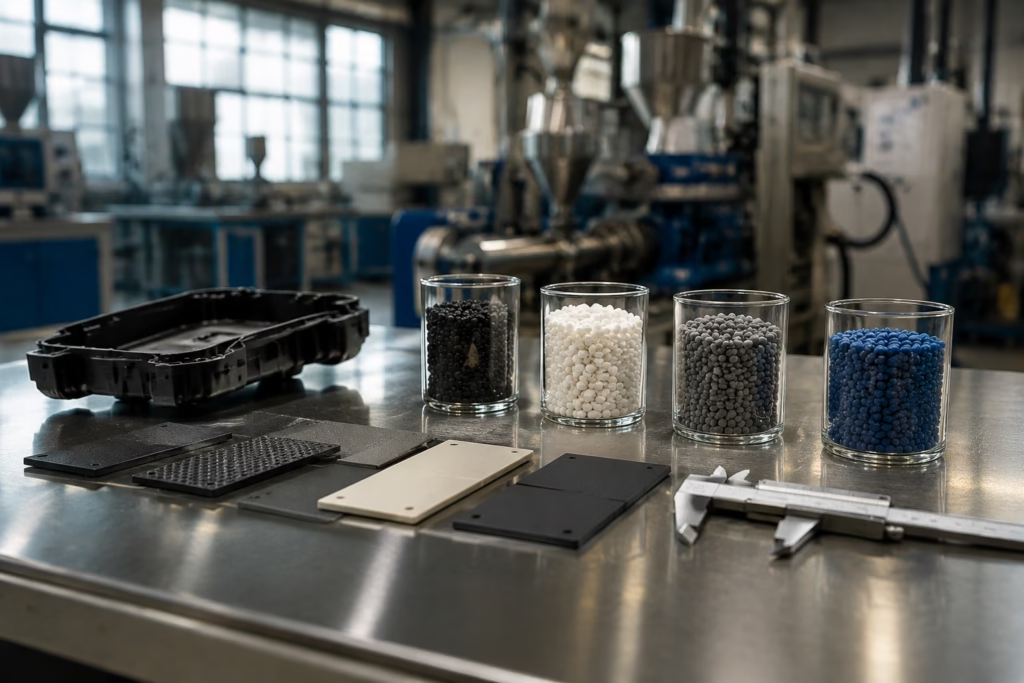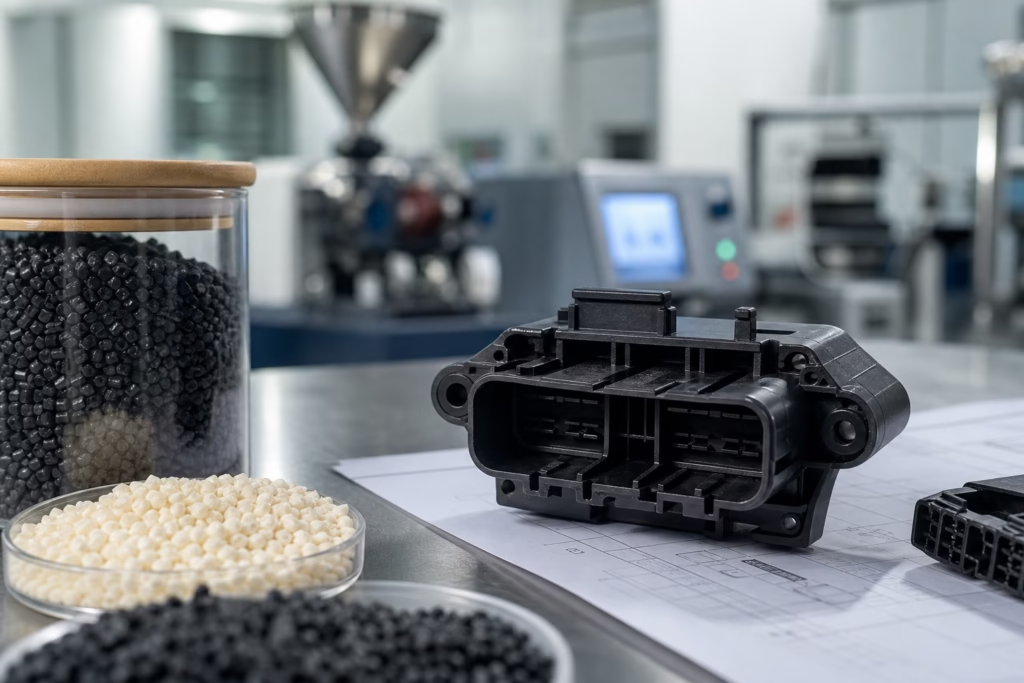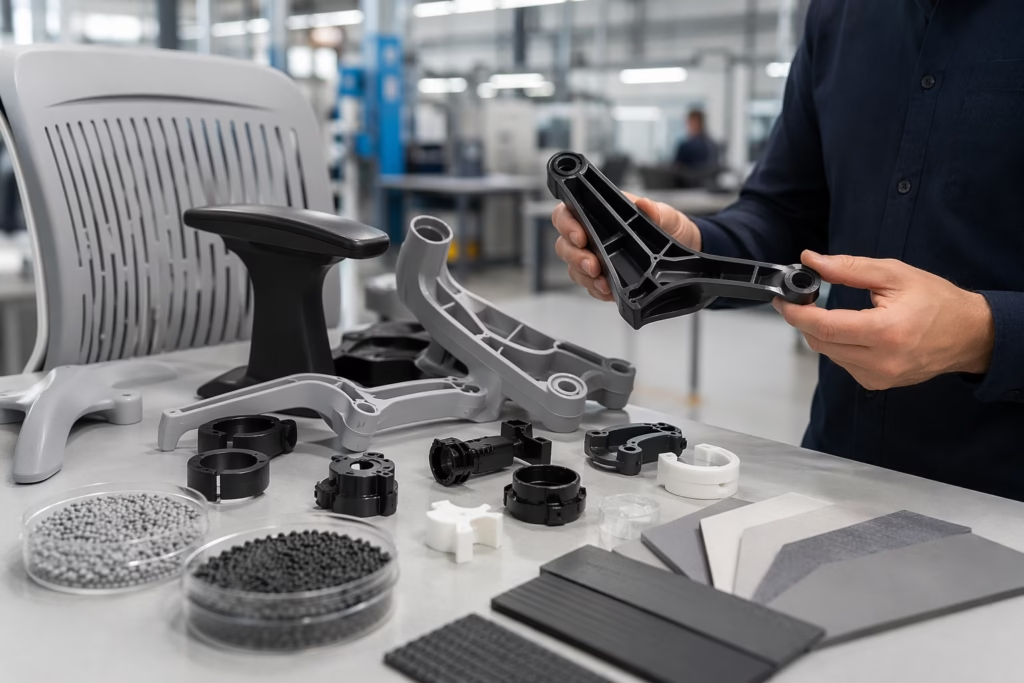
In appliance design, appliance plastic material selection is rarely a one-material decision. The outer housing has to look clean, hold color, resist impact, and stay dimensionally stable for assembly, while the internal functional parts often need a different balance of heat resistance, wear resistance, insulation, flame retardancy, and long-term reliability. When both zones are treated with the same resin logic, the result is often predictable: cosmetic issues on the outside or premature performance failure on the inside.
For teams comparing material systems early, our appliance plastic material selection paths page can help connect real part requirements with practical resin development. At Poly Maro, we usually start by separating the housing requirement from the functional-part requirement, then matching each one to the right resin family, reinforcement level, and processing window so the project is easier to validate in molding, assembly, and mass production.
Why appliance housings and internal parts should not follow the same material logic
Home appliances combine visible surfaces, load-bearing structures, electrical insulation, heat-exposed components, moving parts, and sometimes flame-risk zones. A housing panel on a washing machine, air fryer, vacuum cleaner, or dispenser does not need the same performance profile as an internal bracket, gear, connector body, fan support, or insulating spacer. The outer shell often needs to meet customer-facing goals first: appearance, surface feel, color consistency, low visible shrinkage, and impact resistance. Internal parts are usually judged more harshly on performance under heat, vibration, load, friction, and long-term stress.
That is why appliance plastic material selection should be built around function zones, not around a single “appliance grade” label. A resin that looks excellent in a housing may be too soft, too brittle at temperature, too weak under load, or too unstable after long-term heat exposure inside the machine. Likewise, a high-performance internal grade may be unnecessarily expensive or difficult to finish for an exterior panel that must look smooth and uniform.
| Part zone | Main priority | Typical risk if wrong material is used |
|---|---|---|
| Outer housing | Appearance, impact, color, dimensional stability | Warpage, sink marks, poor surface, color variation |
| Internal bracket | Strength, heat resistance, creep resistance | Deformation, looseness, assembly failure |
| Gear or wear part | Wear resistance, fatigue, low friction | Noise, wear, tooth damage, short life |
| Connector or terminal support | Insulation, flame retardancy, dimensional control | Electrical risk, cracking, fit failure |
Key concerns for appliance housings
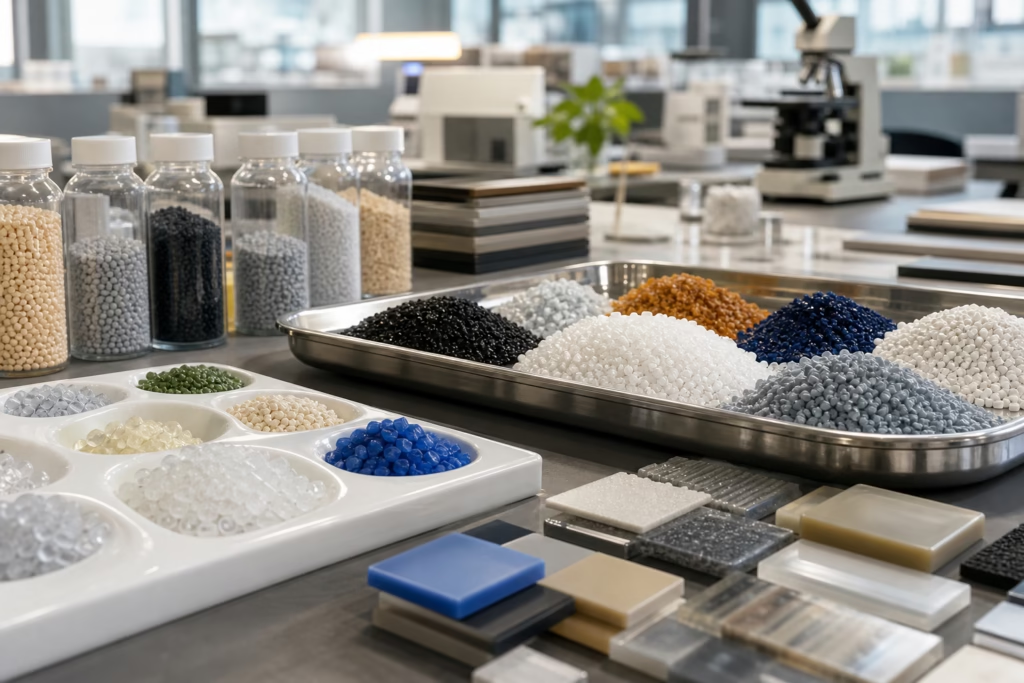
Housing materials are judged first by what users can see and touch. In many consumer appliances, the outer shell is part of the brand identity, so surface finish and color consistency are not cosmetic extras; they are functional quality requirements. In our experience, the most common housing problems are not dramatic failures but subtle issues that accumulate into rejection: gloss inconsistency, flow marks, weld line visibility, shrinkage mismatch, and warpage that affects snap fit or seam alignment.
Appearance and surface quality
For visible parts, ABS, PP, PC/ABS, and some modified PP systems are often considered because they can offer different combinations of appearance, impact balance, and cost. ABS is familiar for good processability and a clean surface, while PP can be attractive for cost and chemical resistance when the design can tolerate its lower stiffness. PC/ABS is often used when a project needs a better balance between impact resistance and heat performance than standard ABS alone can provide. If the shell is large or geometrically complex, flow behavior, weld line control, and shrinkage consistency become just as important as the base resin choice.
Impact resistance and stiffness balance
Housing parts should survive daily handling, transport knocks, and occasional drops without cracking. However, high impact alone is not enough. Too much toughness with too little stiffness can create a flimsy feel, poor screw retention, or deformation around clips and bosses. That is why appliance plastic material selection for housings often becomes a trade-off between appearance, rigidity, and toughness rather than a simple “stronger is better” decision.
Color consistency and batch stability
Unlike hidden parts, housings expose variations immediately. Small changes in moisture, molding temperature, additive dispersion, or lot-to-lot resin behavior can create visible color shifts and surface differences. For procurement teams, this means a material supplier must be evaluated not only on datasheet values but also on production consistency, color control, and the ability to repeat the same result across lots. At Poly Maro, we often treat color match and processing stability as part of the material definition, not an afterthought.
Cost as a controlled design variable
Exterior parts are often where cost pressure is highest, especially in high-volume consumer appliances. The key is not to choose the cheapest resin, but to choose the lowest-cost system that still meets appearance, assembly, and warranty expectations. In some housings, a modified PP or ABS-based solution may be enough. In others, a PC/ABS grade is worth the additional cost because it reduces scrap, warpage rework, and field complaints.
Key concerns for internal functional plastic parts
Internal parts are usually more demanding than housings because they work in the thermal, mechanical, and electrical core of the appliance. They may be hidden from the user, but they often face higher temperatures, tighter tolerances, and long-term stress. In product development, this is where many teams underestimate risk by selecting a “good enough” general-purpose resin that does not survive the real duty cycle.
For any internal component near motors, heaters, power supply areas, or hot airflow paths, heat aging should be examined early. UL’s guidance on heat aging and RTI requirements for appliance plastics is useful here because it shows why short-term heat resistance and long-term property retention are not the same thing. A part can look fine after molding and still soften, creep, or lose strength during repeated thermal exposure.
Heat resistance and long-term reliability
Internal brackets, supports, and covers may live near heaters, compressor zones, motors, or electronics. For these parts, PA6, PA66, PBT, PPS, and LCP can each be considered depending on the exact thermal load, electrical requirement, and dimensional tolerance. PBT is often attractive for electrical and structural internal parts because it can provide a stable balance of heat resistance, electrical insulation, and molding performance. PA66 and reinforced nylon systems may be selected when higher mechanical strength and heat performance are needed, though moisture absorption must be managed carefully.
Wear resistance, creep resistance, and fatigue performance
Moving components such as gears, sliders, supports, and clips need more than stiffness. They need resistance to wear and repeated stress. A part that keeps its static strength in a datasheet may still fail in service if it creeps under constant load, loses tooth profile under friction, or cracks after repeated flexing. This is why internal parts often demand more rigorous application testing than housings, including load holding, thermal cycling, and repeated assembly/disassembly simulation.
Electrical insulation and flame retardancy
Many internal appliance parts sit close to live circuits, terminals, or heat sources. That means the material must be assessed for electrical insulation and flame behavior, not just mechanical strength. UL’s UL 94 and UL 746 standards for appliance plastic selection are widely used reference points because they connect material behavior to short-term flammability, long-term electrical use, and heat-aging performance in electrical equipment. For housings and internal insulating parts alike, the relevant question is not only “does it pass?” but “does it pass at the right thickness, geometry, and location in the appliance?”
Material logic for housings: when ABS, PP, PC/ABS, PC, or modified PP fits better
Housing selection usually starts with appearance, impact resistance, surface quality, and cost. ABS remains a common baseline because it is familiar in molding, offers a good surface, and is relatively easy to process. It is often used where the part is decorative or semi-structural and the heat exposure is moderate. Modified PP can be attractive when cost and chemical resistance matter, but the design must account for lower stiffness and the possibility of higher warpage in some geometries.
PC/ABS is often a strong middle-ground option for appliance housings when the project needs a better balance of heat resistance, toughness, and appearance stability. PC alone may be selected in more demanding applications, but it can raise cost and may require tighter process control. In practice, the right choice depends on wall thickness, boss design, gate position, visible surface demands, and the amount of assembly stress expected in production.
For housing programs that demand both visual quality and stronger heat performance, the selection conversation often turns into a molding discussion as much as a material discussion. If the part is large, thin-walled, or highly cosmetic, process window and shrinkage behavior can matter as much as impact strength.
One practical reference point is our PC/ABS resin options for appliance housings, because PC/ABS often sits at the center of housing decisions where appearance and toughness must be balanced without pushing cost too far upward.
Material logic for internal functional parts: when PA6, PA66, PBT, POM, PPS, LCP, TPU, or reinforced compounds fit better
Internal functional parts should be selected from the operating environment outward. First ask: What temperature range will the part see? Will it carry load continuously? Will it move? Will it touch electricity, moisture, lubricants, or chemicals? The answers determine whether a nylon, polyester, acetal, PPS, or another engineering polymer is the right base resin.
PA6 and PA66 are widely considered for structural internal parts because they offer strong mechanical performance and can be reinforced to improve stiffness and heat resistance. They do absorb moisture, which can be an advantage or a problem depending on the application: moisture can help toughness but can also change dimensions and stiffness. PBT is often used where stable electrical insulation and good molding behavior are important, such as connectors, housings inside control modules, and other precise components. POM is often chosen for gears and sliding parts because of its low friction and wear performance. PPS and LCP enter the discussion when the application becomes more heat-intensive, more dimensionally demanding, or more electrically critical.
For teams choosing internal components for electronics or motor-adjacent parts, our PBT material choices for internal functional parts can be a practical starting point when a stable balance of insulation, molding consistency, and thermal performance is required.
How to map part type to material family
- Gear or wear part: POM, reinforced PA, or a wear-modified compound depending on load and friction.
- Connector body: PBT, PA66, or flame-retardant engineered compounds depending on electrical and thermal requirements.
- Support frame: glass-filled PA, PBT, or PPS when stiffness and heat resistance matter.
- Fan or moving cover: impact-balanced, heat-resistant resin with good dimensional stability.
- Insulating spacer: electrically stable, flame-retardant material with controlled shrinkage.
How reinforcement and modification change the selection logic
Reinforcement and compounding are often what turn a general resin into a usable appliance material. Glass fiber reinforcement can significantly raise stiffness and heat resistance, but it also changes shrinkage behavior, surface appearance, and potential warpage direction. A glass-filled part may be much stronger, yet if the gate location and rib layout are not designed properly, the added stiffness can create deformation or cosmetic flow issues.
Impact modification can improve toughness, especially for housings and snap-fit parts, but too much impact enhancement may reduce stiffness or heat resistance. Flame retardant modification is essential in many internal appliance parts and certain housings, but it can affect mechanical properties, flowability, and processing window. Anti-static or conductive modification may be necessary in special appliance zones, but these changes need to be validated against the end-use requirement instead of added by default.
If a project needs both heat and flame performance, this is where a manufacturer’s compounding experience matters. We often help teams decide whether to start from a base resin and modify it, or to move directly to a formulated compound designed for the target zone. For applications that need higher heat performance, our heat-resistant plastic compound solutions are relevant when long-term thermal behavior is part of the material brief.
For safety-focused appliance parts, material selection may need to include flame behavior from the start. In those cases, the right formulation should be paired with the correct thickness, part geometry, and test plan. Our flame-retardant plastic compound pathways are a useful reference when the project requires a balanced approach to fire safety and processing stability.
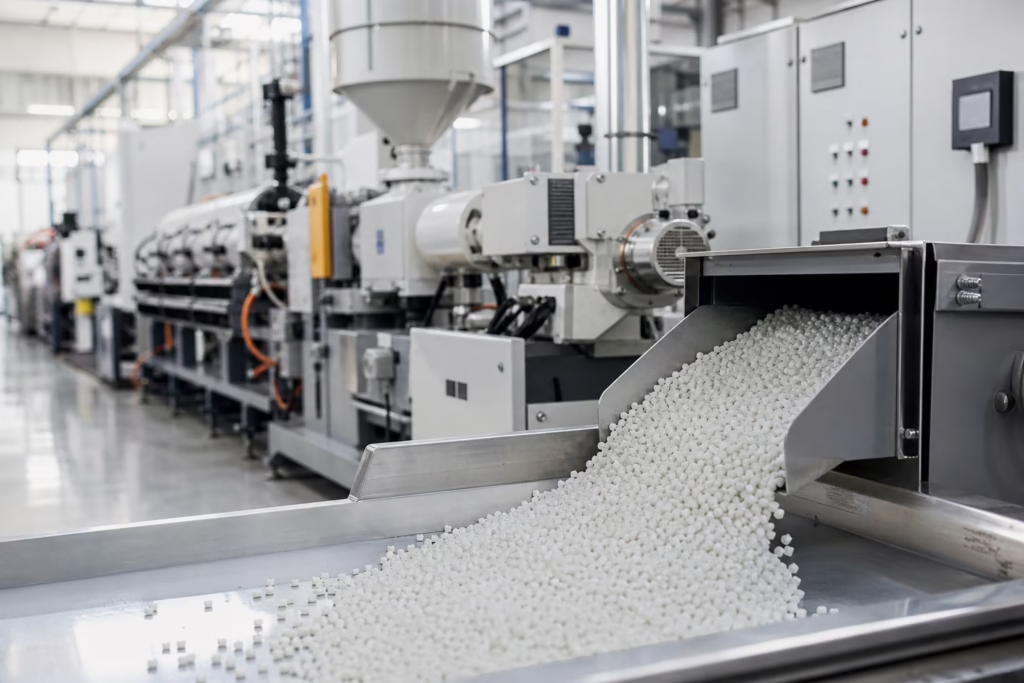
Processing and molding considerations that often decide success or failure
Two materials can look similar on paper and behave very differently on the molding floor. For appliance parts, the practical questions are often: Will the resin dry properly? Will it fill thin ribs and long flow paths? Will it warp after ejection? Will the surface show gloss differences or weld lines? Will the cycle time be acceptable at production scale?
Drying is especially important for moisture-sensitive resins such as PA and PBT. If drying is incomplete, hydrolysis or surface defects can undermine both appearance and mechanical performance. Flowability matters for thin-wall housings and connectors because the part may need to fill fast without excessive pressure. Shrinkage and warpage control are essential for panels, covers, and precision internal brackets, especially when screws, clips, and mating features must stay aligned.
Processing validation should therefore include more than a quick sample shot. We recommend a practical mold trial sequence that checks appearance, dimensional stability, mechanical response after conditioning, and part-to-part repeatability. If the material is reinforced, gate design and fiber orientation must be reviewed. If the material is flame-retardant, the molding window may need tighter control to preserve appearance and avoid surface weakness.
| Processing factor | Why it matters for appliance parts | Common consequence if ignored |
|---|---|---|
| Drying condition | Prevents hydrolysis and surface defects | Brittleness, bubbles, poor strength |
| Flowability | Supports thin walls and long fills | Short shot, weld lines, high pressure |
| Shrinkage | Controls fit and assembly | Gap, mismatch, dimensional drift |
| Warpage | Maintains cosmetic and functional geometry | Rejected parts, assembly difficulty |
| Cycle time | Impacts production efficiency | Higher cost, unstable output |
Common mistakes in appliance material selection
The most expensive material mistake is usually not the raw resin price. It is choosing a material that works in one zone and then forcing it to cover all zones. We see three recurring errors in appliance programs.
- Using one resin for both appearance and function: an attractive housing grade is often not durable enough for internal load-bearing or heat-exposed parts.
- Ignoring the heat source map: parts near heaters, motors, or power electronics need different logic from parts located in cool outer zones.
- Underestimating long-term mechanical stress: clips, brackets, gears, and supports can fail slowly through creep, fatigue, or wear even when the first sample looks acceptable.
Another common issue is evaluating only a datasheet without matching it to the part geometry and processing method. For example, a resin may have enough nominal heat resistance, but if it warps too much in a large housing, the part still fails the project. Or a reinforced grade may provide the needed stiffness, but the surface finish may not be suitable for a visible panel.
How to match material choice to specific appliance zones
A practical appliance development workflow starts by mapping each zone to its dominant risk. For outer shells, that usually means appearance, color, impact, and shrinkage. For structural brackets, it means stiffness, heat, and creep resistance. For gears and moving parts, wear and fatigue matter most. For connector bodies and insulating parts, the focus shifts to electrical safety and flame behavior.
Outer shell
ABS, modified PP, PC/ABS, and some PC grades are common candidates depending on finish and performance target. The decision often depends on whether the shell is large and cosmetic or compact and semi-structural.
Structural bracket and support frame
Glass-filled PA, PBT, or PPS may be better choices if the part sees sustained load or heat. Stiffness alone is not enough; dimensional stability and assembly fit must also be verified.
Gear and moving part
POM or wear-tuned engineering compounds are often selected for low friction and stable motion. If heat is elevated, the design may need a higher-performance polymer or reinforcement strategy.
Connector and switch part
PBT, PA66, or flame-retardant compounds are often assessed because electrical insulation and heat behavior are central to safety and reliability. This is where standards-driven testing becomes important, especially for appliance systems with strict compliance targets.
For projects where regulatory documentation, use-temperature guidance, and enclosure safety are part of the conversation, the broader standards context around flame retardancy requirements for appliance housings and internal parts helps align material choice with component function and thickness.
Cost-performance trade-offs in appliance programs
Cost-performance balance is not the same as choosing the cheapest option. A good housing material can reduce finishing defects, improve assembly, and lower scrap. A good internal functional material can reduce warranty risk, improve reliability, and support compliance. In appliance manufacturing, the cheapest resin can become the most expensive decision if it causes warpage, process instability, or early-life failure.
We usually advise teams to spend budget where it protects the project most. For visible housings, invest enough to control surface, color, and assembly quality. For hidden functional parts, invest enough to avoid long-term failure under heat, load, or electrical stress. This is why the same project may legitimately use a lower-cost shell resin and a higher-performance internal compound. The two material logic systems serve different risks.
Project selection checklist for new appliance development
Before finalizing resin selection, a cross-functional team should confirm the following points:
- Part zone and functional role
- Expected heat exposure and proximity to heat sources
- Mechanical load, impact risk, or wear requirement
- Electrical insulation or flame-retardant requirement
- Appearance target and color consistency need
- Wall thickness, gate location, and flow length
- Drying sensitivity and molding window
- Dimensional tolerance and warpage limit
- Sample verification plan and acceptance criteria
- Mass-production consistency, MOQ, and lead-time expectations
When a supplier can support custom formulation, color matching, and process feedback, the project usually moves faster. That is especially true for appliance programs that combine housing aesthetics with internal reliability. The advantage of working with a manufacturer is not just resin supply, but the ability to tune properties for the exact part geometry and production method.
How a modified plastic manufacturer supports appliance projects
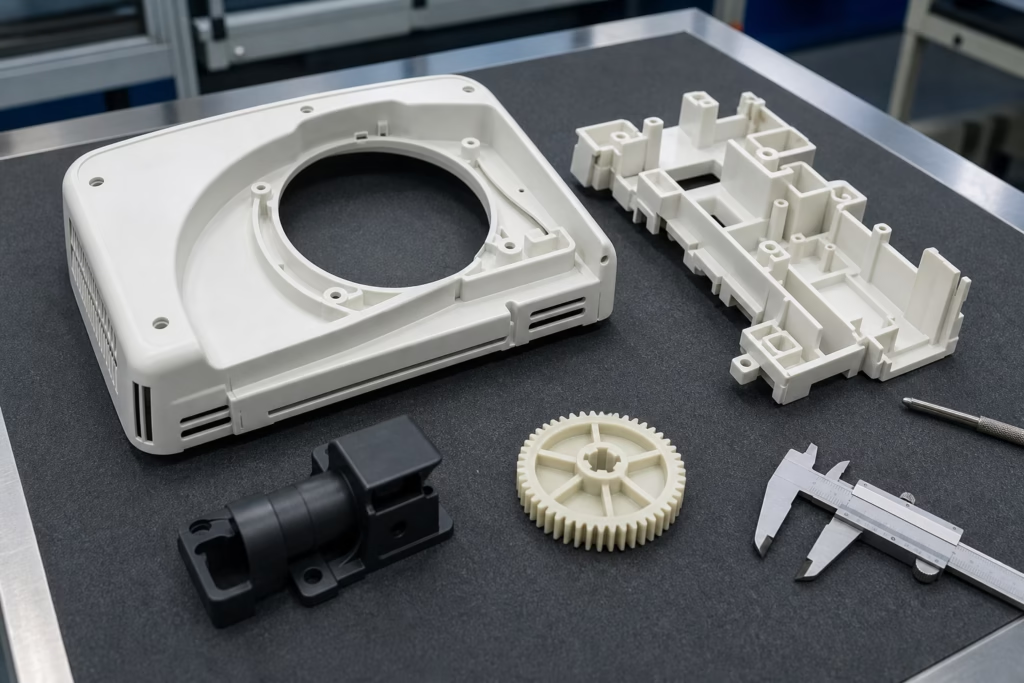
From our compounding and resin-development perspective, appliance programs succeed when the material conversation starts early. We help teams compare base resin families, evaluate reinforcement options, adjust flame-retardant packages, and balance processability against final part performance. In some cases, the best path is a standard grade. In others, the project needs a custom compound tuned for heat, stiffness, impact, or color stability.
That support matters because appliance plastic material selection is not only about choosing a polymer name. It is about controlling the behavior of the finished part in real production and real use. If the part is cosmetic, the material must preserve the look. If the part is structural, the material must preserve the function. If it is both, the project needs a carefully designed compromise rather than a generic resin choice.
Conclusion
Home appliance housings and internal functional parts often need two different material logic systems because they are solving different engineering problems. Housings are mainly about appearance, impact, dimensional stability, and cost. Internal parts are mainly about heat resistance, wear, creep, insulation, flame retardancy, and long-term reliability. When teams separate those requirements early, appliance plastic material selection becomes more practical, the mold trial is easier to manage, and the final product is more stable in production and use.
At Poly Maro, we approach appliance projects by matching the resin family to the zone, then tuning the compound to the process and the real service condition. That is usually the fastest route to a material decision that works on the drawing, in the mold, and in the market.
FAQs
Why should appliance housings and internal parts use different resins?
Because they face different demands. Housings need better appearance, color consistency, impact resistance, and surface quality, while internal parts usually need higher heat resistance, electrical safety, wear resistance, and long-term stability under load.
Is ABS always the right choice for appliance housings?
No. ABS is a strong baseline for appearance and processability, but it is not always enough for higher heat or tougher assembly conditions. PC/ABS, PC, or modified PP may be better depending on the part design and service environment.
When is PBT a good choice for internal appliance parts?
PBT is often a good choice when a part needs stable electrical insulation, good molding behavior, and reliable dimensional performance. It is commonly evaluated for connectors, internal housings, and structural parts that need a balanced property set.
How do glass fibers change appliance plastic selection?
Glass fibers improve stiffness and often help heat performance, but they also increase the risk of warpage, change shrinkage behavior, and may affect surface finish. They are useful when the part needs structural strength, but they require careful mold and gate design.
What should buyers check before approving a new appliance resin?
Buyers should confirm the part zone, heat exposure, load condition, flame or insulation requirement, color target, molding stability, and mass-production consistency. It is also important to validate the material in the actual mold, not only on a datasheet.
Can one supplier support both housing materials and internal functional parts?
Yes, but the supplier should be able to explain resin trade-offs, provide sample support, adjust formulations if needed, and maintain lot-to-lot consistency. For appliance projects, supplier communication is as important as the material itself.