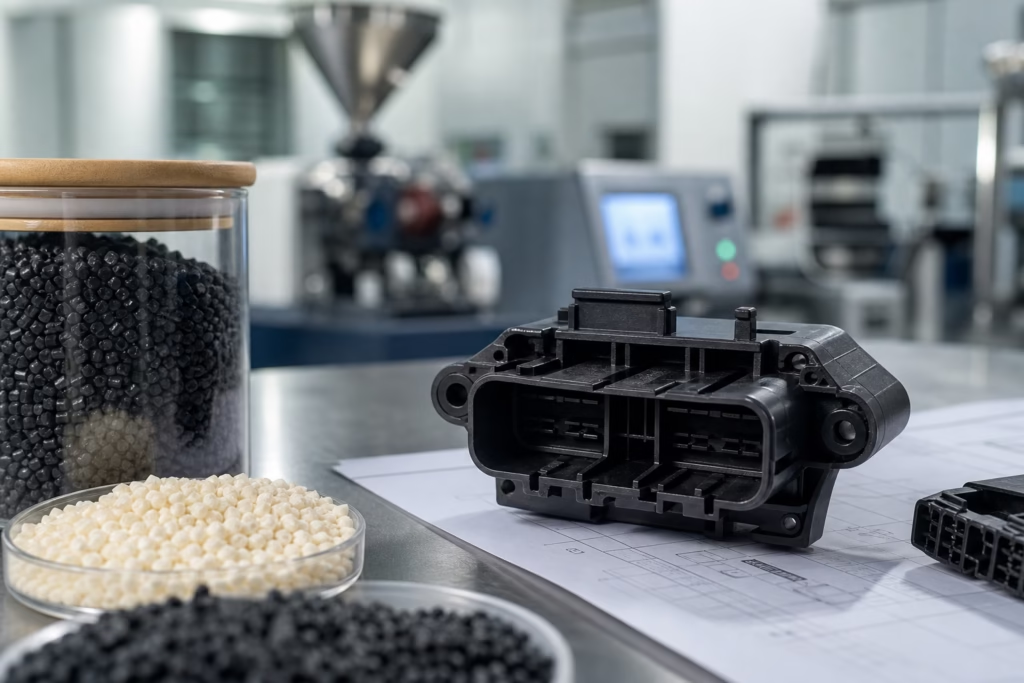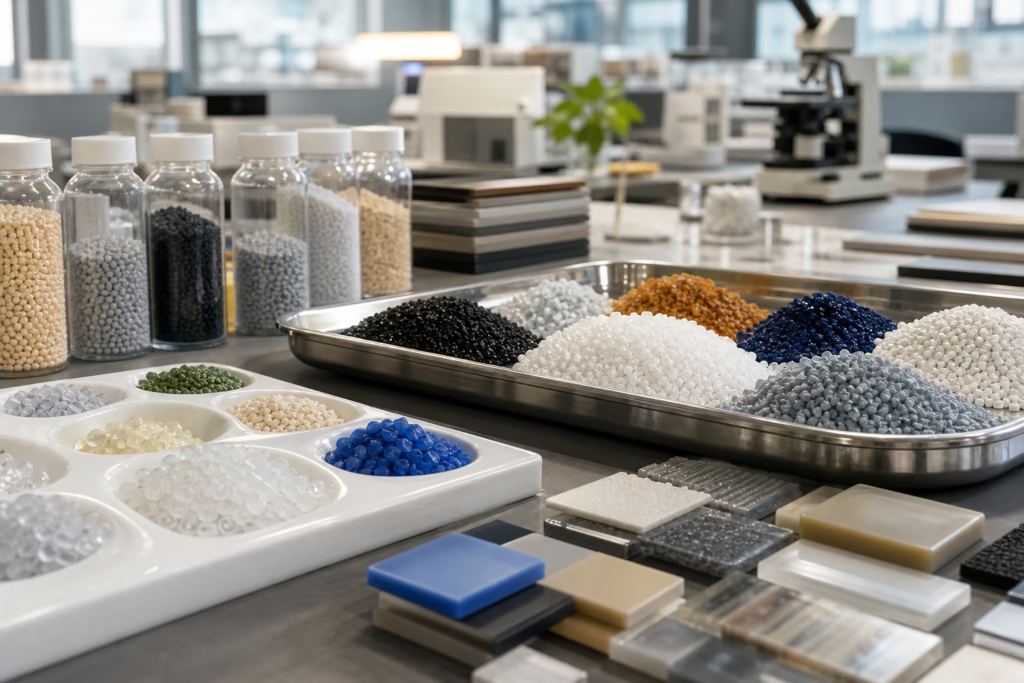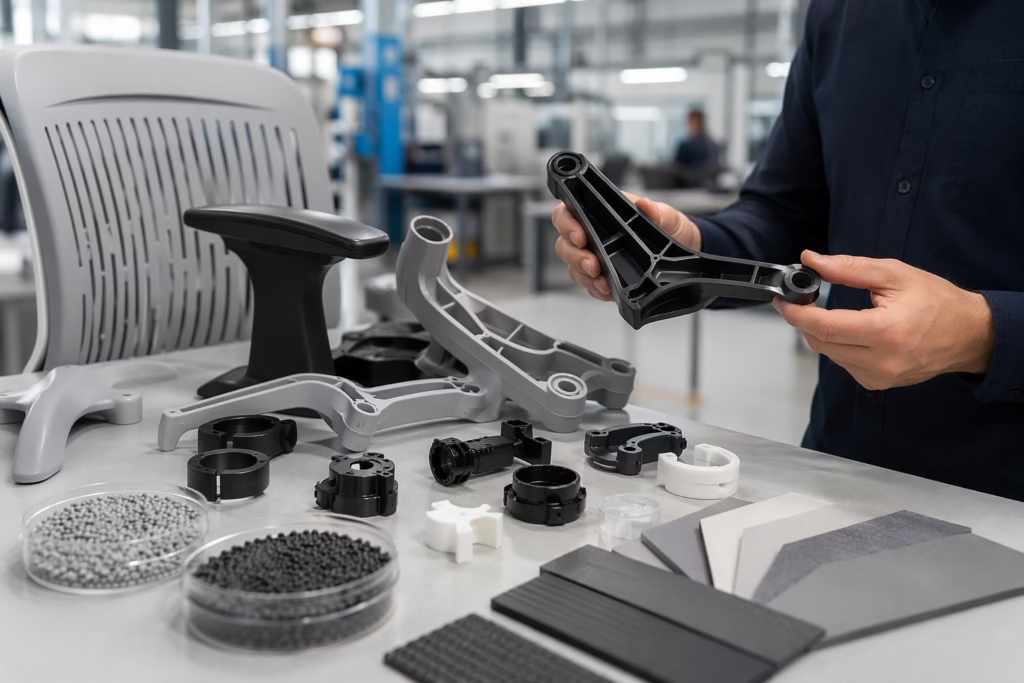
Choosing an automotive plastic compound by part category is usually safer than starting with one universal material standard. A structural bracket, a connector housing, and an interior trim bezel may all sit inside the same vehicle, but they fail for different reasons, age under different conditions, and demand different property balances. When buyers and engineers treat them as if they need the same resin, the result is often over-specification in one area and hidden risk in another. From our material development experience, the right answer starts with the part function, then moves to load, heat, electrical, appearance, and processing constraints.
application-focused polymer material support is especially useful when a project contains mixed part requirements, because a vehicle program rarely needs one compound for everything. At Poly Maro, we typically help teams compare load-bearing needs, flame-retardancy targets, dimensional stability, surface quality, and moldability before they decide whether they need a reinforced structural grade, a connector-grade compound, or an interior-focused formulation. That approach reduces sampling cycles, avoids mismatched expectations, and makes it easier to align material choice with production reality.
Why part type should drive automotive plastic compound selection
The phrase “automotive grade” sounds useful, but it is too broad to make a safe material decision on its own. Two parts in the same assembly can have completely different performance priorities. A support rib may need stiffness and creep resistance. A connector housing may need insulation, flame retardancy, and precise dimensional control. A visible interior part may need low odor, good surface appearance, and color stability. If one compound is forced to serve all three roles, the part will usually inherit compromise where it matters most.
A better method is to rank requirements in the order the part experiences them in service and in manufacturing. First ask what the part must survive in the field. Then ask what the mold, tooling, assembly line, and downstream process can tolerate. Finally, check whether the selected grade can be supplied with consistent batch behavior, realistic MOQ, and a processing window that fits the plant. This is the practical logic behind selecting an automotive plastic compound by part type rather than by resin family alone.
Three common part categories with different material standards
| Part category | Main performance priorities | Common material direction | Main risk if under-selected |
|---|---|---|---|
| Structural parts | Strength, stiffness, heat resistance, creep control, warpage control | Reinforced engineering plastics, heat-stabilized compounds, impact-modified grades | Deformation, fatigue, poor assembly fit |
| Connectors | Flame retardancy, electrical insulation, CTI, precision, low flash | FR PBT, FR PA66, specialty connector compounds | Tracking, shorting, burn risk, poor terminal fit |
| Interior components | Appearance, odor, touch feel, scratch resistance, color stability | PC/ABS, modified PP, FR or non-FR interior grades | Visible defects, odor complaints, poor texture match |
This framework keeps teams from overvaluing resin names and undervaluing end-use function. It also makes supplier comparison more accurate, because the same resin family can be customized in very different ways.
Structural parts: prioritize load, heat, and dimensional stability
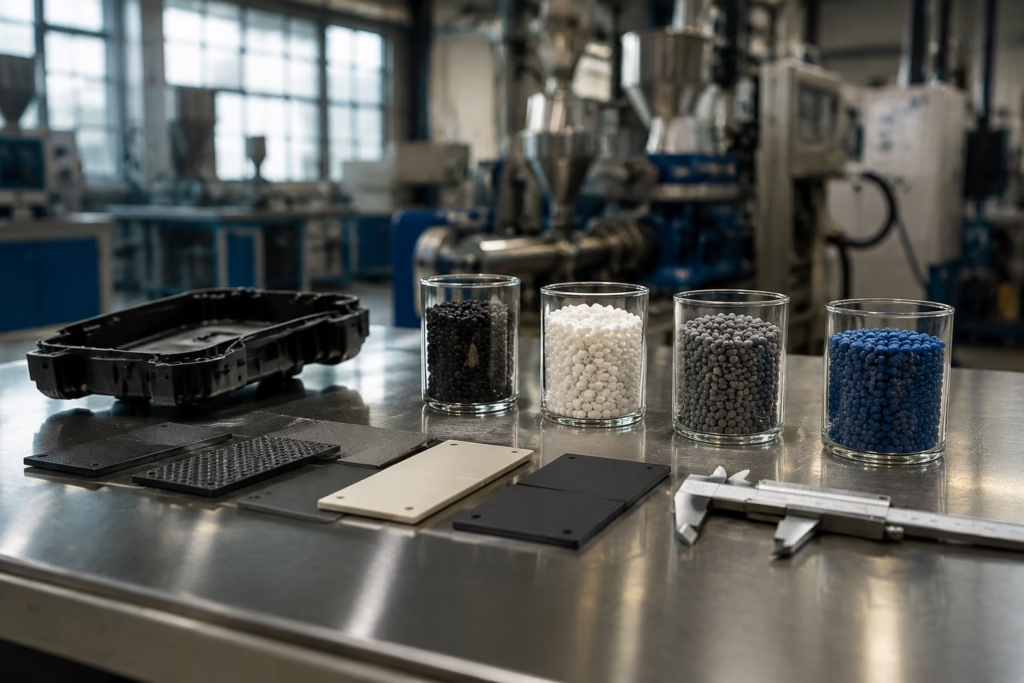
Structural automotive parts include brackets, mounts, clips with load duty, housings with fastening stress, under-dash supports, and other components that experience repeated force or long-term stress. These parts are not judged mainly by appearance. They are judged by whether they keep their shape, remain secure, and support assembly over time. In this category, stiffness, tensile performance, creep resistance, thermal stability, and shrinkage control become the core decision criteria.
For many structural applications, reinforced engineering plastics are the first place to look. Glass fiber reinforcement can significantly raise modulus and reduce creep, but it also increases anisotropy and may raise warp risk if the mold or gate design is not well matched. Mineral-filled compounds can improve dimensional stability and reduce shrinkage more uniformly than high glass loading in some geometries, though at the cost of lower impact performance. Impact modification can help where clips or snap features must survive assembly abuse, but it should be balanced carefully against stiffness loss.
When a structural part must carry load and still maintain heat resistance, a stronger engineering resin route is often more suitable than a general-purpose resin. For example, our PA66 engineering resin solutions for stronger structural components are often considered when the part needs a better balance of rigidity, thermal endurance, and mechanical retention than commodity plastics can provide. Even then, the final selection depends on wall thickness, weld-line location, undercut geometry, and how much moisture the part will absorb in service.
Key structural-part trade-offs
- Glass fiber reinforcement: improves stiffness and heat performance, but may increase warp and surface fiber read-through.
- Impact modification: helps assembly robustness, but may reduce modulus and heat resistance.
- Heat stabilization: supports long-term performance near warm engine-adjacent zones, but can raise cost.
- Mineral filling: can help shrinkage control and flatness, but may reduce toughness if overused.
For structural parts, we usually ask whether the part is load-bearing, semi-structural, or only dimensionally important. That distinction changes the compound design. A heavy ribbed bracket may justify a high-glass engineering compound. A decorative support piece may need a lower-fiber grade with better surface and processing stability. The right answer is not the highest-performance resin; it is the most suitable balance of performance and manufacturability.
Connectors: electrical reliability, flame retardancy, and precision come first
Connector parts are a different world. Their job is to hold terminals in place, preserve electrical insulation, resist heat from current or nearby components, and keep dimensional tolerances tight enough for mating and assembly. A connector may be small, but its failure mode is serious. If the housing tracks, deforms, cracks, or flashes excessively, the electrical system becomes less reliable even if the resin looked acceptable on a datasheet.
For this category, flame retardancy is often part of the specification, but it should not be evaluated alone. Electrical performance, dimensional precision, flow into thin walls, post-molding stability, and compatibility with overmolding or reflow-adjacent thermal exposure may all matter. That is why connector programs benefit from a formulation designed for electrical parts rather than a generic high-strength grade. In many cases, a compound with controlled shrinkage and clean mold release is just as important as its mechanical numbers.
When a project needs a connector-focused material route, our PBT material paths for electrical and connector parts are often evaluated for balance between insulation behavior, processability, and dimensional consistency. Depending on the connector design, PA66, PBT, or a specialty blend may be appropriate, but the choice should follow the part’s electrical, thermal, and molding requirements rather than a habit from a previous program.
Flame-retardant systems deserve special attention because they can influence flow, color, mechanical retention, and mold cleanliness. A compound that passes a flammability target in testing may still create trouble if it flashes, warps, or leaves terminal fit unstable. In connector work, the compound should be assessed as part of the entire part-and-process system, not as a lab property in isolation.
UL 94 plastic flammability classifications are frequently used as a reference point when teams discuss flame-retardant requirements for electrical and interior components. The practical lesson for buyers is that a flame-retardancy label alone does not complete the material decision; the grade still needs to meet dimensional, electrical, and processing expectations in the actual connector design.
What connector buyers should compare
| Comparison point | Why it matters | What can go wrong |
|---|---|---|
| Flame-retardant system | Supports safety and compliance targets | Excessive brittleness, poor mold release, unstable color |
| CTI and insulation behavior | Helps manage tracking and electrical reliability | Surface tracking, leakage risk |
| Dimensional precision | Controls terminal fit and assembly | Loose fit, insertion force issues, misalignment |
| Thin-wall flow | Allows cavity filling in compact connector designs | Short shots, weld-line weakness, flash |
For purchasing teams, it is wise to request sample parts, not only pellets, when connector geometry is tight. A resin can look fine in a general datasheet and still behave poorly in a thin-wall mold with high gate shear or sensitive terminal retention features.
Interior components: appearance, odor, and user experience lead the ranking
Interior components often receive too much engineering attention on strength and too little on customer perception. Yet in a cabin environment, the user sees, touches, and smells the part every day. Dash trim, bezels, pillar parts, vents, decorative covers, switches, and visible housings need a different material standard from load-bearing or electrical parts. Here, surface quality, texture consistency, low odor, color stability, scratch resistance, and dimensional fit matter as much as any mechanical number.
The right compound for an interior part depends on whether it is hidden, semi-visible, or fully visible. A hidden support inside the dashboard can tolerate different surface trade-offs than a visible bezel next to a soft-touch panel. Some parts need paint or coating compatibility; others need natural color stability and a texture that holds well after molding. If a grade has excellent strength but poor surface appearance, it may be the wrong choice for the cabin even if it works perfectly in a structural bracket.
In interior programs, our flame-retardant plastic compound options for automotive interiors and connectors may be relevant when the part needs both cabin safety performance and a surface acceptable for visible use. The exact formulation depends on whether the priority is low odor, paintability, hardness, or thermal resistance. Interior teams often find that appearance consistency is not a secondary issue; it is the main product acceptance criterion.
Interior selection priorities by visible level
- Hidden interior parts: prioritize cost-performance, stability, and processability.
- Semi-visible parts: prioritize color consistency, moderate scratch resistance, and assembly fit.
- Visible parts: prioritize appearance, texture reproduction, low odor, and aging behavior.
PC/ABS is often considered when impact, appearance, and moldability must coexist. PP-based interiors may be suitable when cost and weight are key, but they typically need careful modification if stiffness, scratch performance, or heat resistance must be improved. The right material route depends on the actual zone in the cabin, the expected touch frequency, and the required surface finish after molding.
How to compare materials by performance priority, not resin name
Many sourcing teams start by asking whether they should choose PA66, PBT, PC/ABS, or PP. That is understandable, but it can create the wrong hierarchy. The first question should be what the part needs to do. Only then should the resin family be selected. Two compounds from the same resin family can behave very differently if one is reinforced, flame-retarded, impact-modified, or heat-stabilized.
A practical comparison method is to rank the part’s top three priorities and the top two risks. For example, a structural bracket may rank stiffness, warp control, and heat resistance as the top three priorities, while a connector may rank flame retardancy, insulation, and tolerance control. An interior bezel may rank appearance, odor, and scratch resistance. Once that ranking is clear, the resin family becomes easier to narrow down.
| Part type | Top priorities | Common resin logic | Why it wins |
|---|---|---|---|
| Structural | Stiffness, creep resistance, thermal stability | PA66, reinforced PP, mineral-filled or heat-stabilized engineering compounds | Supports load and long-term dimensional control |
| Connector | Flame retardancy, insulation, precision | PBT, PA66, FR specialty blends | Supports electrical reliability and fine geometry |
| Interior | Appearance, odor, scratch resistance | PC/ABS, modified PP, specialty interior compounds | Balances visual quality and manufacturability |
Because we are a manufacturer, we often encourage customers to compare compounds using part drawings, target wall thickness, assembly temperature, and expected loading profile, not just a property table. That gives a more accurate answer than name-based selection and helps prevent late-stage tooling changes.
PC/ABS resin options for balanced impact and heat performance are a good example of why resin-family thinking is not enough on its own. The same PC/ABS family can be tuned toward better heat resistance, better impact, or better flow, and the right choice depends on whether the part is a visible interior part, a housing, or a moderately loaded assembly.
Compound design choices that shift performance
Once the resin family is chosen, compound design determines whether the material really fits the part. The same base polymer can be modified in many directions. Glass fiber can lift stiffness. Mineral filler can improve dimensional stability. Flame-retardant packages can support electrical or cabin requirements. Impact modifiers can prevent brittle failure. Heat stabilizers can help retention after thermal exposure. The challenge is not choosing all of them; it is balancing them without undermining the part’s primary goal.
For structural parts, reinforcement usually matters more than flame retardancy unless the part sits near hot or regulated zones. For connectors, flame-retardant chemistry and precision often outweigh maximum stiffness. For interior parts, visible quality and odor can override a small gain in heat or impact. Every additive choice creates a trade-off in flow, shrinkage, color, or cost.
- Glass fiber reinforcement: best for stiffness and heat, but watch for warp, anisotropy, and surface fiber visibility.
- Mineral filling: useful for shrinkage balance and flatter parts, but may reduce impact resistance.
- Impact modification: improves toughness and snap-fit durability, but can soften the feel or reduce heat margin.
- Heat stabilization: supports durability in warm service zones, but should be matched to the resin family.
- Flame-retardant systems: critical for electrical and selected interior applications, but may affect viscosity and cleanliness.
For buyers, the key is to ask not “Is this resin strong?” but “What was added to this resin, and what trade-off did that create?” A compound should be evaluated as a design solution, not as a raw polymer label.
Processing requirements change by part type
Material selection does not end at the datasheet. The part type also changes how the compound must be processed. Structural parts with thick ribs may be sensitive to sink, warp, and differential cooling. Connectors may need narrow molding windows and extremely clean cavity filling. Interior parts may be more visible to flow marks, gloss variation, and color shift. A compound that is theoretically suitable can still fail if drying, temperature, pressure, or cycle control is poor.
Hygroscopic materials such as PA and PBT require controlled drying before molding, and moisture sensitivity can change both surface and mechanical behavior. This is one reason why material selection and processing discipline must be reviewed together. For readers who want a deeper technical refresher on moisture behavior in engineering plastics, water absorption and drying behavior of engineering plastics is a useful reference point for understanding how absorbed moisture affects molding consistency and dimensional stability.
Drying matters because a compound can arrive in good condition and still be damaged by poor pre-processing. PA66 or PBT that is not dried properly may show splay, hydrolysis-related property loss, or unstable dimensions. Interior PC/ABS may be less moisture-sensitive than polyamides, but it still needs the right melt and mold conditions to preserve gloss and surface quality. In practice, processing instructions are part of the material specification, not an afterthought.
Processing checkpoints by part type
| Checkpoint | Structural parts | Connectors | Interior components |
|---|---|---|---|
| Drying discipline | Important for hygroscopic compounds | Critical for dimensional and electrical consistency | Important for surface quality and low defects |
| Flowability | Must fill ribbed or thick sections evenly | Must fill thin walls cleanly | Must support cosmetic surfaces |
| Shrinkage control | Very important for fit and warp | Critical for terminal alignment | Important for trim fit and visible gaps |
| Surface finish | Secondary unless exposed | Functional, but flash must be minimized | Primary quality criterion |
Validation checklist before mass production
Sample approval should never stop at a good-looking pellet or a successful short-shot trial. Automotive material validation should connect lab results with the actual part, mold, and assembly process. Before mass production, the team should confirm whether the compound performs in the same way under realistic cycle time, tooling, and environmental conditions.
- Mechanical testing: check tensile, flexural, and impact behavior against the part’s real load path.
- Thermal testing: verify heat deflection and retention under expected service temperatures.
- Electrical testing: confirm insulation, CTI, or related requirements for connectors and electrical zones.
- Aging resistance: evaluate heat aging, humidity, and possible chemical exposure relevant to the vehicle environment.
- Assembly fit: confirm mating, snap-fit, torque, and insertion force under production-like conditions.
- Dimensional verification: measure shrinkage, warp, and tolerance drift across sample lots.
One of the most common mistakes in automotive material sourcing is to approve a grade from a data sheet and a small molded coupon, then assume the production part will behave the same way. That assumption is risky. Real parts have ribs, bosses, weld lines, gate effects, and cooling gradients. The sample must prove the design intent in the actual geometry, not only in a generic test piece.
Common sourcing mistakes to avoid
We often see the same sourcing errors repeat across programs. The first is using one grade across unrelated part types because procurement wants to simplify supply. That may reduce complexity on paper, but it often increases technical risk. The second is ignoring processing constraints, especially drying and mold temperature. The third is assuming a sample lot fully represents mass-production consistency. The fourth is selecting a material for one target property and forgetting the trade-offs created by reinforcement or flame-retardant additives.
Another frequent issue is undervaluing the difference between a good laboratory result and a good production window. A compound with excellent test numbers may still be difficult to mold at stable cycle time. When that happens, defect rates rise and quality becomes harder to hold. For automotive programs, stable processability is part of the material value, not a separate manufacturing problem.
Supplier evaluation and procurement questions
When comparing suppliers, ask questions that reflect the actual part requirement. Can the supplier show how the compound was tuned for the specific part category? Can they explain what changed in stiffness, impact, flame retardancy, odor, or shrinkage after modification? Can they support sample iterations, documentation, and production scale-up? Can they hold consistency across lots? These are better questions than simply asking for a resin name and a price.
At Poly Maro, we usually treat automotive compound development as a fit-for-part exercise. That means understanding the geometry, environment, and assembly process before recommending a formulation direction. The same logic applies whether the project needs a reinforced structural grade, a connector-grade flame-retardant resin, or an interior material with a better surface profile. When the team aligns material choice with part function early, the project tends to move faster and with fewer surprises.
custom plastic compound development for part-specific requirements becomes valuable when none of the standard grades fully matches the part. In those cases, the best path is often a controlled modification plan with clear targets for property balance, processing behavior, and production consistency.
Conclusion
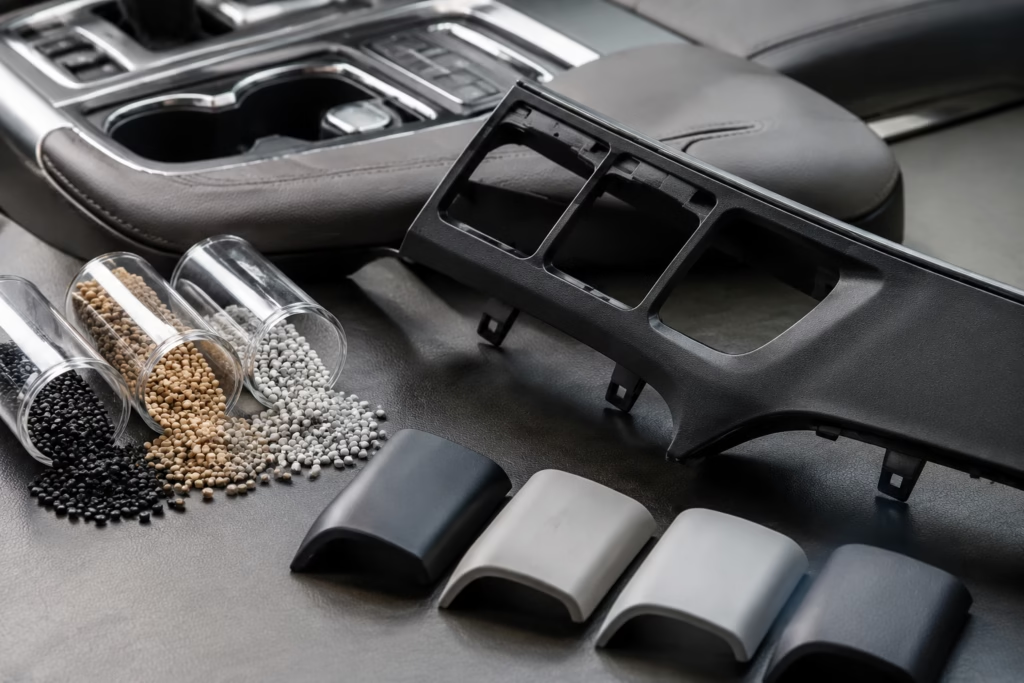
Automotive material selection is safer when it starts with the part, not with a generic standard. Structural parts need strength, stiffness, and dimensional stability. Connectors need precision, electrical reliability, and flame-retardant control. Interior parts need appearance, odor management, and long-term visual consistency. Once the category is clear, the compound design, processing window, and validation plan become much easier to define.
That is the core logic behind a practical automotive plastic compound decision: match the compound to the part’s real job, then verify it in real production conditions before scale-up. When buyers, engineers, and suppliers use that approach together, they reduce rework, improve launch confidence, and choose materials that are more likely to succeed in the vehicle, not just on paper.
FAQs
Can one automotive plastic compound be used for structural parts, connectors, and interior parts?
It is usually not a good idea. The three part groups have different priorities, so one compound will almost always force a compromise. Structural parts need stiffness and creep resistance, connectors need electrical and flame-retardant performance, and interior parts need appearance and odor control. A single grade may work only when the requirements are very mild.
Which property matters most for connector materials?
Flame retardancy is important, but it is not the only key property. Connector materials also need good insulation, dimensional precision, stable shrinkage, and reliable thin-wall flow. If one of those areas is weak, the connector may fit poorly or lose reliability even if it meets a flammability target.
Why do reinforced compounds often warp more?
Reinforced compounds, especially glass-filled grades, are more anisotropic than unfilled materials. Fiber orientation can make shrinkage different in flow and cross-flow directions, which increases warp risk. Good mold design, gate placement, cooling balance, and material choice are all needed to control that effect.
What should buyers check before approving an automotive plastic compound?
Buyers should check mechanical performance, thermal resistance, electrical requirements if relevant, processing behavior, dimensional stability, and appearance under production-like conditions. It is also wise to verify drying instructions, sample consistency, and whether the supplier can support scale-up without changing the compound behavior.
Is PC/ABS always better for interior automotive parts?
No. PC/ABS is useful when impact and appearance must be balanced, but it is not automatically the best choice for every interior part. Some visible parts need different scratch, heat, or cost performance. The best choice depends on the exact location in the cabin, the load, and the surface requirement.
How can a supplier support part-specific automotive compound development?
A capable supplier should ask for the part drawing, target properties, processing conditions, and production constraints before recommending a grade. They should also support sample tuning, explain trade-offs clearly, and help confirm that the material behaves consistently from trial to mass production. That is especially important when the project needs a custom formulation rather than a standard resin.