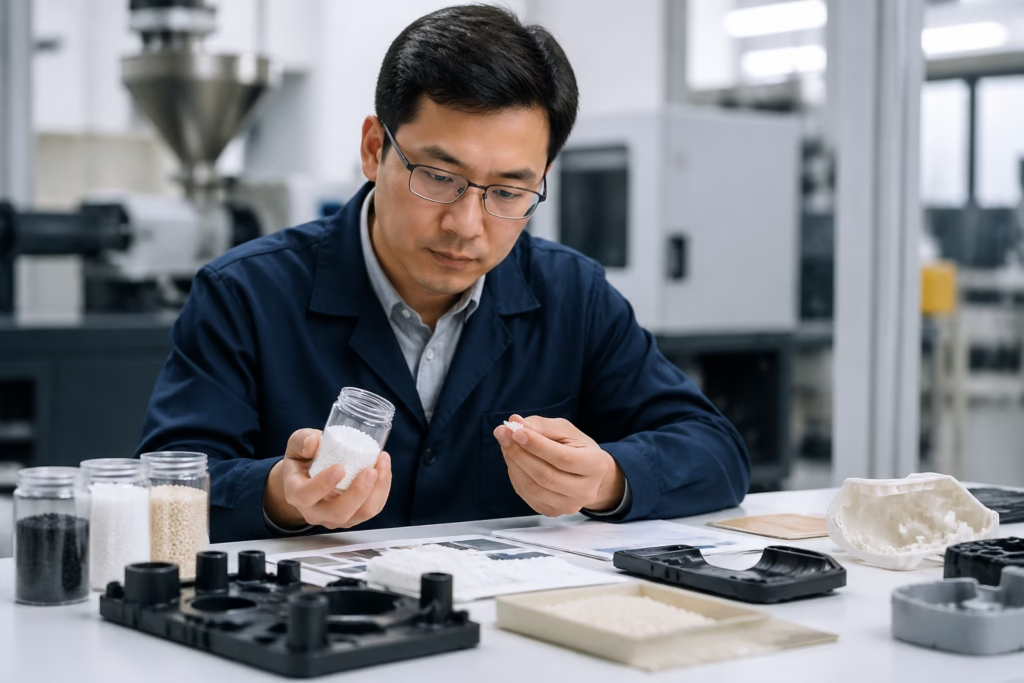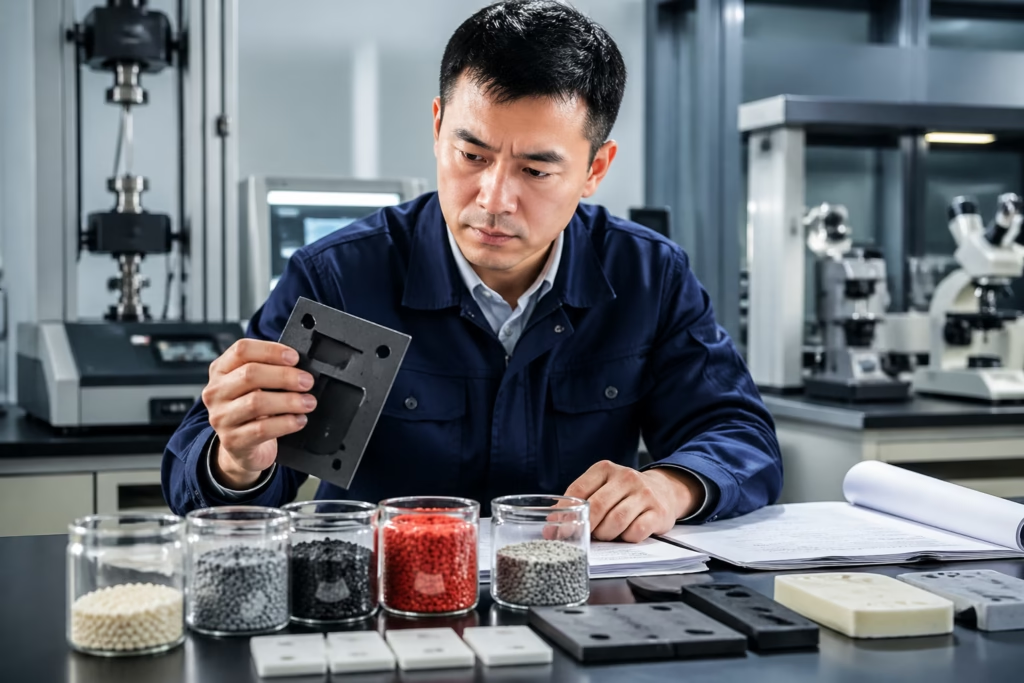
Judging chemical resistance is rarely as simple as checking whether a plastic survives a liquid in a chart. In real plants, parts face mixed media, temperature swings, mechanical load, and long exposure times, which is why the same resin can look fine in a lab and fail in service. When engineers evaluate chemical resistant plastic compound options early, they reduce the chance of swelling, cracking, softening, and stress-related failure later.
For application-driven selection, the most useful starting point is often engineering plastic applications, because the right material choice depends on both the chemical and the part’s job in the system.
What chemical failure looks like in service
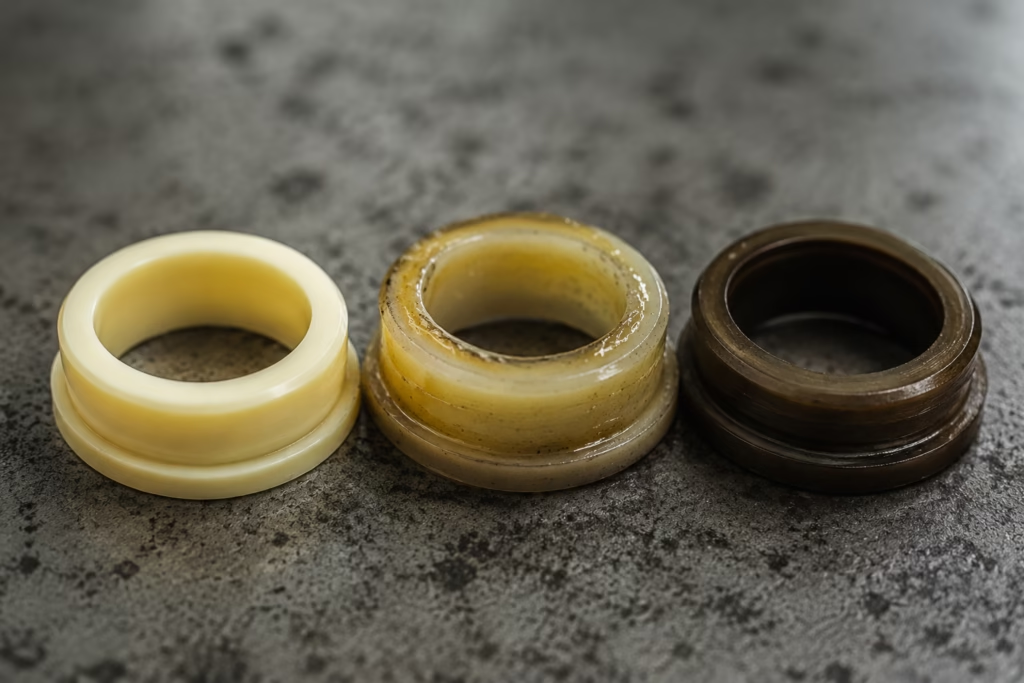
Chemical attack is not always dramatic. A part may keep its shape at first while quietly losing mechanical reliability. Common signs include swelling, surface haze, softening, discoloration, embrittlement, loss of dimensional accuracy, and cracking near stress points.
These symptoms matter because a component can remain visually acceptable while its tensile strength, impact resistance, or sealing performance is already falling. In housings, fluid-contact parts, and precision components, that hidden loss often creates the real failure event.
Why visible damage is only part of the story
Some chemicals remove plasticizers, extract additives, or create microcracks before the part ever breaks. Others attack the polymer slowly, so the part may hold under low load but fail when clamped, threaded, or exposed to vibration.
That is why a material judgment should consider not only whether the plastic “survives,” but whether it still performs after exposure. This distinction becomes especially important when selecting a compound for pumps, valves, covers, connectors, and industrial enclosures.
Why plastics fail in oil, cleaners, and industrial media

Failure usually comes from one or more interaction mechanisms. Oils may cause swelling or additive extraction. Cleaners and detergents can promote stress cracking or surface damage. Solvents often penetrate more aggressively and may soften amorphous materials faster than expected.
Industrial media can also vary by formulation, so two fluids with the same name may not behave the same way. A lubricant package, a coolant blend, or a cleaning chemical can shift compatibility depending on temperature, concentration, and time.
When a project needs a tighter selection process, technical support for material selection helps translate media conditions into a more realistic resin choice, especially where one material family alone is unlikely to cover every requirement.
Stress makes chemical damage worse
Many plastics do not fail because of chemistry alone. They fail when chemical exposure combines with load, molded-in stress, sharp corners, threaded joints, or assembly force. This combination can trigger environmental stress cracking even when the fluid concentration is not especially high.
For that reason, a part that passes a simple immersion test may still fail in the field if it carries torque, pressure, or continuous strain.
Different media create different risk patterns
Oils, fuels, solvents, detergents, acids, alkalis, coolants, lubricants, and process fluids each create different material risks. Oils often challenge dimensional stability and long-term toughness. Fuels can be more aggressive toward certain plastics and may also carry additives that complicate the interaction.
Cleaners and detergents are often underestimated because they may look mild, yet some formulations are highly effective at stress-crack initiation. Acids and alkalis can be severe, but their impact depends strongly on concentration, temperature, and exposure time.
| Media type | Typical risk | Selection caution |
|---|---|---|
| Oils and lubricants | Swelling, softening, additive extraction | Check long-term dimensional stability |
| Cleaners and detergents | Stress cracking, haze, surface damage | Test under load, not just immersion |
| Solvents | Rapid softening or cracking | Confirm exposure concentration and time |
| Acids and alkalis | Surface attack, embrittlement, property loss | Account for temperature and concentration |
| Coolants and process fluids | Gradual swelling, additive interaction | Review full formulation, not just base fluid |
How to judge chemical resistance correctly
Judging compatibility starts with the actual exposure conditions, not the chemical name alone. The right questions are: what is the exact medium, what is its concentration, what is the maximum temperature, how long is the exposure, and will the part be under stress during service?
For example, a part exposed for minutes during cleaning behaves differently from a part immersed continuously for months. A material that tolerates brief contact may still fail in a reservoir, sealing ring, or line component if the exposure is constant.
Poly Maro often approaches this as a system question rather than a single-resin question, because a chemical resistant plastic compound may need adjustment in base resin, reinforcement, filler package, or stabilizer package to fit the real use environment.
When requirements are strict, custom plastic compound solutions can help align chemical resistance with the part’s mechanical and processing needs instead of forcing a standard grade to do everything.
Why concentration and temperature matter so much
Many chemicals become more aggressive as temperature rises. Higher temperature can accelerate diffusion into the polymer, speed up additive extraction, and reduce the margin between acceptable performance and failure.
Concentration also changes risk. A diluted cleaner may be manageable, while a concentrated version of the same chemistry can trigger swelling or cracking much faster.
How to compare a chemical resistant plastic compound with standard plastics
Standard plastics may work when exposure is short, mild, or secondary to the part’s main function. A chemical resistant plastic compound becomes more valuable when the medium is continuous, the part is structurally loaded, or failure would stop the system.
In practice, the comparison should not be “which resin is strongest.” It should be “which resin keeps enough strength, shape, and surface integrity after contact with the actual medium.” That means looking at absorption behavior, stress-crack sensitivity, heat deflection, creep resistance, and expected aging.
For demanding media environments, PPS compounds for harsh media are often considered because PPS is known for maintaining stability in challenging chemical and thermal conditions, especially where stiffness and dimensional control matter.
How engineering trade-offs show up
A more chemically resistant material may be less impact-tolerant, more expensive, or harder to process. A filled compound may improve stiffness and chemical stability in one area while increasing brittleness or reducing weld-line strength in another. Selection is always a balance.
That balance is why part geometry, assembly method, and expected load must be part of the same conversation as the chemical exposure itself.
Common engineering plastics and their strengths and limits
Different resin families bring different strengths in harsh media. PA-based materials may be useful for some mechanical applications but can absorb moisture and change dimensions. POM can offer good wear behavior in some environments but is not universal for aggressive chemicals. PPS is often chosen for demanding chemical and thermal exposure, but it still needs confirmation against the exact medium.
PA12 is often evaluated when lower moisture absorption and better dimensional stability are important than in some other polyamides. In fluid-contact or under-the-hood style conditions, PA12 material options are frequently reviewed because the resin can offer a useful balance of toughness, processability, and environmental stability depending on the design.
Why “chemical resistance” is not one single property
A material can resist one fluid well and fail in another. It may handle oils but not strong oxidizers, or tolerate cleaning agents but suffer in hot alkali. This is why a general label like “resistant” is never enough for final approval.
Instead, you need to judge whether the material resists the exact media set, at the right temperature, with the right stress level, for the required service life.
How to use compatibility charts without over-trusting them
Compatibility charts are useful for narrowing options, but they are not a substitute for application validation. They usually simplify the problem into broad ratings, which can hide the effect of temperature, stress, exposure duration, and formulation differences.
A chart can help screen out clearly unsuitable candidates, but it cannot tell you whether a molded housing with ribs and screw bosses will survive a specific cleaner after six months of cyclic use. That last step needs testing.
When a project needs material-development input rather than just a rating lookup, PA12 material options or other engineered compounds may be reviewed alongside reinforcement and additive choices to match the real operating window more closely.
Selection factors beyond chemical resistance
Chemical resistance matters most when it is paired with the rest of the design requirements. Temperature may affect both chemical attack and creep. Pressure can increase permeation or leak risk. Load can amplify stress cracking. Sealing needs can expose hidden weaknesses in surface finish or dimensional stability.
Long-term aging also deserves attention. A part that performs in the first week may still fail later as the polymer slowly changes. That is especially important for components that must hold tight tolerances or maintain sealing force over time.
For parts that need a tailored mix of chemical, mechanical, and processing behavior, custom plastic compound solutions can be more practical than forcing a generic grade into a high-risk environment.
Mechanical load and creep are often the hidden limit
Many chemical failures begin as mechanical failures. If a plastic part creeps under load while also being exposed to oil, coolant, or cleaner, the combined effect can be much worse than either factor alone.
This is why engineers should test the part in its loaded state whenever possible, especially for clips, housings, threaded parts, seals, and structural supports.
Recommended testing methods for real applications
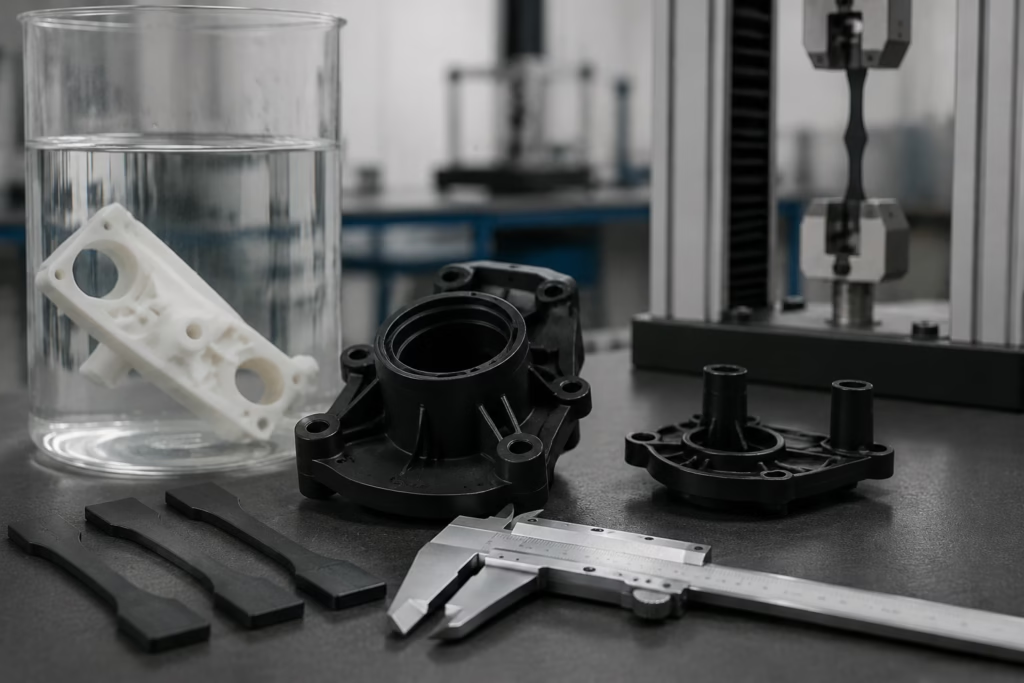
Useful evaluation usually includes more than one test method. Immersion tests show basic compatibility. Stress-crack tests help reveal susceptibility under load. Accelerated aging can expose early property loss, but it should be interpreted carefully because aggressive acceleration can distort the result.
Real-condition validation is the most valuable step because it mirrors actual use. That means using the true chemical formulation, service temperature, part geometry, and assembly stress where practical.
When the operating window is especially demanding, it can be helpful to combine lab screening with material development input from a manufacturer rather than relying on a published chart alone.
What a practical test plan should include
A solid test plan should define the medium, concentration, temperature, duration, and load condition. It should also define what failure looks like: swelling beyond a limit, cracking, hardness change, loss of tensile performance, or leakage.
Without a pass/fail definition, test results can become subjective and difficult to compare across material candidates.
How to build a practical test plan for industrial parts
Start with the real chemical, not a substitute. Then test the part in the same geometry, or as close as possible. Include a baseline measurement before exposure, then remeasure after exposure for mass change, dimensional change, hardness, and visible surface damage.
If the component is load-bearing, test it under load or after assembly. If the component seals a fluid, test it with the actual sealing interface and torque condition. If the part sees repeated cleaning, include multiple exposure cycles rather than a single soak.
That approach is often more predictive than a simple pass/fail result from a generic coupon test.
Common mistakes in judging chemical resistance
One common mistake is treating every fluid by its family name only. Another is ignoring temperature or assuming room-temperature compatibility will hold in hot service. A third is overlooking load, which often turns a borderline material into a failure risk.
It is also easy to over-trust a single data point. One short immersion test or one chart entry does not prove suitability for a long-life industrial part. The safer approach is to combine screening, mechanical review, and validation testing.
For readers comparing resin families, PPS compounds for harsh media can serve as one benchmark for demanding environments, especially when the failure mode involves both heat and aggressive media.
How to avoid premature failure
Design out stress concentration where possible. Reduce sharp corners, review fastener loads, and check wall thickness transitions. If the material is borderline, reconsider the whole system rather than relying on a coating or sealant to compensate.
In many cases, a small change in geometry or a different compound can extend service life more effectively than simply increasing thickness.
Selection checklist for harsh media environments
Choose a chemical resistant plastic compound when the part is exposed to a defined medium, the exposure is repeatable or long-term, and failure would create downtime, leakage, or safety risk. Prefer a more specialized compound when the medium is hot, concentrated, mixed, or combined with mechanical stress.
Switch materials when the standard resin loses too much strength, swells beyond tolerance, or becomes unstable in the real service environment. If the part also needs controlled moisture uptake, toughness, or dimensional stability, the final choice should reflect those priorities too.
When the selection question is still open, technical support for material selection can help narrow the field before testing begins, which saves time and reduces trial-and-error on the production side.
Conclusion
Judging chemical resistance correctly is less about memorizing compatibility rankings and more about matching the material to the real use case. The best decision process considers the actual medium, its concentration, temperature, exposure duration, mechanical stress, and the part’s long-term performance target.
If you evaluate a chemical resistant plastic compound in that structured way, you can reduce hidden failure risk and choose materials with a much better chance of surviving in oil, cleaners, and industrial media.
FAQ
What is the most important factor in chemical resistance?
The most important factor is the exact combination of chemical, concentration, temperature, exposure time, and mechanical stress. A material that performs well in one condition may fail in another.
Why do plastics crack after contact with cleaners?
Many cleaners create stress cracking rather than simple surface attack. If the part is under load or has molded-in stress, the cleaner can accelerate crack growth even when it looks mild.
Is an immersion test enough to prove compatibility?
No. Immersion tests are useful for screening, but they do not fully represent load, assembly stress, cyclic exposure, or long-term aging in real service.
Which plastics are often considered for harsh media?
Engineers often evaluate PPS, PA12, and some other engineered plastics depending on the medium, temperature, and mechanical requirement. The right answer depends on the application rather than the resin name alone.
Why do compatibility charts sometimes give misleading results?
Charts simplify many variables into broad ratings, so they can miss the effects of heat, stress, formulation changes, and long exposure. They are a starting point, not final proof.
When should a custom compound be considered?
A custom compound is worth considering when a standard grade cannot balance chemical resistance, mechanical performance, processing behavior, and dimensional stability for the actual operating environment.