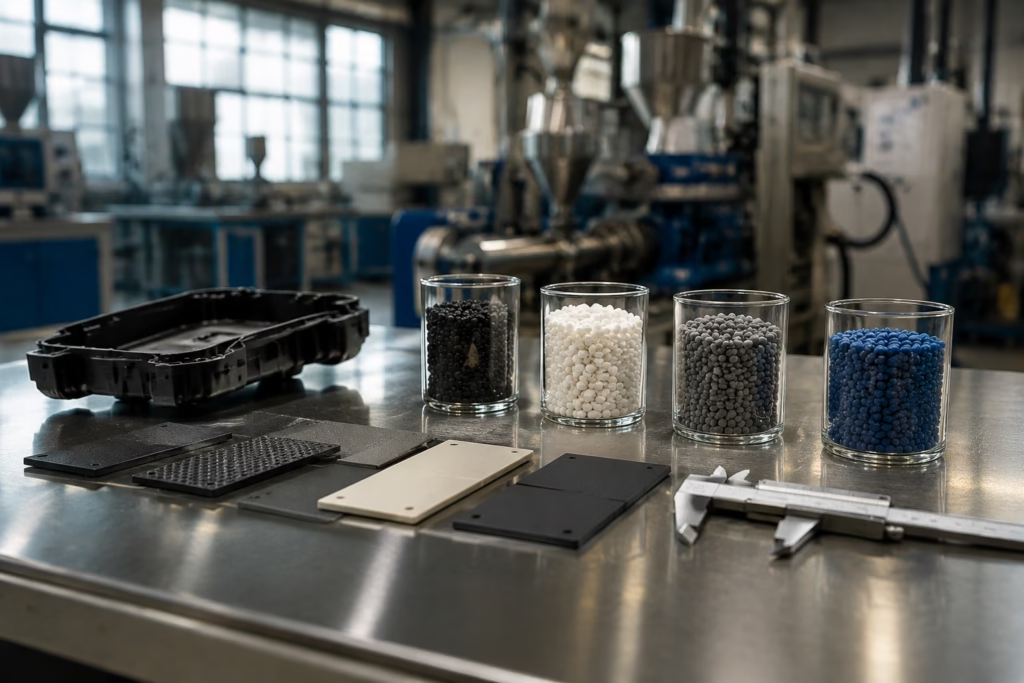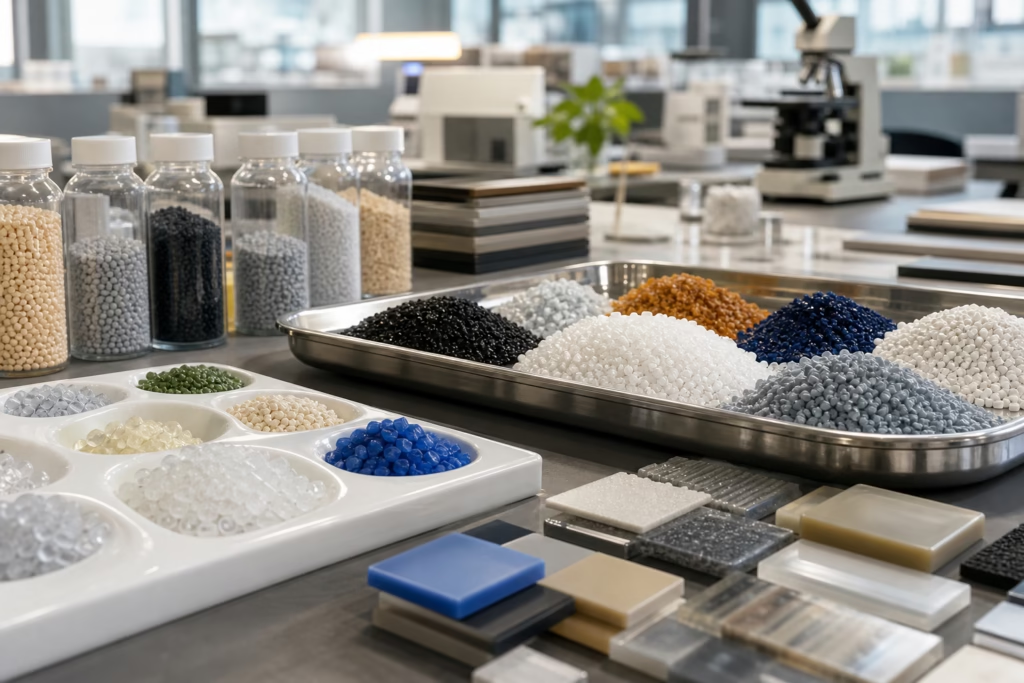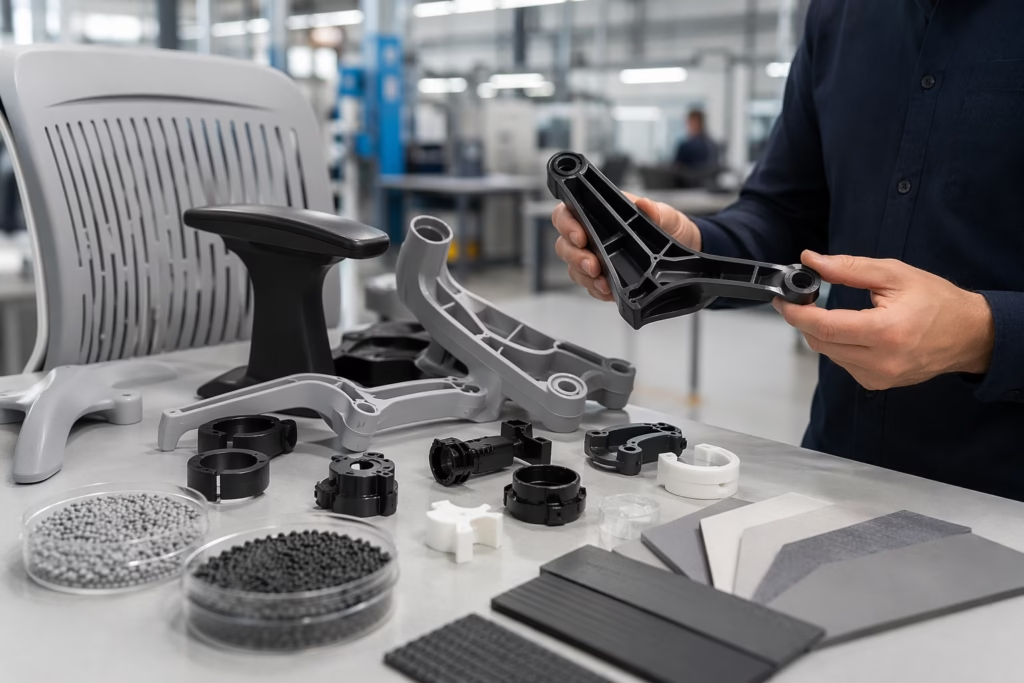
For electrical connectors, connector material selection is rarely about a single property. A resin may pass flame-retardant requirements and still create problems in fit, alignment, or long-term reliability if it warps, absorbs moisture, or changes dimension under heat and humidity. In connector housings, terminals and pins must stay precisely aligned, insulating walls must remain stable, and assembly tolerances must survive molding, storage, shipment, and end-use conditions. That is why we look beyond UL 94 and examine dimensional stability, moisture absorption, electrical performance, and processing consistency together.
When the part is a connector housing, socket, terminal retainer, or precision latch, small changes in shrinkage or moisture behavior can become large production risks. Our application-focused polymer material support approach starts with the end-use environment first, then narrows the resin family, reinforcement level, and modification package. At Poly Maro, we develop and compound plastic pellet solutions for manufacturers who need flame retardancy, low warpage, stable molding behavior, and reliable batch-to-batch performance in mass production.
Why connector material selection must go beyond flame retardancy
Flame retardancy is important because connectors often sit near heat sources, electrical load, or fault-risk areas. But a connector that self-extinguishes after a test does not automatically deliver a stable fit on the line or a durable fit in the field. For designers and procurement teams, the real question is whether the material can support both electrical safety and mechanical precision over time.
In practice, a connector housing has to do several jobs at once: hold metal contacts in the correct position, insulate live conductors, resist deformation during soldering or nearby thermal exposure, and stay consistent through molding and storage. If a material is too moisture-sensitive, it may swell and alter terminal alignment. If it creeps under load, pin retention may weaken. If it warps, assembly force can rise and scrap can increase. Flame retardancy is one requirement, but it is only one piece of a larger selection system.
What electrical connectors need from plastic materials
Electrical connector plastics are usually judged by a combination of thermal, electrical, mechanical, and processing criteria. The housing must provide insulation, dimensional precision, adequate stiffness, impact resistance during assembly, and surface quality that supports automated manufacturing. For many programs, a stable molding window is just as important as the base resin’s published properties.
- Electrical insulation: dielectric strength, volume resistivity, surface resistivity, and tracking resistance.
- Mechanical stability: resistance to warpage, creep, shrinkage variation, and cracking.
- Processing fit: drying sensitivity, flow behavior, mold filling, and demolding stability.
- Environmental durability: heat, humidity, chemicals, vibration, and aging resistance.
For insulation performance, flame tests alone are not enough. Electrical qualification also depends on tracking and insulation behavior under contamination and moisture. UL Solutions’ comparative tracking index (CTI) testing for insulating plastics is one of the clearest examples of why connector designers must look at the full electrical profile, not just flammability classification. In polluted or humid conditions, a material with stronger tracking resistance can be more reliable than a material that merely meets a fire rating.
Key failure modes in connectors: what goes wrong in production and use
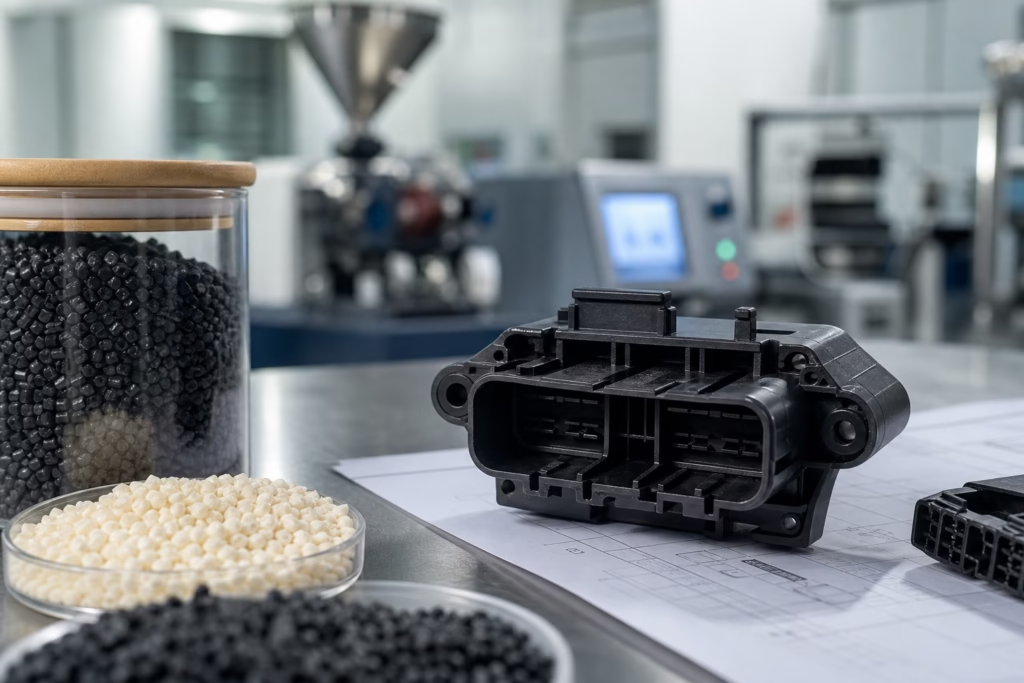
Connector programs often fail not because the wrong resin family was chosen in theory, but because a hidden material behavior showed up in mass production. The most common issues are dimensional and process-related, and they may appear only after tooling is stabilized or after environmental conditioning.
| Failure mode | What it affects | Typical material-related cause | Production impact |
|---|---|---|---|
| Warpage | Pin alignment, latch fit, mating force | Uneven shrinkage, internal stress, moisture variation | Assembly difficulty, poor fit, scrap |
| Shrinkage drift | Critical dimensions and cavity replication | Inconsistent reinforcement, molding instability | Tolerance loss, tool adjustments |
| Creep | Terminal retention and housing strength | Insufficient heat resistance or stiffness | Long-term loosening or deformation |
| Cracking | Snap fits, ribs, thin sections | Brittleness, poor impact balance, stress concentration | Assembly damage and field failure |
| Performance drift | Electrical and dimensional stability | Moisture uptake, aging, thermal exposure | Late-stage reliability problems |
Autodesk’s discussion of warpage caused by shrinkage and moisture variation aligns with what we see in connector development: deformation is usually a system result, not a single-cause defect. Part geometry, gate design, packing, drying, fiber orientation, and moisture conditioning can all contribute. That means material choice and processing setup must be considered together.
How dimensional stability affects connector fit and assembly reliability
Dimensional stability is one of the most underappreciated properties in connector material selection. A connector housing can look acceptable right after molding and still become a problem after thermal cycling, storage, or moisture exposure. If the housing changes dimension, the terminal pitch can shift, the latch may not engage properly, and the contact system can lose repeatability.
This matters especially for fine-pitch connectors, high-pin-count housings, sealed connectors, and parts with tall walls or long flow lengths. A small increase in warp or shrinkage variation can create visible assembly issues. For automated lines, even a slight change in insertion force or seating height can reduce throughput and increase rejects.
Dimensional stability is strongly linked to resin family, reinforcement, and moisture behavior. Glass fiber reinforcement usually improves stiffness and reduces thermal deformation, but it can also introduce orientation-related anisotropy and surface roughness. Unfilled materials may offer better cosmetic finish or more uniform shrinkage in some geometries, but they may not hold tolerance as well under load or heat. The right answer depends on the part geometry and service environment.
From our compounding experience, this is one reason the PBT material options for electrical connector parts are frequently considered in connector programs. PBT is often valued for a balanced profile of dimensional stability, moldability, and electrical performance, especially when the application needs reliable repeatability across many cavities and long production runs.
Where low warpage becomes critical
- Pin and socket housings: maintaining terminal centerlines and mating geometry.
- Latch connectors: preserving snap-fit retention and release force.
- Automotive connectors: handling heat, vibration, and thermal cycling.
- Miniaturized housings: where small distortion can break fit or insulation clearance.
For high-volume production, dimensional stability is also a sourcing issue. A resin that performs well in the lab but drifts from lot to lot can create hidden tooling and quality costs. That is why we evaluate shrinkage consistency, moisture-conditioned dimensions, and molding stability before approving a material for serial production.
Why moisture absorption matters more than many teams expect
Moisture absorption changes both the dimensions and the properties of many engineering plastics. In connector materials, that can show up as swelling, softening, altered mechanical behavior, reduced electrical performance under humid conditions, and long-term dimensional drift. This is especially important for polyamides, which are strong and versatile but naturally more moisture-sensitive than some other engineering resins.
When a connector housing absorbs water, the material may expand slightly. In a part with tight tolerances, that expansion can change cavity spacing or contact position. Moisture also changes the mechanical response of some polymers, which can affect snap-fits, retention features, and resistance to creep. If the part is already close to a tolerance limit, conditioning can move it outside the acceptable window.
That is why buyers should not ask only, “Does it meet flame rating?” They should also ask, “How does it behave after drying, shipping, storage, and end-use humidity?” For precision housings, low water uptake can reduce dimensional drift and help preserve the intended fit between plastic and metal components. Autodesk’s material guidance on low moisture absorption and dimensional stability in electrical plastics is a useful reminder that low-absorption materials can improve consistency in electrically demanding applications.
If moisture sensitivity is a major risk, the PA12 material options for low moisture absorption may be worth reviewing. PA12 is not the answer for every connector, but in some designs its lower moisture uptake can help control dimensional drift, especially where environmental stability matters more than maximum stiffness.
Moisture-related risks in real production
- Parts may change size between molding and assembly.
- Insertion force can vary after conditioning.
- Snap-fits can feel inconsistent across lots.
- Long-term electrical and mechanical reliability can drift under humidity.
Comparing common electrical connector plastic options
No single resin family is ideal for every connector. The right selection depends on temperature, current environment, size, geometry, and tolerance sensitivity. Below is a practical comparison often used in early material screening.
| Material | Strengths | Trade-offs | Typical connector fit |
|---|---|---|---|
| PA66 | Good strength, heat balance, toughness | Moisture absorption can affect dimensions | General-purpose connectors, structural housings |
| PA6 | Tough, cost-effective, processable | Higher moisture sensitivity and shrink variation | Less critical housings, cost-sensitive parts |
| PBT | Good dimensional stability, moldability, electrical properties | May need reinforcement or modification for higher load | Electrical connector housings, precision parts |
| PET | Stiff, stable, good electrical behavior | Processing window may be less forgiving | Precision electrical parts and structural inserts |
| PPS | High heat resistance, chemical resistance, stability | Higher cost, may be over-specified for simple parts | High-temperature or demanding electrical connectors |
| LCP | Excellent flow, low warpage, precision | Cost and design constraints | Miniature, fine-pitch, thin-wall connectors |
| PC/ABS | Good impact and appearance | Usually less suitable for high-temperature connector housings | Enclosures, non-critical electrical components |
Among these, PA66 still remains popular when a connector needs a useful balance of strength and heat resistance. In many programs, its performance is enhanced through reinforcement, flame-retardant modification, or low-warpage tuning. For buyers comparing resin families, our PA66 material options for strength and heat balance can serve as a useful reference point when the design needs durability but cannot tolerate excessive brittleness or deformation.
For teams in the early stage of material screening, the practical choice is not “best resin overall” but “best resin for this connector geometry and service condition.” A fine-pitch connector in an electronics module may favor flow and low warp. A high-load terminal housing may prioritize stiffness and heat resistance. A moisture-exposed automotive connector may need a lower-absorption solution or a more tightly controlled conditioning strategy.
How to judge insulating plastic material performance by application
Application fit should be judged using the real service environment, not just a datasheet headline. Connector designers should classify the part by temperature exposure, electrical load, humidity, mechanical stress, and expected production volume. That framework helps avoid over-specifying material or choosing a resin that performs well in one category while failing in another.
Decision factors to map before choosing a resin
- Temperature: continuous operating temperature, peak exposure, and nearby heat sources.
- Humidity: dry indoor, intermittent condensation, or sustained high-moisture environments.
- Electrical demand: insulation clearance, tracking risk, and voltage stress.
- Mechanical load: snap-fit retention, terminal push-out, vibration, and creep.
- Geometry: wall thickness, rib layout, thin sections, and gating strategy.
A material with excellent flame retardancy may still be a poor choice if the application is highly sensitive to dimensional drift. Likewise, a low-absorption resin may not be enough if the connector also needs high heat resistance or excellent flow through thin walls. Good connector material selection balances all of these requirements instead of ranking just one property.
Processing behavior that influences connector quality
Processing is where many material choices either succeed or fail. A resin may look excellent on paper, but if it requires strict drying, has narrow molding conditions, or fills thin features poorly, production issues can appear quickly. For connector parts, flowability, moisture control, and warpage management are especially important.
Drying is often critical for polyamides and other moisture-sensitive engineering plastics. If drying is incomplete, the material may hydrolyze, lose properties, or create surface defects. If the material is over-dried or exposed too long, process stability can still suffer. The right drying protocol should be part of the material approval package, not an afterthought.
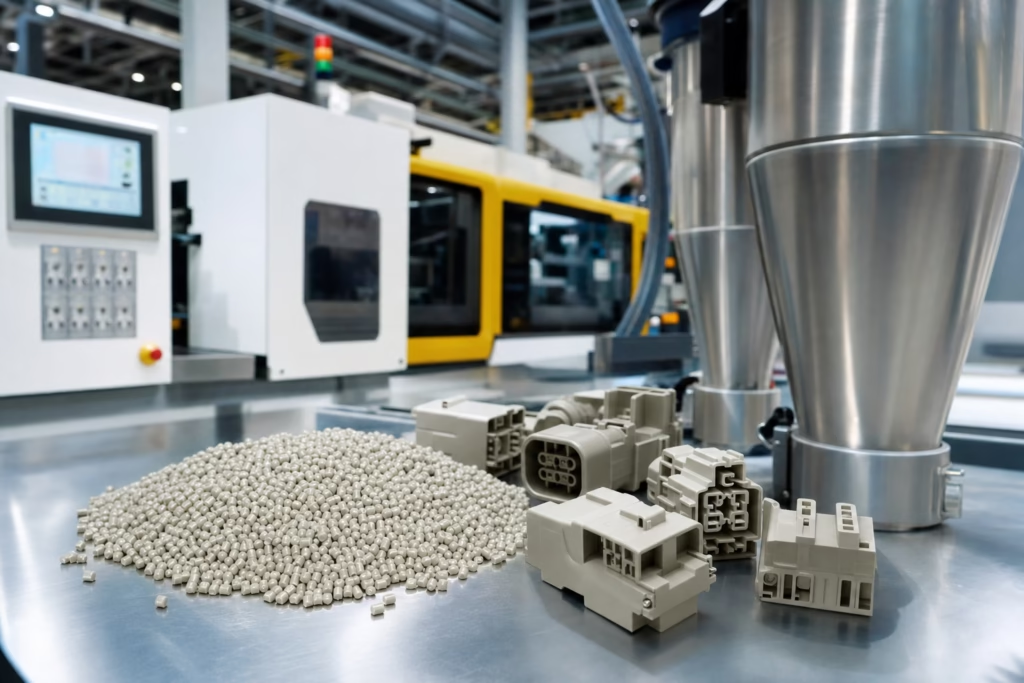
Flow behavior also matters because many connectors have thin walls, long flow paths, or multiple gates. A resin with good flow can fill small features more consistently, but it must still retain enough stiffness and electrical performance after molding. Surface finish, weld line quality, and gate blush can affect both aesthetics and functional reliability.
For teams that want a more standardized way to minimize processing risk, a purpose-built flame-retardant formulation can help when the connector must meet fire safety requirements without losing moldability. Our flame-retardant plastic compound options for connectors are developed with the idea that fire performance, mechanical balance, and processing stability should be engineered together rather than treated separately.
Processing checkpoints that deserve attention
- Drying conditions: temperature, time, and moisture level before molding.
- Melt and mold temperature: stable filling and crystallization behavior.
- Packing control: dimensional consistency and shrinkage management.
- Cooling balance: prevention of warp and internal stress.
- Tooling compatibility: gate design, venting, and fiber orientation risk.
In our experience, many “material problems” are actually process-material mismatches. That is why we recommend sample trials that include real tooling, production-like drying, and conditioned testing after molding. A clean first article is not enough if dimensions shift after 48 hours or after humidity exposure.
Test points engineers should review before approval
Connector qualification should combine electrical, thermal, mechanical, and environmental tests. Engineering teams often focus on one or two headline metrics, but hidden risk usually appears where tests intersect. A resin can pass flammability while still showing poor dimensional retention or electrical drift after conditioning.
| Test area | Why it matters | What to review |
|---|---|---|
| UL 94 | Basic flammability screening | Rating, thickness dependence, and part geometry |
| CTI | Tracking resistance under contamination | Surface insulation risk in humid or dirty environments |
| Dielectric strength | Insulation robustness | Breakdown resistance at relevant thickness |
| Moisture conditioning | Predicts dimensional drift and property change | Size change after humidity exposure |
| Heat aging | Long-term performance under thermal stress | Retention of dimensions and mechanical properties |
| Dimensional tolerance | Ensures fit and assembly reliability | Critical dimensions before and after conditioning |
UL Solutions’ electrical testing methods for insulating plastics are useful here because they connect the practical resin review with the property categories engineers actually need: dielectric strength, surface resistivity, volume resistivity, and tracking behavior. For connector programs, these tests help separate “flame-rated” from “electrically dependable.”
How to read a datasheet without missing hidden risks
Datasheets are useful, but they can be misleading if they are read as a promise instead of a starting point. A connector team should pay close attention to test conditions, sample thickness, conditioning state, and whether the data is based on unfilled or reinforced grades. A material that looks strong in one format may behave differently after reinforcement, coloring, or flame-retardant addition.
Look closely at the following fields:
- Conditioning state: dry-as-molded versus conditioned properties.
- Shrinkage range: directionality and thickness dependence.
- Water absorption: short-term and long-term behavior.
- CTI and electrical data: relevance to the actual connector environment.
- Heat resistance: whether the test reflects continuous use or short-term exposure.
- Reinforcement content: how glass fiber or mineral filler changes fit and flow.
If a datasheet does not clearly describe the test condition, the buyer should ask for clarification before sample approval. For connector material selection, the difference between dry and conditioned values can be the difference between a smooth launch and a late-stage fit problem.
When to choose reinforced or modified compounds
Many connector projects benefit from modification. Reinforcement, flame-retardant packages, low-warpage tuning, and low-absorption strategies can all improve fit for the application. The key is to choose the modification based on the actual failure mode you want to prevent.
- Glass fiber reinforcement: improves stiffness, heat resistance, and dimensional control, but may increase anisotropy.
- Mineral filling: can reduce shrinkage and improve dimensional stability, though impact balance may change.
- Flame-retardant modification: supports safety requirements, but must be balanced against flow, toughness, and surface quality.
- Low-absorption formulation: helps stabilize dimensions in humid environments.
- Low-warpage tuning: helps preserve mating accuracy in precision connectors.
We often remind customers that “more modification” is not always better. A higher filler load may improve stiffness but make thin-wall filling more difficult. A more aggressive flame-retardant package may meet the test target but reduce weld-line strength or surface appearance. The right compound is the one that satisfies the part’s functional risk profile with the least unintended compromise.
For buyers balancing stiffness, moisture behavior, and production stability, the most useful step is often a targeted sample plan rather than a broad resin search. At Poly Maro, our material development and compounding work is structured around these trade-offs so that connector designers can evaluate options against real part requirements, not just catalog language.
Supplier selection checklist for connector material sourcing
In connector projects, the supplier is part of the material system. Even a well-chosen resin can create risk if lot consistency, drying advice, documentation, or lead time cannot support production. Procurement teams should screen suppliers for technical responsiveness as well as cost.
| Checklist item | Why it matters | What good looks like |
|---|---|---|
| Batch consistency | Prevents dimension drift across production lots | Stable properties and repeatable shrinkage |
| Sample validation | Confirms material fit before mass production | Parts molded in real conditions and conditioned after molding |
| Lead time | Affects launch and replenishment planning | Clear commitments and realistic scheduling |
| Technical support | Reduces trial-and-error risk | Guidance on drying, molding, and test interpretation |
| Customization ability | Supports exact application needs | Options for reinforcement, FR, color, or low-warp tuning |
| Documentation quality | Supports engineering and audit needs | Clear datasheets and consistent test conditions |
The goal is not to overcomplicate sourcing. It is to avoid treating resin as a commodity when the connector is a precision component. Better supplier communication reduces scrap, shortens validation cycles, and improves the chance of a clean transition from sample to mass production.
Practical decision framework for connector designers and buyers
A simple framework can help teams choose more confidently. Start with the environment, then the geometry, then the manufacturing process, and finally the commercial constraints. If the connector faces high heat, electrical stress, or outdoor exposure, prioritize heat resistance, tracking resistance, and stable insulating performance. If the housing is thin-walled and precision-critical, prioritize flow and dimensional stability. If humidity is high, reduce moisture absorption risk early in the selection process.
In many programs, the best solution is not a generic flame-retardant resin but a modified engineering plastic matched to the exact job. That may mean PBT for stable electrical housings, PA66 for balanced strength and heat, PA12 when moisture uptake is a major concern, or a specialized reinforced compound when the design needs tighter dimensional control. The point is to match the resin family to the connector’s real operating envelope.
We recommend that engineering and procurement teams define acceptance criteria before approving a material: target tolerance, allowable moisture-conditioned drift, required flame class, expected assembly behavior, and test conditions for validation. When those criteria are clear, supplier comparison becomes much easier and production surprises become much less likely.
Conclusion
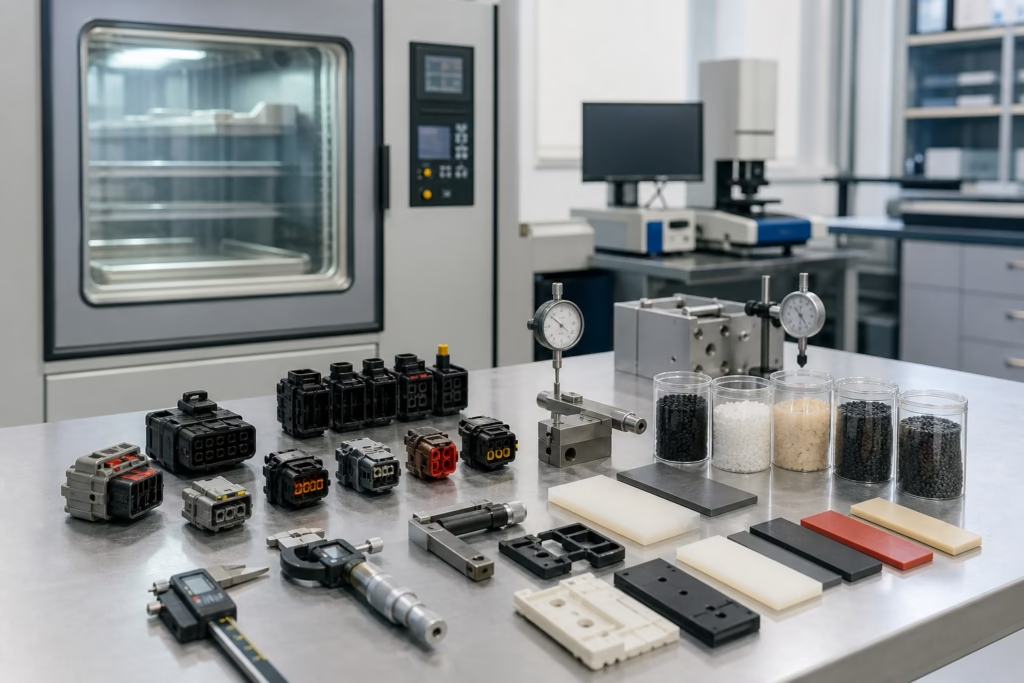
Connector material selection is not solved by flame retardancy alone. For electrical connectors, the more complete question is whether the material can preserve insulation, dimensional accuracy, and process stability throughout manufacturing and service life. Dimensional stability controls fit and assembly reliability. Moisture absorption influences swelling, drift, and long-term consistency. Processing behavior shapes yield, surface quality, and warpage risk. When these factors are evaluated together, connector programs become more robust and sourcing decisions become more defensible.
From our manufacturing perspective, the best connector material is the one that performs reliably in the real part, under the real process, and in the real environment. That is the standard we use when developing modified plastics for connector applications.
FAQs
Is flame retardancy enough for electrical connector materials?
No. Flame retardancy is important, but connector housings also need dimensional stability, moisture control, insulation performance, and process consistency. A resin can pass a flame test and still create fit or reliability problems if it warps, absorbs water, or drifts in size after molding.
Why is moisture absorption such a concern for connectors?
Moisture absorption can change part dimensions, soften the material, and affect long-term mechanical behavior. For connectors, that may mean altered pin alignment, changed insertion force, or reduced stability after conditioning, storage, or humid service.
Which resin families are commonly used for electrical connectors?
PA66, PBT, PET, PPS, LCP, and some modified grades are common choices, depending on heat, geometry, electrical needs, and cost targets. PA66 is often used for balanced strength and heat resistance, while PBT is frequently chosen for dimensional stability and molding consistency.
How should engineers compare datasheets for connector housing materials?
Compare test conditions, conditioning state, shrinkage data, moisture absorption, CTI, dielectric values, and heat resistance. The most useful datasheet is the one that reflects the actual part geometry and use environment, not just the nominal resin properties.
When should a connector use a reinforced or modified compound?
Use a modified compound when the base resin does not fully meet the part’s needs for stiffness, warpage control, flame resistance, or moisture behavior. Reinforcement and additives can improve performance, but they must be balanced against flow, impact, and surface quality.
What should procurement teams ask a supplier before mass production?
Ask about lot consistency, recommended drying and molding conditions, sample validation support, lead time, documentation quality, and customization options. For connector material selection, supplier reliability is part of product reliability.