
Deciding whether to start a custom plastic compound development project is rarely a pure material question. It is usually a business decision wrapped around a technical problem: can a new formulation lower total cost, improve part performance, reduce scrap, solve a compliance issue, or unlock a product that a standard resin cannot support? If the answer is not clear, the project can consume time and budget without delivering enough value.
custom plastic compounding support is most valuable when the application has a real performance gap or a stable production opportunity that justifies formulation work, sample iteration, and validation. At Poly Maro, we look at that decision through both lenses at once: the part requirements, the processing window, the production volume, and the cost-to-benefit ratio over the full life cycle, not just the first trial order.
Why custom plastic compound development is not always the right choice
Many projects begin with a request that sounds technical but is actually a sourcing shortcut. A buyer may ask for a custom compound because a previous grade had shrinkage problems, a machine ran poorly, or a part cracked in testing. In some cases, a standard engineering plastic or an existing modified grade will solve the issue faster and more economically than a new formulation.
The most common mistake is assuming that a custom solution automatically means better performance. In reality, custom plastic compound development adds formulation work, trial production, sample approval, quality agreement, and often a longer lead time. If the application is low volume, short life cycle, or tolerant of minor performance compromise, the added development cost may never return enough value.
That is why the first question should not be “Can we develop it?” but “Should we develop it?” The answer depends on how difficult the application is, how expensive the part failure would be, how much production volume will run through the material, and whether the requirement is unique enough to justify a dedicated compound.
What qualifies as a true project-specific compound?

A real project-specific compound is not just a color change or a generic reinforcement tweak. It is a formulation built to solve a defined application problem that a standard grade cannot meet well enough. In practice, this usually means one or more of the following:
- mechanical performance must be tuned for a specific load, impact, or stiffness target
- heat resistance must rise beyond the standard grade’s safe operating range
- dimensional stability must improve for tight-tolerance molding
- flame retardancy, electrical insulation, or conductivity must meet product requirements
- wear, creep, chemical resistance, or UV resistance must be improved for the working environment
- processing behavior must be adjusted for fill, weld line strength, warpage, or cycle time
From a manufacturing perspective, a genuine project-specific compound usually includes a defined end-use part, a target process window, a performance spec, and an approval path. Without those four items, the project is often still at the idea stage, not yet ready for compound development.
When a custom modified plastic project is worth considering
There are several situations where a custom project can create strong business value. The first is when a performance gap is blocking product launch or causing recurring field risk. For example, if a housing needs higher impact strength at low temperature, or a connector body needs better dimensional stability and heat resistance, the cost of a custom grade may be small compared with the cost of redesign, warranty claims, or delayed launch.
The second is when processing problems are driving hidden cost. A compound that improves flow, reduces warpage, shortens cycle time, or lowers scrap can pay back quickly on a high-volume line. In that case, the material may cost more per kilogram but less per usable part.
The third is when compliance or end-use conditions are unusually demanding. For instance, if an electrical part needs a specific flammability profile or an appliance component must keep its shape under sustained heat, a standard resin may not be enough. In such cases, custom plastic compound development can be the difference between a workable product and a risky one.
When the issue is impact-related, many teams start by comparing an existing grade with custom compound vs standard grade options before deciding whether a tailored formulation is justified. That comparison is often the fastest way to separate a genuine material need from a requirement that can be solved by design, drying, molding conditions, or grade selection.
Project size and application threshold: when ROI starts to make sense
Project scale matters because custom development has fixed costs. Even if the compound itself is not expensive to formulate, the project still needs requirement definition, lab compounding, sample preparation, testing, and often more than one validation round. A small annual volume may not absorb those costs well.
We usually advise teams to think in three threshold layers:
| Threshold factor | What to evaluate | Why it matters |
|---|---|---|
| Production volume | Annual kilograms, part count, and forecast stability | Higher volume spreads development cost over more parts |
| Part value | Economic value of each molded part or assembly | High-value parts can justify more material engineering effort |
| Product life cycle | How long the part will stay in production | Longer life cycles improve the chance of payback |
If a part runs for only a short program window, a custom compound can be difficult to recover unless the performance need is severe. If the part will stay in production for years, a small per-piece savings or a meaningful reduction in scrap can create a strong return.
In our experience, ROI improves when the material choice affects recurring operating cost, not just one-time performance. A compound that reduces rejects, stabilizes molding, or extends product life usually has a stronger case than a formulation that merely sounds more advanced.
Cost side of the equation: what the project really consumes
When teams estimate the cost of a new compound, they often look only at resin price. That is not enough. The true cost includes raw materials, formulation time, pilot production, testing, approval cycles, packaging requirements, and the internal time spent by engineering, quality, procurement, and production teams.
Typical cost buckets include:
- base resin and additives
- reinforcement or functional fillers
- color matching or appearance adjustment
- trial compounding and small-batch output
- mechanical, thermal, and process testing
- tooling adjustments or molding parameter tuning
- sample shipment, review, and re-test cycles
- documentation and release approval work
One hidden cost is delay. If the project adds weeks to the development schedule, that delay can be more expensive than the material itself, especially when the product launch has a commercial deadline.
Another hidden cost is risk of iteration. A first sample rarely meets every target at once. A practical development plan should assume that formulation refinement may be needed after testing and molding trials.
Benefit side of the equation: where the return comes from
The return on a custom compound usually comes from one or more of six sources. The first is performance improvement: higher impact, better heat resistance, lower shrinkage, stronger dimensions, or more stable electrical behavior. The second is scrap reduction. If the new compound improves flow or warpage control, the line may produce more acceptable parts per hour.
The third is cycle-time savings. Faster filling, quicker cooling, or more predictable demolding can improve throughput. The fourth is warranty risk reduction. A compound that resists creep, cracking, or heat deformation may reduce field failures and customer complaints.
The fifth is differentiation. In some product categories, a material that enables thinner walls, lighter weight, or improved surface quality can support a more competitive product design. The sixth is supply-chain simplification. If a custom grade consolidates multiple material requirements into one compound, it can reduce complexity for purchasing and inventory management.
When high impact performance is the main need, it may be useful to compare the economics against impact-modified plastic compound solutions. A well-chosen impact-modified grade can sometimes deliver the needed toughness without the full cost of a completely new formulation.
How to estimate custom modified plastic ROI in a practical way
A simple ROI view does not need to be complicated. Start by estimating annual benefit and compare it with annualized development and material cost. The benefit side should include savings from scrap reduction, cycle time reduction, warranty avoidance, and any increase in acceptable output. The cost side should include the price premium of the compound, plus the amortized cost of development, testing, and launch support.
A practical screening formula is:
Annual Net Benefit = (Process savings + Scrap savings + Failure avoidance + Product value gain) – (Material premium + Development cost + Validation cost)
If the annual net benefit is positive and stable, the project may be worth continuing. If the benefit depends on uncertain assumptions, the team should treat the project as higher risk and require stronger evidence before moving forward.
It also helps to compare the project against the make-or-buy logic used in manufacturing decisions. In many cases, a custom compound is justified only when the cost of not doing it is larger than the total project cost. For a broader decision framework on that trade-off, MIT’s discussion of make-vs-buy decision framework is a useful lens for evaluating whether a tailored material is the right investment.
Technical feasibility check: can an existing grade already solve the problem?
Before starting a custom project, we recommend a disciplined feasibility screen. In many cases, the issue can be solved by moving to a different resin family, adding reinforcement, changing drying conditions, adjusting wall thickness, or selecting an existing modified grade with better flow or toughness.

That is why a material evaluation should begin with the application, not the compound request. Ask whether the part needs more stiffness, more toughness, better heat resistance, or improved dimensional stability. Then ask whether a standard engineering plastic already offers that balance. If the answer is yes, custom development may not be necessary.
This is where a conversation with a material partner matters. At Poly Maro, we often start by comparing the real stress conditions, processing constraints, and life-cycle target against available resin families before proposing a custom route. In some cases, a standard grade with a small processing adjustment is enough. In others, the part truly needs formulation work.
When the part is exposed to elevated temperature, heat-resistant plastic compound options may solve the problem without a fully bespoke project. That comparison is especially important for appliance, electrical, and under-the-hood applications where thermal margin is limited.
Development workflow for a project-specific compound
A well-run project follows a clear workflow. First, the team defines the requirement in measurable terms. That means target properties, processing conditions, regulatory needs, appearance requirements, and part geometry constraints. Vague requests produce vague compounds.
Second, the formulation is designed around the real need. This may include base resin selection, reinforcement type, impact modification, flame retardancy, heat stabilization, lubrication, anti-static function, or other additives. The formulation should be chosen for the application, not for theory alone.
Third, sample materials are produced and molded. During this stage, processing behavior is as important as lab numbers. A compound that looks good on paper but fills poorly, warps excessively, or dries unpredictably is not ready for production.
Fourth, the sample is tested in both laboratory and application settings. Mechanical strength, heat resistance, dimensional stability, and consistency should all be checked. For many applications, real mold trials reveal more than a datasheet can.
Fifth, the formulation is adjusted if needed, then verified for mass production. This final step should confirm batch consistency, color stability if relevant, and molding repeatability across actual equipment and operating conditions.
What to define before the first sample
The more precise the brief, the better the compound decision. At minimum, the project team should define the resin family preference, target properties, molded part thickness, expected production volume, drying capacity, injection or extrusion equipment constraints, and acceptance criteria for approval.
To avoid common early-stage errors, teams often review a sample-request checklist before development starts. We recommend details to confirm before requesting samples because a weak brief usually creates avoidable sample revisions and wasted time.
Key approval criteria before launch
Before a custom compound is approved for mass production, the team should confirm that it meets both the property target and the manufacturing target. A material that passes one but not the other is not production-ready.
| Approval area | What to confirm | Why it matters |
|---|---|---|
| Mechanical properties | Tensile, flexural, impact, hardness, or elongation targets | Ensures the part performs under load |
| Heat resistance | Dimensional retention at operating temperature | Prevents softening, deformation, or premature failure |
| Dimensional stability | Shrinkage, warpage, and tolerance fit | Supports assembly and repeatability |
| Processing stability | Drying behavior, flow, cycle time, and demolding | Reduces scrap and line instability |
| Batch consistency | Lot-to-lot repeatability and color or filler stability | Protects production quality over time |
Mechanical testing is not just a lab formality. It is the evidence that the compound is solving the actual problem. For teams validating polymer property and processing selection, MIT OpenCourseWare’s polymer property and processing selection materials are a useful reference point for understanding how performance and processability must align before a design is approved.
Common situations where custom compounding fails to pay back
Some projects fail not because custom compounding is ineffective, but because the business case is weak. One common problem is low volume. If the part runs in limited quantities, even a technically successful compound may not recover its development cost.
Another problem is vague requirements. If the team cannot say whether the issue is impact, heat, creep, warpage, or chemical resistance, the formulation process becomes guesswork. A third problem is trying to fix a design issue with material alone. Sometimes geometry, gate location, wall thickness, or drying practice is the real cause.
Projects also fail when the launch timeline is too short. If the product needs to go into production immediately, there may not be enough time to iterate the formulation, validate the molding window, and confirm consistency. In that case, a standard grade or an existing modified material is often the safer choice.
A fourth failure mode is over-specification. Teams sometimes ask for performance that exceeds what the end use truly needs. That can push the compound into a more expensive category without adding practical value.
Supplier evaluation questions for custom plastic compound development
The supplier side is as important as the formulation side. A strong compound partner should be able to discuss application needs, not just sell resin. They should ask about part geometry, process equipment, drying conditions, service environment, target life cycle, and approval criteria.
Useful questions include:
- What problem is the compound solving, and what is the acceptance criterion?
- Can the target be achieved with an existing grade or a smaller modification first?
- What trade-offs will come with higher stiffness, higher impact, or higher heat resistance?
- How will the sample be validated in real molding conditions?
- What is the expected MOQ, lead time, and batch consistency plan?
- How will formulation changes be controlled after approval?
If the supplier cannot answer these questions clearly, the project risk rises. A good partner should be able to explain not only what the compound is, but why it is the right technical and commercial choice. When the need is more specialized, material evaluation and technical support can help shorten the path from requirement to validated sample by focusing the conversation on application fit rather than generic specifications.
Decision matrix: proceed, revise, or choose a standard material
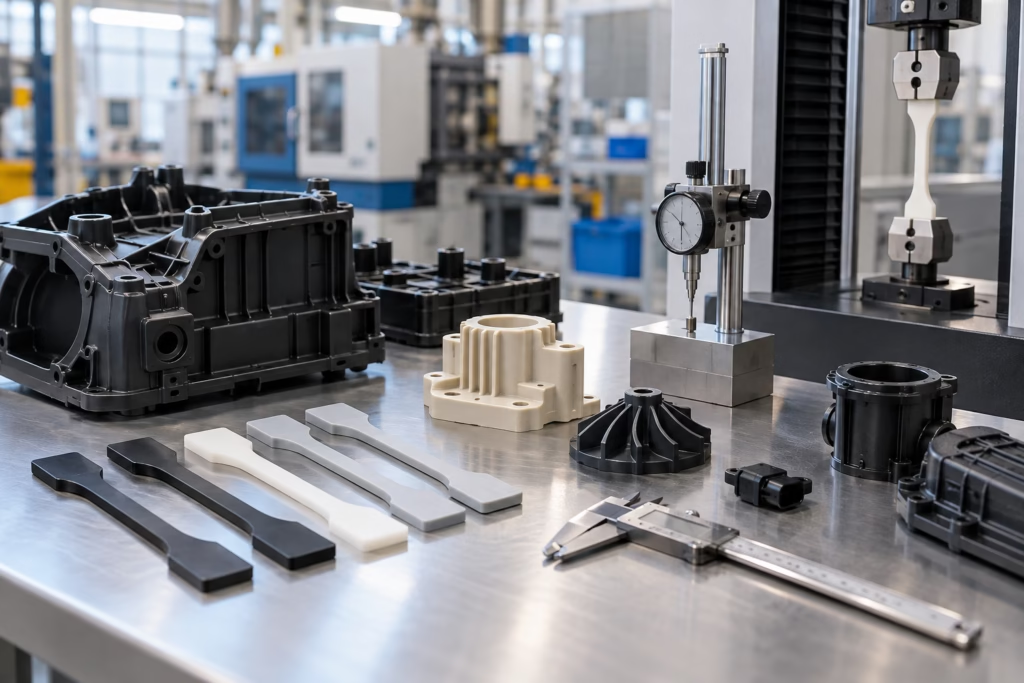
At the end of the screening process, the team should classify the project into one of three outcomes. Proceed when the performance gap is real, the production volume is large enough, the part life cycle is long enough, and the custom compound is expected to lower total cost or risk. Revise the specification when the need is real but not yet specific enough, or when a standard grade might work after process or design changes. Choose a standard material when the application is not demanding enough to justify development cost, or when the business timeline is too compressed for a custom route.
For teams comparing commodity polymers against engineered alternatives, the application fit may also depend on whether the goal is strength, cost control, or dimensional stability. In that case, a comparison such as PP vs PA for cost-sensitive structural parts can clarify when a lower-cost standard grade already meets the practical need.
A useful final test is simple: if the compound disappears into the part without reducing risk, improving process stability, or creating measurable commercial value, it may not be worth doing. If it changes the economics or feasibility of the product in a meaningful way, custom plastic compound development can be a strong investment.
How to make the final go or no-go call
We recommend that engineers, procurement teams, and product developers use a balanced scorecard before approval. Score the project on technical need, production volume, process stability, expected service life, and economic return. If the technical need is high but the commercial return is weak, revise the scope. If the commercial return is high but the technical brief is weak, refine the specification. If both are strong, the project is likely worth doing.
The most successful projects are the ones where the material solution is tied to a clear business outcome. That may mean a lighter part, fewer rejects, better field reliability, easier molding, or faster approval. The key is to avoid treating custom development as a default path. It should be a deliberate investment with a measurable reason to exist.
Frequently Asked Questions
How do I know if custom plastic compound development is necessary?
It is usually necessary only when a standard grade cannot meet the application’s key requirement after normal design and process optimization. If the issue is performance, heat, dimensional stability, or process behavior that directly affects production or field reliability, a custom compound may be justified.
What is the biggest mistake companies make when starting a custom compound project?
The most common mistake is starting with a vague request instead of a measurable requirement. If the team does not define the failure mode, target property, and approval method, the project can drift into unnecessary trial work and cost.
Can a standard engineering plastic replace a custom compound?
Yes, in many cases. A standard resin or existing modified grade can often solve the problem if the need is not highly specific. The right decision depends on whether the application truly needs a tailored balance of strength, toughness, heat resistance, or processing stability.
What should I check before approving a sample for production?
Check mechanical performance, dimensional stability, heat behavior, processing window, and lot consistency under real molding conditions. If possible, confirm the sample on the same equipment and mold conditions used for mass production.
How do MOQ and lead time affect the business case?
MOQ and lead time affect inventory risk, production planning, and the ability to recover development cost. If the forecast is unstable or the launch window is short, the project becomes harder to justify unless the performance need is urgent.
What should I ask a supplier before moving forward?
Ask whether the problem can be solved with an existing grade first, what trade-offs the custom compound will create, how samples will be validated, and how batch consistency will be controlled. A strong supplier should answer in application terms, not only in datasheet terms.