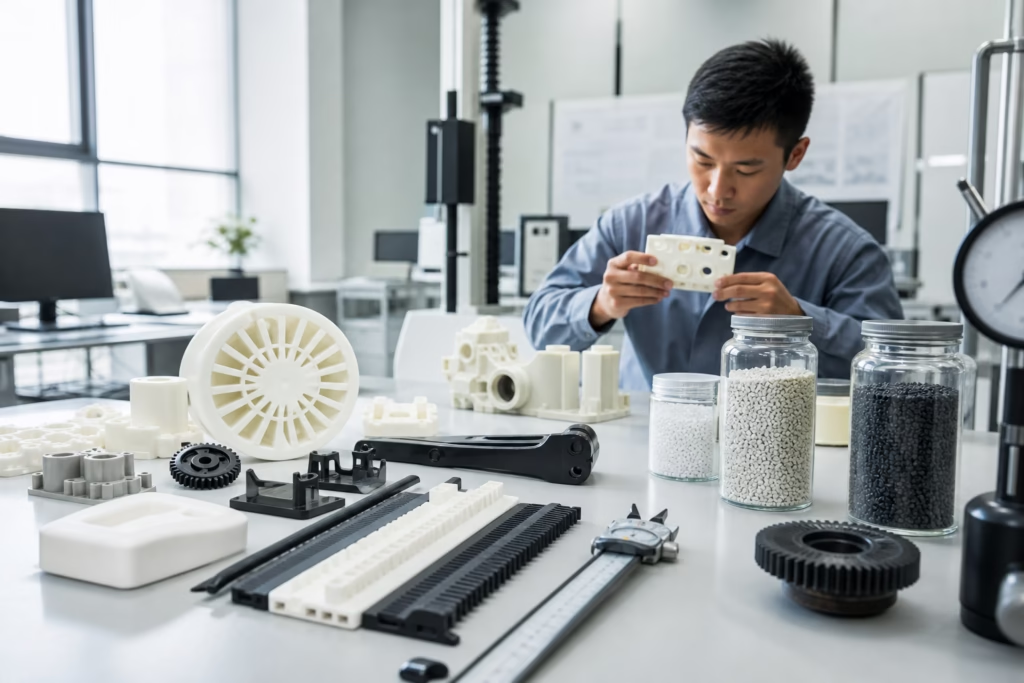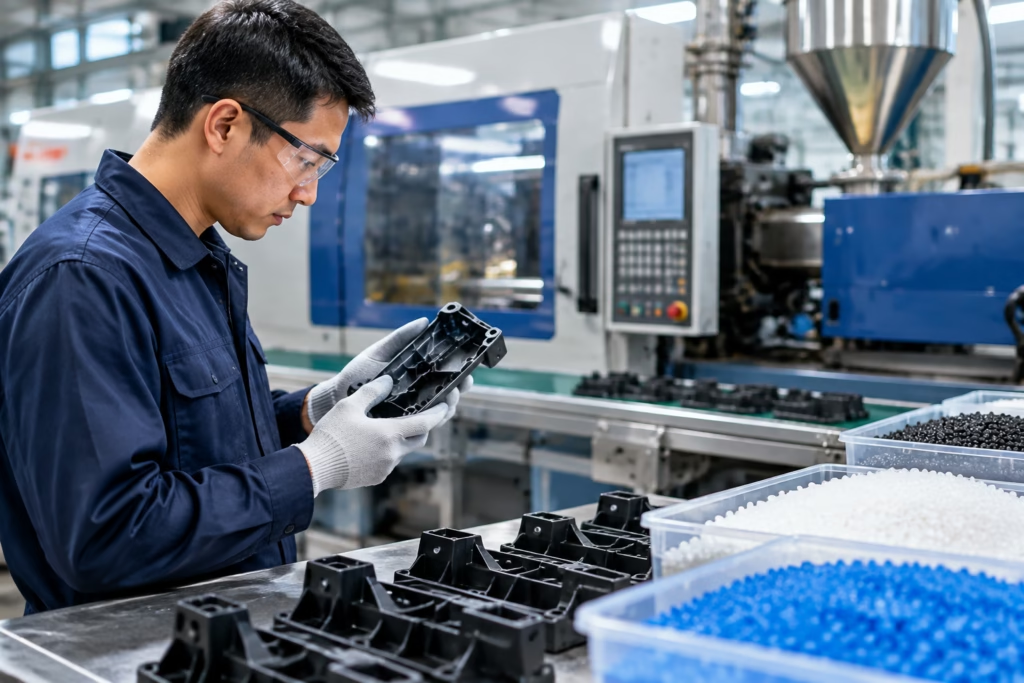
The nylon moisture issue usually does not start at the machine. It often starts in the warehouse, during transit, or the moment a bag is opened and left unsealed. Because nylon is hygroscopic, it can absorb water from the surrounding air, and that absorbed moisture changes how the resin behaves before it ever reaches the injection molding press. For engineers and buyers, the practical question is not just whether nylon is “wet,” but how much moisture has been absorbed, how long it has been exposed, and whether the part will fail because of that exposure.
For teams selecting the right grade for a demanding part, PA6 material options for strength and processing balance can be a useful starting point when comparing moisture sensitivity, stiffness, and processability. At Poly Maro, we look at nylon selection and moisture control together, because the best resin choice is only part of the answer; packaging integrity, drying discipline, molding setup, and lot handling all determine whether a nylon part ships with stable dimensions and acceptable surface quality.
Why Nylon Becomes More Sensitive After Moisture Absorption
Nylon is not simply “more difficult” after it absorbs moisture. Its polymer chains interact with water, and that interaction changes the way the material melts, flows, and solidifies. In practical terms, absorbed moisture can reduce melt stability during processing, alter the viscosity profile, and increase the chance of hydrolysis when the resin is heated. That is why a nylon moisture issue often shows up as a chain reaction: storage exposure leads to higher moisture, higher moisture affects drying demand, and insufficient drying leads to molding defects.
The impact is especially visible in PA6 and PA66, but the same basic logic applies across polyamides. When moisture content rises, the material may still appear usable, yet its process window becomes narrower. Parts that were previously stable can begin to show flash, bubbles, surface haze, splay, or unexpected warpage. If the application is sensitive to fit, load, or appearance, even a small change in moisture state can become a production problem.
What moisture changes before processing
Before a nylon pellet enters the barrel, absorbed water can influence three important areas: physical properties, flow behavior, and processing stability. First, nylon can become more ductile after moisture uptake, but that does not mean it is safer to mold without control. The apparent toughness change can hide a real reduction in mechanical consistency. Second, moisture can destabilize melting and venting behavior, which makes the molding machine work harder to produce a clean fill. Third, once the resin is heated, remaining moisture can accelerate degradation and reduce part reliability.
For critical applications, it is worth comparing moisture behavior across materials. Some projects can tolerate PA6 with strict drying, while others benefit from a lower-absorption alternative such as PA12. In those comparisons, the question is rarely “Which resin is best?” It is “Which resin can hold the required performance while matching the plant’s storage, drying, and cycle discipline?”
Storage Risks That Trigger Moisture-Related Problems
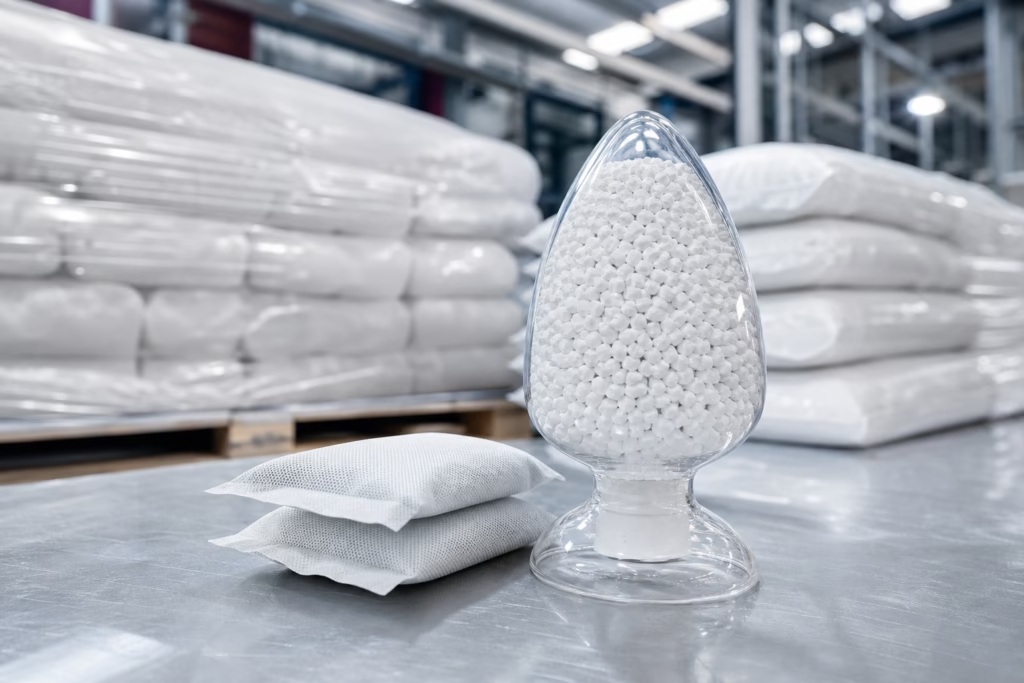
Many moisture defects can be traced to the point where nylon left controlled packaging and entered open air. A sealed bag, desiccant protection, and dry storage only help if the handling process is equally disciplined. If pallets are left near dock doors, if cartons are opened long before use, or if re-sealing is poor, the resin can absorb enough water to require longer drying and tighter process control.
When nylon is exposed to humid air, the absorption rate depends on ambient conditions, exposure time, pellet surface area, and the initial moisture state of the resin. That means two bags from the same lot may behave differently if one was opened early and the other stayed sealed. From a manufacturing perspective, this is a traceability issue as much as a material issue. Storage records, open-bag timing, and FIFO discipline all matter.
For resin handling decisions, Poly Maro’s PA66 engineering resin solutions for higher heat performance are often evaluated by teams that need both heat resistance and reliable processing discipline. Higher-performance nylon grades can solve the application load, but only if the moisture-control workflow matches the material’s sensitivity and the part’s dimensional tolerance.
Common warehouse mistakes
- Opening moisture-sensitive nylon packaging too early in the shift and leaving material exposed.
- Using damaged or weak sealing after partial bag consumption.
- Storing nylon near doors, loading bays, or areas with large humidity swings.
- Mixing older opened stock with freshly received material without moisture verification.
- Assuming a resin is ready to mold just because the packaging looks intact.
A useful rule is simple: the more time nylon spends outside controlled packaging, the more likely the drying burden will shift to the press room. That shift is expensive because it moves a storage problem into the molding process, where the result becomes visible scrap.
Transportation and Handling Risks Before Molding
Moisture risk does not stop at the warehouse gate. During shipping, containers can experience temperature swings that encourage condensation, especially when pallets move from cool storage into warm, humid environments. If packaging integrity is weak, the result can be a resin lot that arrives with higher-than-expected moisture variation from one bag to another. This is one reason incoming inspection matters even when the supplier has packed the material correctly.
Handling also matters at the production line. A bag opened too early, a hopper left unprotected, or a drying system bypassed during a short run can create enough exposure for a moisture-related quality issue. In busy plants, these shortcuts often happen when teams are trying to keep a line running. The problem is that moisture damage is usually discovered later, after multiple shots have already been molded.
When evaluating risk, compare the actual process environment rather than the intended one. If the plant has inconsistent humidity control, long staging times, or frequent line changes, then a lower-moisture-absorption option may be worth considering. For some applications, PA12 resin options for lower moisture absorption and stability can reduce the sensitivity of the process, especially for precision parts that cannot tolerate large dimensional swings.
PA Processing Moisture: What Happens During Drying and Preheating
Drying is not only about removing visible dampness. It is about bringing the resin into a moisture range that supports stable melt behavior and reduces the risk of hydrolysis during processing. In nylon molding, the target moisture level depends on the grade, part requirements, and processor capability. But the principle stays the same: if drying is not sufficient, the press will usually reveal the problem through unstable fill, surface defects, or inconsistent mechanical properties.
According to drying before molding guidance for PA materials, residual moisture should be removed in a closed and monitored system. That process logic is important because open handling after drying can undo much of the benefit before the resin ever reaches the screw. Drying should be treated as a controlled process, not a one-time event.
For teams that need a formal moisture verification step, ASTM’s moisture testing method for plastics is useful as a control reference when setting incoming inspection and release criteria. In practice, the point is not to test for its own sake, but to know whether a lot needs more drying, tighter handling, or rejection before it becomes a process problem.
Drying conditions and what insufficient drying looks like
Drying performance is influenced by temperature, time, air dryness, and the initial moisture content of the pellets. If any one of those factors is weak, the material may still be “drier” than before, but not dry enough for stable molding. That is why two lots can require different drying times depending on how they were stored. Open-package exposure often increases the time required to recover processability.
Insufficient drying usually appears in one of three ways. The first is visual defects, especially splay or silver streaks caused by vapor release during melt flow. The second is processing instability, where fill changes from shot to shot. The third is property loss, including brittle behavior or reduced strength consistency after molding. If the dryer is performing poorly, the plant may only see the symptom, not the root cause.
For a deeper comparison of materials intended for tight-tolerance parts, how to judge low moisture absorption plastics for precision parts is a helpful reference point when selecting between resins that face different dimensional requirements and humidity exposure levels.
How Moisture Affects Injection Molding Behavior
Once nylon enters the injection molding machine, residual moisture can affect melt viscosity, venting, and cycle stability. During heating, moisture may turn to steam and create irregular flow patterns. That makes it harder for the melt to fill thin ribs, long flow paths, or detailed cosmetic surfaces. If venting is not well designed, the gas burden becomes even more visible as burn marks, trapped gas, or incomplete fill.
Moisture can also make the process harder to hold from cycle to cycle. A stable nylon mold depends on repeatable melt behavior. When moisture varies, the machine may need to compensate with pressure or temperature changes, and those changes can create a new set of problems such as flash, sink variation, or dimensional scatter. The result is often higher scrap and more time spent adjusting a process that should have been stable from the start.
Typical defects linked to moisture
- Splay or silver streaks: usually visible on the surface and often related to vapor escaping during melt flow.
- Bubbles or void-like appearance: can occur when retained moisture flashes during molding.
- Surface haze: a common sign that the melt state is not clean and consistent.
- Brittleness: may appear when hydrolysis or degradation has reduced polymer integrity.
- Dimensional instability: parts can shift in shrinkage or warpage behavior as moisture state changes.
Not every surface line is caused by moisture, and not every warp problem comes from wet resin. That is why defect diagnosis should start with material history. If the problem appears after bag opening, warehouse exposure, or a dryer interruption, moisture is a high-probability suspect.
How Moisture Increases Warpage, Shrinkage Variation, and Property Loss
Dimensional stability is one of the first areas to suffer when nylon moisture handling is inconsistent. As moisture changes, the material’s behavior in the mold changes as well. That can alter local shrinkage, especially in parts with uneven wall thickness, long flow length, or molded-in reinforcement. If a part already has a narrow tolerance window, even minor moisture variation can push it out of spec.
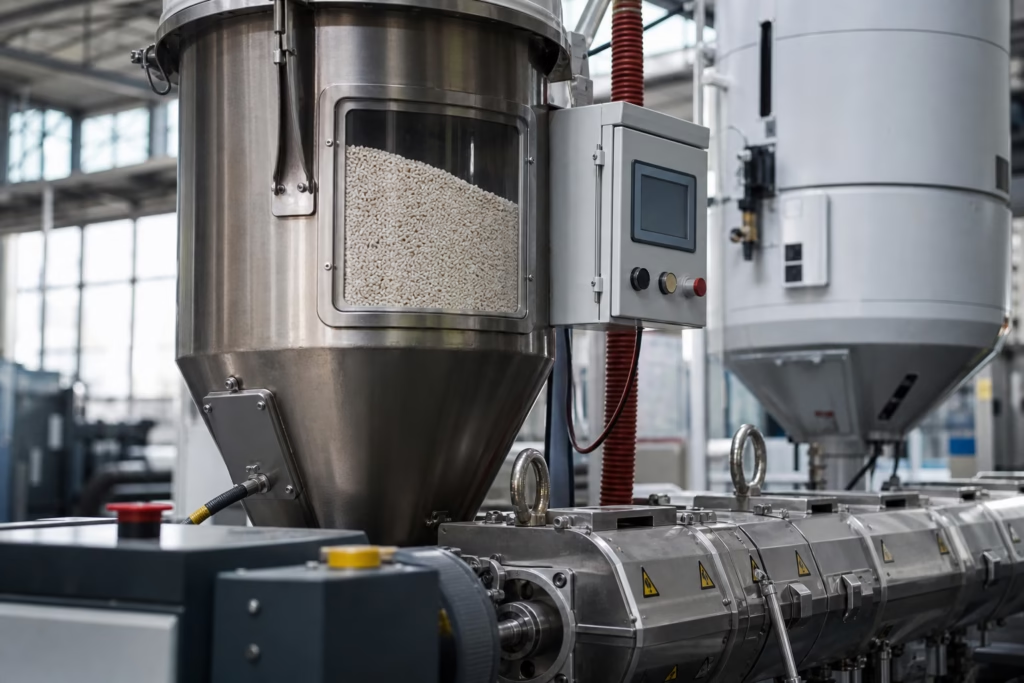
For this reason, we often pair moisture-control discussions with dimensional-stability reviews. A material that looks acceptable in a datasheet can still perform poorly if the production environment cannot hold its moisture condition. The article how to evaluate dimensional stability in plastics is relevant here because it helps teams connect resin choice, reinforcement, moisture state, and molding behavior into one decision framework.
Moisture can also create a misleading property picture. A sample that appears tougher after absorption may not remain reliable after molding, especially if the heat history is severe. Meanwhile, parts with inconsistent moisture levels can show scatter in tensile strength, flexural performance, and impact response. For buyer teams, this is why lot consistency and processing discipline matter as much as the base resin grade.
A Practical Risk Checklist from Storage to Molding
When we help teams troubleshoot a nylon moisture issue, we usually walk the process from the pallet to the press. That approach helps separate material problems from handling problems and gives each department a clear responsibility. The following checklist is practical enough for procurement, warehouse, and molding teams to use together.
| Checkpoint | What to verify | Risk if missed |
|---|---|---|
| Incoming packaging | Bag integrity, seal condition, and desiccant presence | Hidden moisture uptake before storage |
| Warehouse storage | Dry area, stable temperature, no dock exposure | Accelerated absorption from ambient air |
| Open time tracking | How long material stays exposed after opening | Lot-to-lot moisture variation |
| Dryer setup | Temperature, time, airflow, and dew point control | Residual moisture before molding |
| Hopper transfer | Closed transfer and minimized open-air time | Re-absorption after drying |
| Press start-up | First-shot appearance and stability checks | Scrap before the issue is noticed |
| Rejected parts review | Compare defects with material history | Misdiagnosis and repeated waste |
A moisture-control workflow should be written down, not just remembered. If every shift handles nylon differently, the process will drift. A clear checklist makes it easier to identify where the variation starts and whether the fix belongs in storage, drying, or molding.
How to set up moisture control in daily production
Good control does not require complicated systems, but it does require discipline. Keep unopened packaging sealed until the material is needed. Use resealable containers or protected bins after opening. Store nylon away from humid air sources and review FIFO habits so older open material does not sit too long. Dryers should be verified regularly, and the resin should move from dryer to hopper with minimal exposure. If the material is likely to sit for a long time after drying, the process needs a protected transfer method, not just a higher dryer temperature.
In our own material-development work at Poly Maro, the most successful nylon programs are the ones where packaging, storage, and molding are treated as one process chain. If one link is weak, the whole chain becomes the source of the defect.
When to Test Incoming Moisture and When to Re-Dry
Incoming moisture testing is most useful when the supply chain has any uncertainty: long transit time, variable warehouse conditions, open bags returned from line-side storage, or a critical tolerance application. It is also useful when a process that was stable suddenly begins to show appearance or dimensional problems. In those cases, the test provides a fast way to decide whether the material can go straight to drying, needs extra drying, or should be quarantined for review.
Re-drying is often required when nylon has been opened for too long, when it has absorbed humidity in staging, or when the dryer was interrupted before a run. The key is to define a re-dry rule before production starts. That rule can be based on open time, storage condition, or measured moisture level, but it should be consistent across shifts. Without a rule, teams often guess, and guessing is expensive.
For precision applications, material choice can reduce risk but not eliminate it. Even lower-absorption grades still need handling discipline. The point of a lower-moisture material is to widen the practical process window, not to excuse poor storage or skip drying. That is why supplier communication should include both resin selection and process expectations.
Supplier and Production Coordination Points
Nylon moisture control works best when the supplier, warehouse, and molding team share the same definitions. The supplier should know the intended application, target appearance, tolerance class, and processing environment. The processor should know the expected delivery form, packaging format, and any re-dry requirements. Procurement should understand that a slightly different resin choice can change downstream drying time, scrap rate, and line stability.
This is where application-specific material development matters. If a part needs better heat resistance, we may start with PA66. If the priority is lower moisture uptake and better dimensional stability, PA12 can be a better fit. If the application needs a custom balance of stiffness, toughness, color, or surface quality, a tailored compound may be the correct answer rather than a standard grade. That decision should be made with the production reality in mind, not only the datasheet headline numbers.
For teams comparing moisture-sensitive materials against each other, PA66 vs PA12 for strength and moisture absorption trade-offs is useful when the core question is how much process stability can be gained by moving to a lower-absorption polyamide.
How to Distinguish Moisture Defects from Other Processing Defects
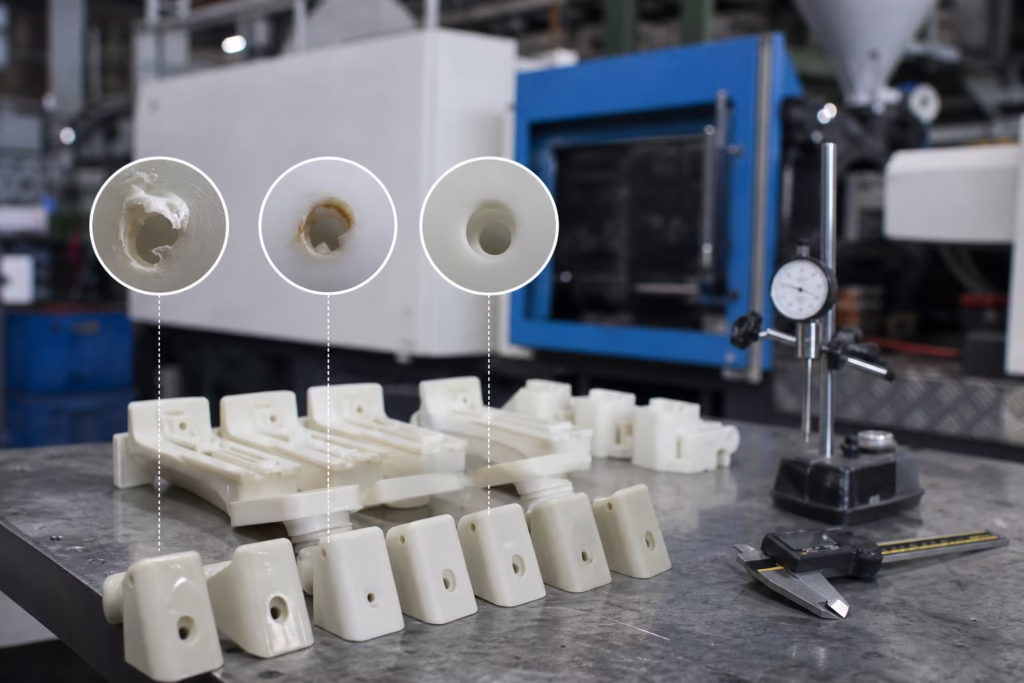
One common troubleshooting mistake is attributing every cosmetic issue to moisture. In reality, moisture defects usually have a pattern. They often appear soon after a storage or drying change, affect multiple cavities or shots in a similar way, and improve when the resin is properly dried. By contrast, gate problems, tool wear, or cooling imbalance tend to create more localized symptoms.
A good diagnostic method is to ask four questions. Did the defect start after the bag was opened? Did the dryer run correctly throughout the shift? Did the resin sit exposed before molding? Did the issue improve after re-drying or material replacement? If the answers point toward exposure or drying failure, the moisture path is likely correct. If not, the root cause may lie in mold temperature, venting, or machine setup.
A Moisture-Control Workflow That Reduces Nylon Molding Problems
The most reliable nylon programs follow a simple sequence: receive sealed material, store it dry, limit open time, dry it with verified settings, transfer it with minimal exposure, and release it only after the material has passed an incoming or pre-run check. That workflow sounds basic, but it prevents many of the rework loops we see in production.
For buyers and engineers, the biggest lesson is that nylon moisture issue control is not a single action. It is a chain of small controls that protect the resin from the moment it arrives until the moment the molded part leaves the tool. If the chain is weak in storage, drying, or handling, the defect will often appear in the press room, even though the root cause began earlier.
That is why material selection, packaging, process setup, and supplier coordination should be evaluated together. When those pieces are aligned, nylon can be a stable, high-performing engineering plastic. When they are not, moisture becomes the hidden variable that undermines productivity.
FAQs
Why does nylon become more difficult to mold after absorbing moisture?
Absorbed water changes how nylon melts and can trigger hydrolysis during heating. In practice, that means the resin may flow less predictably, create surface defects, and produce parts with less consistent mechanical performance. The effect is especially important in applications that need stable dimensions and clean appearance.
How can we tell whether a nylon moisture issue started in storage or at the machine?
Start by checking packaging history, open-bag time, warehouse humidity exposure, and whether the dryer ran correctly before molding. If the defect appears after long exposure or improves after re-drying, the root cause is likely storage or pre-processing. If the symptom is localized to one area of the tool, the issue may be elsewhere.
Is drying always required before molding PA6 or PA66?
Yes, drying is normally required because polyamides absorb moisture from the environment. The exact drying conditions depend on grade, initial moisture level, and processing setup, but the goal is always to reduce residual moisture enough to support stable molding and prevent surface or hydrolysis-related defects.
When should incoming nylon material be tested for moisture?
Incoming moisture testing is especially useful after long transit, when packaging has been opened or damaged, when the warehouse environment is uncertain, or when the application has tight dimensional limits. It is also helpful if a stable process suddenly starts showing splay, bubbles, or other moisture-related symptoms.
Can a lower-moisture nylon grade solve all moisture problems?
No. A lower-absorption grade can widen the process window and reduce sensitivity, but it does not replace proper storage, drying, and handling. Even more stable nylon grades can still absorb water over time, so production discipline remains essential.
What is the most common mistake teams make with nylon moisture control?
The most common mistake is assuming that sealed delivery means the material will stay ready forever. Once packaging is opened, exposure time, re-sealing quality, and transfer discipline become critical. Many defects start because the material sat too long in open air before drying or molding.