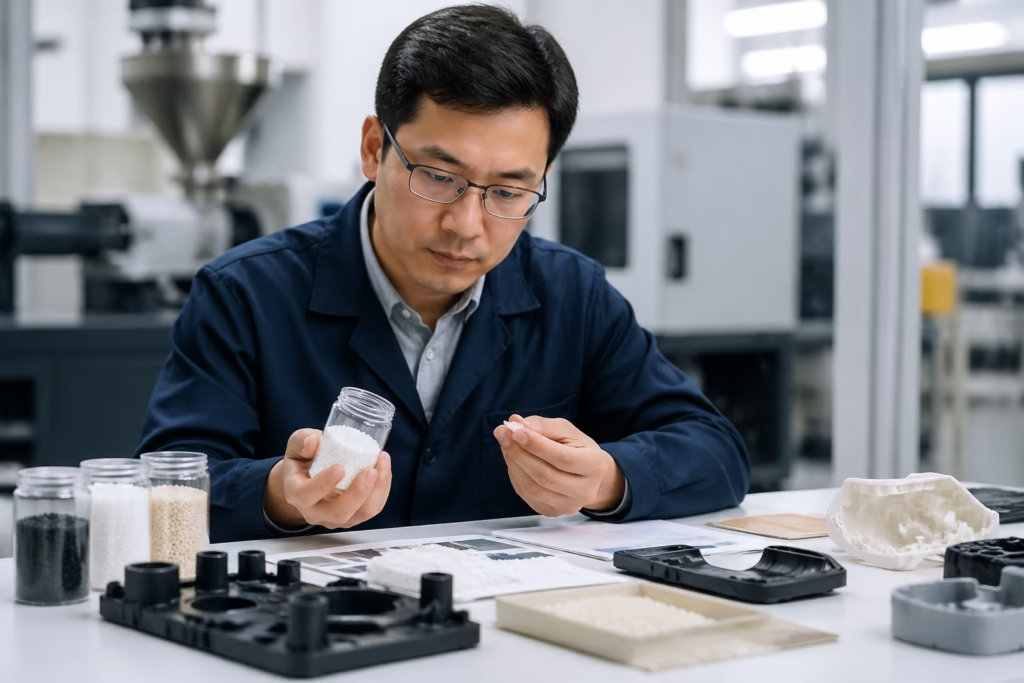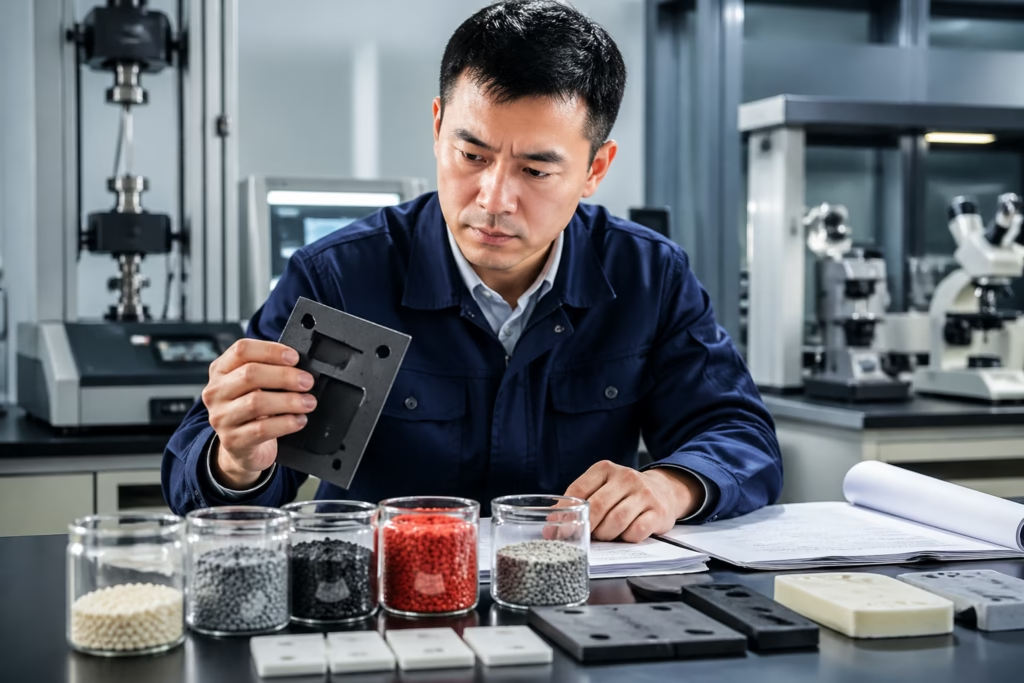
Choosing a wear resistant plastic compound is rarely about finding one material that performs well in every moving part. Gears, sliders, guides, cams, bushings, and other wear-prone components each face different combinations of load, speed, heat, and surface contact, so the right choice depends on how the part actually moves in service.
For a practical starting point, it helps to map the part to its applications for wear parts and then narrow the material family based on friction, stiffness, moisture response, and expected life.
Why wear resistance is not the same as low friction
Many teams assume a low-friction plastic will automatically be the most wear-resistant option. In practice, these are related but not identical goals. A material can slide easily yet lose mass quickly under repeated contact, while another may resist wear well but generate more heat or noise.
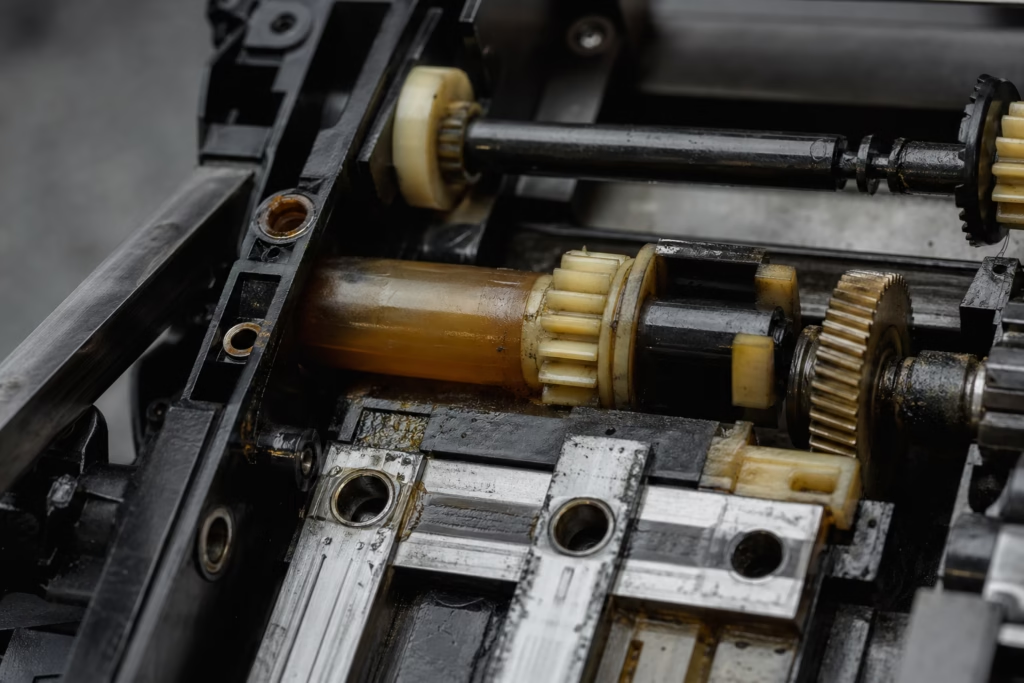
For gears and sliding assemblies, wear usually comes from a mix of abrasion, adhesion, stick-slip, and thermal softening. The wrong compound may still look acceptable in early testing, then degrade once the part sees continuous duty, a higher load, or a less controlled surface finish.
Common failure modes in moving parts
- Abrasion: hard particles or rough counterfaces remove material from the polymer surface.
- Adhesion: two surfaces transfer material to each other, increasing drag and wear.
- Stick-slip: inconsistent motion creates noise, vibration, and local heat buildup.
- Creep: sustained load slowly changes shape and alignment.
- Fatigue: repeated motion weakens teeth, lips, or thin sections over time.
- Dimensional wear: small losses in thickness, pitch, or clearance can cause functional failure.
Because Poly Maro works with material systems for industrial parts, the selection question is usually not just “which resin wears best?” but “which compound stays stable under the real combination of motion, load, and environment?”
What operating conditions matter most

The same resin can perform very differently depending on the application. Before choosing a compound, define the operating window as clearly as possible:
| Condition | Why it matters | Selection impact |
|---|---|---|
| Load | Higher force increases contact stress and creep risk | May require stiffer or reinforced materials |
| Speed | Higher sliding speed raises heat and friction sensitivity | Material must manage temperature rise |
| Contact type | Gear mesh, flat slide, rolling contact, or oscillation all wear differently | Different surface behavior is needed |
| Lubrication | Dry running and greased systems behave differently | Some compounds excel only in dry conditions |
| Temperature | Heat can reduce stiffness and accelerate wear | May rule out softer commodity plastics |
| Moisture | Water absorption changes dimensions and mechanical response | Important for PA-based choices |
| Duty cycle | Continuous motion is harder on materials than intermittent use | Determines life expectancy expectations |
If moisture and dimensional change are a concern, it is often worth comparing PA66 compounds against lower-absorption alternatives rather than assuming a standard nylon grade will remain stable.
Material selection routes for different performance needs
There is no universal winner, but several material families appear often in wear-prone designs. POM materials are frequently chosen for their balance of low friction, decent stiffness, and easy processing, especially where noise and smooth motion matter. PA-based materials can offer better toughness and higher load tolerance, but they are more sensitive to moisture. UHMWPE is valued for abrasion resistance and low friction, yet its lower stiffness can limit precision. PTFE-filled compounds can reduce drag and improve sliding behavior, while higher-performance families such as PEEK and PPS grades are often considered when heat, chemical exposure, or long service life become more demanding.
The right wear resistant plastic compound is therefore a balance of friction, rigidity, thermal stability, and dimensional control. A softer material may slide quietly but deform too much under load. A stiffer material may hold geometry well but need a modifier package to reduce wear against the counterface.
How to choose plastic for gears
Gear applications place a special emphasis on tooth wear, fatigue resistance, and dimensional stability. A gear may not experience the same sliding distance as a long guide rail, but repeated tooth engagement creates concentrated stress and demands predictable geometry over time. If backlash, noise, or tooth profile retention are critical, the compound needs enough stiffness to preserve the mesh while still resisting surface wear.
For many projects, the choice between POM vs PA for gears comes down to whether the application values smoother dry running and stable dimensions or higher toughness and load support. In gear systems, the best material is often the one that keeps tooth form stable after long cycling, not just the one with the lowest friction number in isolation.
When selecting a gear material, check these points:
- Tooth wear rate: material loss on the flank and root.
- Fatigue behavior: resistance to repeated load cycles.
- Stiffness: enough modulus to hold pitch accuracy.
- Noise control: especially important in consumer or office equipment.
- Heat buildup: long duty cycles can reduce performance if the material softens.
How to choose plastic for sliding components
Sliding components often face the harshest friction-related problems because the contact area is continuous and motion can be repetitive. Guides, wear strips, bushings, and sliders need controlled friction, consistent surface behavior, and compatibility with the mating surface. A compound that performs well against steel may behave differently against aluminum, plated surfaces, or another polymer.
Surface finish also matters more than many teams expect. A rough counterface can make a good material look poor in testing, while a polished or well-machined surface may reduce wear dramatically. This is why a reliable selection process should consider both the plastic and the mating part as a system, not as isolated materials.
For long-life sliding parts, the goal is often to reduce adhesive wear without sacrificing load-bearing ability. Some compounds use internal lubricants or solid lubricant packages to improve sliding, but those additions can also alter strength, weld line behavior, and moldability.
How to choose plastic for moving parts under higher stress
When parts see higher load, more heat, or less forgiving alignment, heat resistance and creep resistance become decisive. This is especially true in compact mechanisms where the part is small, the motion is repeated, and there is little room for deformation before function is affected. In these cases, a more advanced polymer family may be justified even if it raises material cost.
Materials like PPS grades can be attractive when the design must withstand elevated temperatures, maintain stiffness, and resist chemical exposure. For some assemblies, that stability can extend service life more effectively than simply choosing a lower-friction resin with weaker high-temperature behavior.
The decision should focus on whether the part fails by surface wear first or by loss of shape first. If creep, deflection, or heat softening are the main risks, a compound with stronger thermal performance may outperform a material that only looks good in short-term wear tests.
When fillers and modifiers help
Fillers and modifiers can improve wear behavior, but they must match the application. Glass fiber can increase stiffness and dimensional stability, yet it may increase counterface wear and reduce toughness. PTFE can lower friction and support smoother sliding, but it can also influence strength and processing behavior. Molybdenum disulfide and silicone-based additives may help with lubrication and noise control in selected systems. Solid lubricant blends are often useful when dry running is unavoidable.
The same principle applies when working with PA66 compounds: a modifier package can make the material more suitable for a specific wear problem, but the compound should still be checked for moisture response, impact resistance, and long-term dimensional stability.
A practical way to think about modifiers is this:
- Need more stiffness? Consider reinforcement.
- Need lower friction? Consider internal lubrication.
- Need quieter motion? Consider a balanced additive package.
- Need better high-temperature life? Consider an engineering-grade base resin.
Trade-offs to avoid when improving wear performance
Better wear resistance can come with side effects. A compound that slides well may be harder to machine, more brittle, more expensive, or less stable in humid conditions. A highly reinforced material may hold geometry better but create extra wear on the mating part. A very slippery blend may lose load capacity or weld strength. For that reason, wear performance should never be judged alone.
This is where manufacturer input can help. A supplier like Poly Maro can evaluate whether a compound should prioritize friction reduction, stiffness, impact resistance, or environmental stability, depending on the part’s actual function.
Before locking in a resin, check the likely trade-offs against the real operating environment:
- Will the part run dry or with lubricant?
- Will the mating surface be hard or soft?
- Will moisture change dimensions enough to matter?
- Will the part need impact tolerance during assembly?
- Will the part need machining after molding?
Validation before final selection
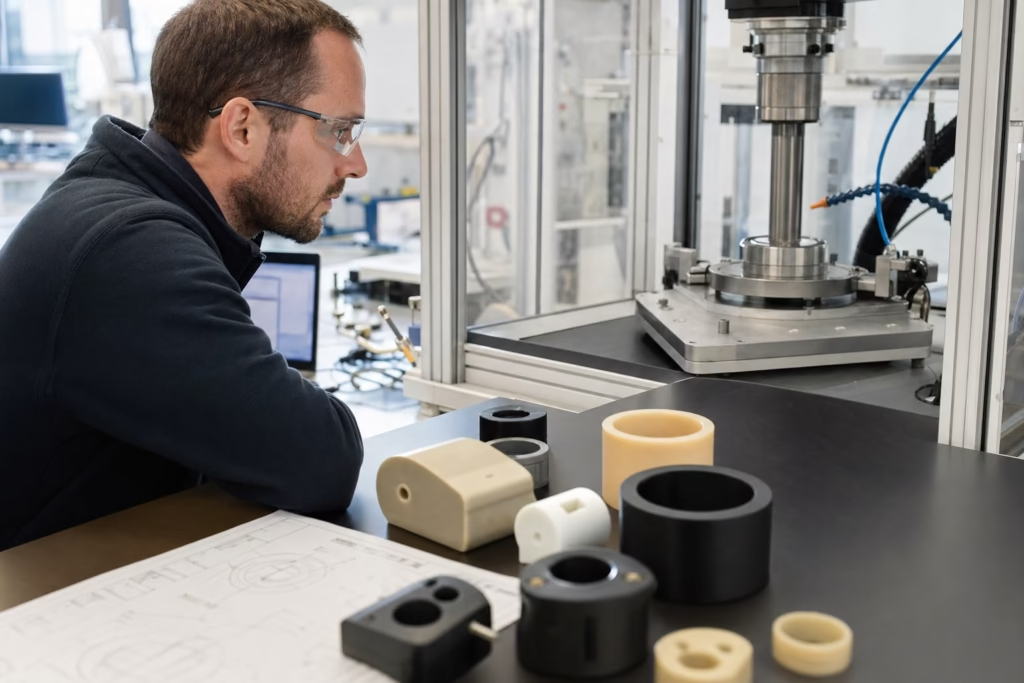
Wear performance should be validated under conditions that resemble the real part as closely as possible. Laboratory wear data is useful, but it becomes far more meaningful when paired with prototype testing, actual counterface materials, and realistic duty cycles. Even a strong material choice can fail if the surface finish, alignment, or loading pattern differs too much from production.
Useful validation methods include wear testing, coefficient of friction checks, accelerated life testing, and application-specific prototypes. Where possible, compare multiple compounds side by side using the same geometry, same mating part, and the same operating profile. That approach often reveals whether a part needs a true wear resistant plastic compound or simply a better compound balance for stiffness, temperature, and moisture control.
Practical selection checklist
Use this checklist to narrow the material family before final testing:
- Define the part function: gear, slider, bushing, cam, or guide.
- Identify the main failure mode: abrasion, creep, heat buildup, or fatigue.
- Check the motion type: rotating, reciprocating, oscillating, or mixed.
- Confirm load, speed, and duty cycle.
- Note the environment: dry, lubricated, hot, humid, or chemically exposed.
- Decide whether low friction, high stiffness, or dimensional stability matters most.
- Choose a baseline resin family and then test modifiers if needed.
- Validate with prototypes before committing to production volume.
For teams comparing material families, POM vs PA for gears is a useful reference point because it highlights the most common trade-off between smooth running and load tolerance.
Conclusion
Selecting the right wear resistant plastic compound is a decision about function, not just material popularity. Gears need tooth stability and fatigue resistance. Sliding components need friction control and counterface compatibility. Higher-stress moving parts need thermal stability and creep resistance. The best outcome usually comes from matching the compound to the actual failure mode, then verifying the choice with testing that reflects the real application.
When the operating conditions are not fully defined, a conservative material choice can be misleading. A better approach is to compare the likely candidates by wear, friction, heat response, and dimensional stability, then narrow the field through prototype validation. That process reduces the chance of defaulting to POM when a different engineered compound would deliver a longer and more reliable service life.
FAQ
Is POM always the best wear-resistant plastic for moving parts?
No. POM is a strong baseline for many dry-running parts, but higher load, heat, moisture, or chemical exposure may make another resin family more suitable.
What is the difference between wear resistance and low friction?
Low friction reduces sliding resistance, while wear resistance measures how well the material keeps its mass and shape over time. A material can do one better than the other.
When should I use a filled compound instead of a neat resin?
Use a filled compound when the part needs better stiffness, lower friction, or improved stability under load, but confirm that the filler will not damage the mating surface or reduce impact performance too much.
Are glass fiber reinforced plastics good for wear parts?
They can be, especially when stiffness and dimensional control matter, but they may increase wear on the counterface and are not always the best choice for gentle sliding contact.
How important is moisture absorption for wear performance?
Very important for many nylon-based parts, because moisture can change size, stiffness, and wear behavior. If tolerances are tight, moisture response should be evaluated early.
What test should I run before approving a material?
At minimum, test wear, friction, and life under the same load, speed, and mating surface expected in production, then verify the part with an application-specific prototype.