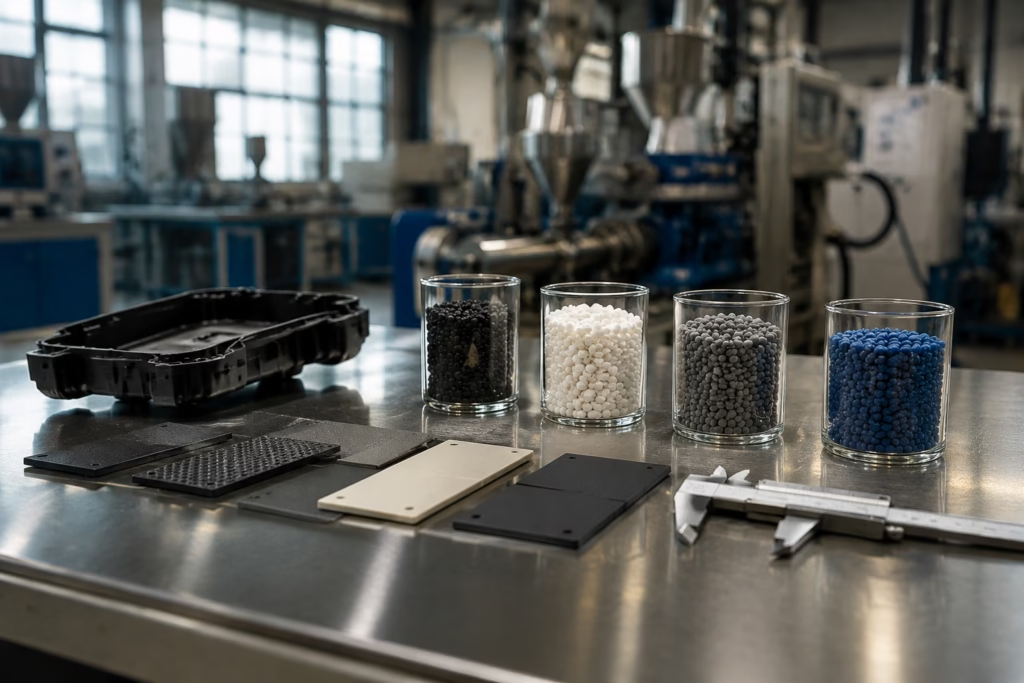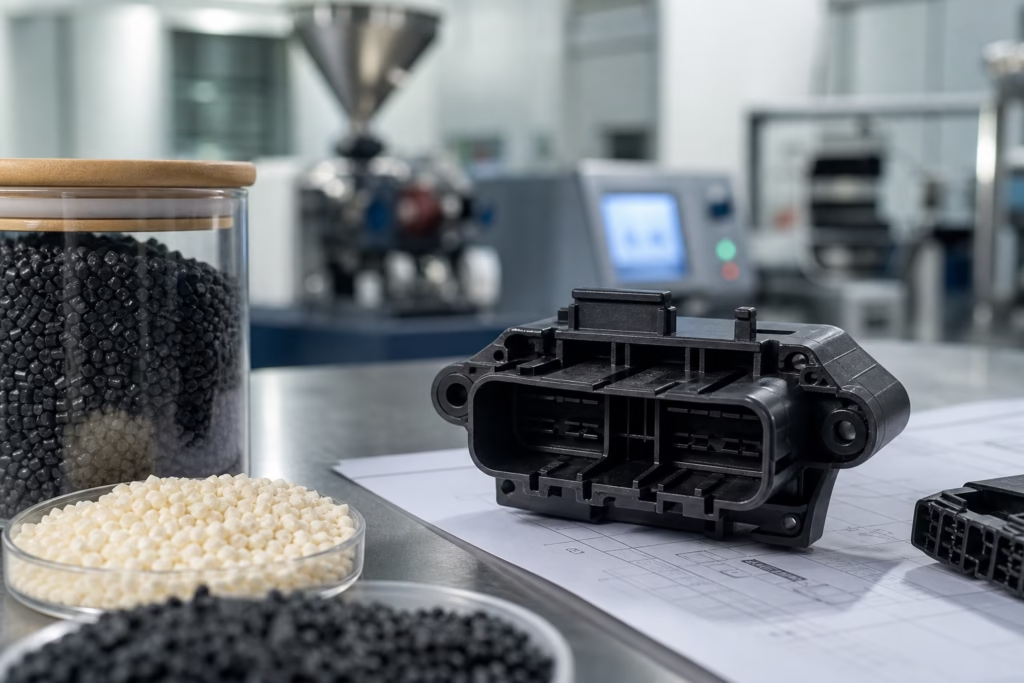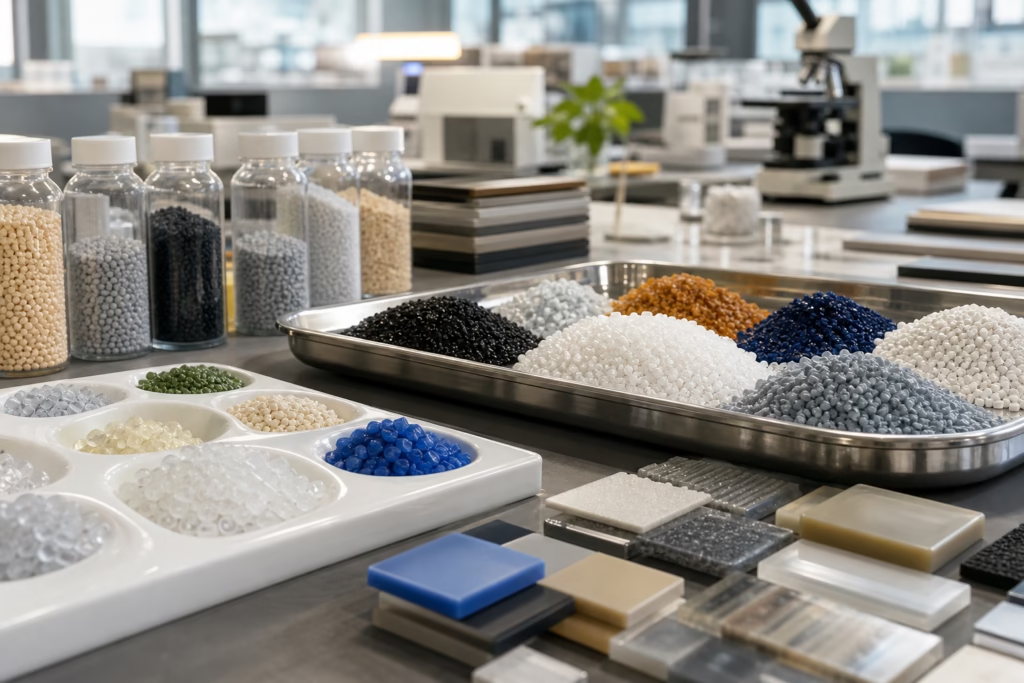
Choosing the right industrial plastic parts material for gears, bushings, and sliding parts is rarely about one property alone. In equipment, these parts fail for different reasons: gears can lose tooth accuracy or wear at the mesh line, bushings can creep or seize under load, and sliders can scuff, heat up, or drift out of tolerance after repeated motion. The correct material choice starts with the real working condition, not the resin family name.
At Poly Maro, we often help engineers narrow the field by comparing load, speed, duty cycle, lubrication, temperature, dust, and chemical exposure before a resin is even shortlisted. If a project needs durable motion parts rather than general-purpose plastic components, our wear-resistant plastic compound solutions for moving parts are designed to support that kind of selection process, including reinforcement choice, friction tuning, dimensional control, and sample validation for industrial equipment applications.
What Industrial Moving Parts Need from Plastic Materials
Industrial gears, bushings, and sliding blocks may all move, but they do not ask the material for the same performance. A gear needs consistent tooth form, stable modulus, and resistance to wear under repeated contact. A bushing needs low friction, good conformability, and strong creep resistance under long contact pressure. A slider or guide needs smooth motion, low wear debris, and shape stability across temperature changes. This is why a material that works well in one part type may fail in another.
In practice, moving parts fail from several mechanisms at once. Wear can increase backlash or clearance. Heat can reduce stiffness and accelerate deformation. Moisture can change dimensions, especially in polyamides. Chemicals can attack the surface and reduce service life. That is why material selection should be based on the dominant failure mode, not just on tensile strength from a datasheet.
Start with the Operating Conditions
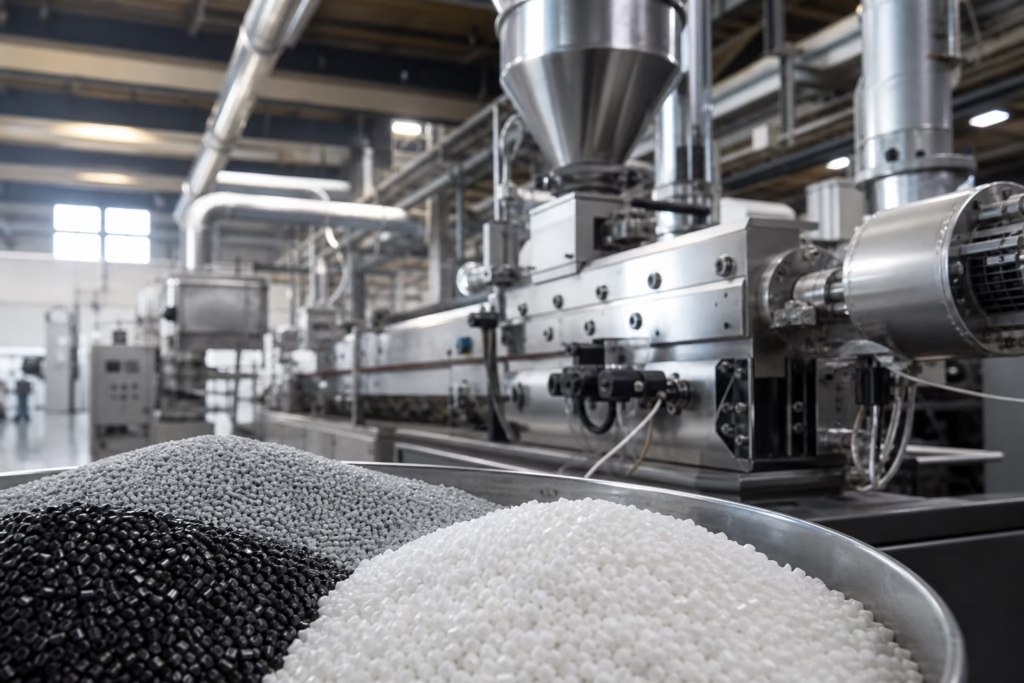
Before comparing resins, define the actual service environment in a structured way. We recommend asking these questions:
- What is the load: steady, shock, or cyclic?
- What is the motion: continuous, intermittent, oscillating, or start-stop?
- What is the speed, and does frictional heat build up?
- Is the part dry-running, grease-lubricated, or exposed to oils and cleaners?
- What is the temperature range during operation and shutdown?
- Is dust, abrasive powder, or foreign particle contamination expected?
- Will the part see water, humidity, fuel, alcohol, cleaning agents, or industrial media?
These conditions often decide the winner more than the base resin family. For example, a strong but moisture-sensitive resin can become dimensionally unstable in a humid environment. A low-friction resin can perform well at room temperature but soften too quickly at elevated temperature. A glass-filled resin may improve stiffness but increase mating wear if the contact pair is not designed carefully.
For that reason, it is useful to compare resins not as abstract materials but as system candidates. In our experience, many buyers get better results when they review POM vs PA for gears early in the project, because those two families often appear first in motion-part selection and illustrate the core trade-off between sliding performance, moisture sensitivity, strength retention, and tolerance stability.
Key Property Priorities to Check First
When we evaluate an industrial plastic parts material for gears, bushings, or sliders, we usually rank properties in this order of practical importance:
| Property | Why It Matters | Common Risk If Ignored |
|---|---|---|
| Wear resistance | Controls service life under repeated contact | Rapid clearance growth, noise, and failure |
| Friction coefficient | Determines sliding smoothness and heat generation | Stick-slip, overheating, power loss |
| Creep resistance | Protects shape under sustained load | Deformation, backlash, loss of fit |
| Dimensional stability | Maintains accuracy in toleranced parts | Noise, misalignment, binding |
| Heat resistance | Controls stiffness and wear at elevated temperature | Softening, distortion, accelerated aging |
| Impact and fatigue strength | Resists shock and repeated motion | Cracking, tooth damage, edge failure |
Two materials may look close on a datasheet but behave very differently in use. A higher tensile strength does not automatically mean lower wear. A higher modulus does not always mean better gear life. A part can also be too stiff, causing load concentration at the contact face. The best selection is the one that balances wear, creep, heat, and process stability under the real duty cycle.
For buyers and engineers who need a quick screening step, a good way to separate candidates is to first judge whether the part is primarily a load-bearing part, a low-friction part, or a tolerance-critical part. That simple sorting step often makes the next material choice much clearer.
Gears vs Bushings vs Sliding Blocks
Each part type has a different material priority, even when they are used in the same machine.
Gears
For gears, tooth stiffness, fatigue resistance, and wear behavior matter most. The material must preserve tooth geometry, mesh smoothly, and resist tooth root cracking under repeated load. In many moderate-load applications, unfilled or lightly modified POM, PA, PBT, or engineered blends are considered first. Where loads or temperatures rise, reinforced compounds may be needed, but the effect on mating wear must be checked carefully.
Bushings
For bushings, creep resistance and friction are often more important than pure strength. A bushing may not look highly stressed, but long-term contact pressure can cause deformation, increased clearance, and shaft misalignment. This is why bushing selection should be based on sustained load rather than only peak load.
Sliding blocks and guides
For sliding blocks, friction stability, abrasion resistance, and surface quality are critical. These parts often work with imperfect alignment, changing loads, or contamination from dust and debris. A slider that performs well in clean lab testing may still fail in the field if the surface finish, debris evacuation, or mating material is not considered.
For precision motion parts, dimensional retention is often the deciding factor. That is why we advise buyers to study how to evaluate dimensional stability in plastics before final approval, especially when the part runs under tight clearances, in an assembly stack-up, or across changing humidity conditions.
Material Routes for Industrial Plastic Parts
The most common material routes for motion parts include PA, POM, PBT, PPS, PC, TPU, and modified engineering plastics. Each one can be a valid choice if the operating window matches the material profile.
| Material Family | Typical Strengths | Typical Watchouts | Best Fit |
|---|---|---|---|
| POM | Low friction, good wear, low moisture absorption, stable dimensions | Heat limit and chemical exposure must be checked | Precision gears, bushings, sliders |
| PA6 / PA66 | High toughness, good fatigue performance, wide reinforcement options | Moisture absorption affects dimensions | Loaded gears, structural bushings |
| PBT | Good stability, good electrical insulation, balanced processing | Less forgiving in severe sliding wear than dedicated wear grades | Moderate-load moving parts |
| PPS | High heat resistance, chemical resistance, good dimensional retention | Higher cost, brittle if not modified correctly | Hot, chemically exposed equipment parts |
| PC | Impact resistance and toughness | Wear and creep performance may be insufficient alone | Parts needing impact tolerance more than sliding life |
| TPU / TPE | Elasticity, shock absorption, grip | Not ideal for rigid precision gears | Soft interfaces, dampers, compliant sliding elements |
POM is often chosen as a baseline material for precision motion parts because it combines low moisture absorption with useful wear and sliding behavior. In many projects, it serves as the first benchmark material before moving to modified or reinforced options. If you need a quick technical overview, our article on POM vs PA for gears is a practical starting point, especially when your team is balancing low-friction performance against moisture-driven dimensional change.
When to Use Reinforced or Filled Compounds
Reinforcement and filling can improve stiffness, heat resistance, and dimensional control, but they must be used carefully in moving parts.
- Glass fiber reinforced compounds raise modulus and reduce deformation under load, which helps structural gears and brackets. The trade-off is higher abrasion on mating shafts or gears if the contact pair is not optimized.
- Mineral-filled compounds can improve dimensional stability, shrinkage control, and warpage behavior. They are useful when flatness or fit consistency matters more than maximum toughness.
- Self-lubricating additives reduce friction and wear, especially in dry-running or lightly lubricated applications. They are often helpful in sliders and bushings.
- Wear-resistant modifications can extend life in abrasive or oscillating motion, especially when paired with an appropriate mating material and surface finish.
Overuse of glass fiber is a common mistake. If a gear or bushing becomes too abrasive, the mating shaft or counterface can fail first. In other words, improving one side of the system can create a new failure point elsewhere. That is why modification should be decided as a pair-system problem, not a single-part problem.
When heat is part of the problem, we also recommend checking how to choose heat-resistant plastic compounds. Temperature rise from ambient conditions, friction, or nearby heat sources can change stiffness, creep, and wear behavior faster than many teams expect.
How Friction and Wear Should Be Evaluated
Wear testing should reflect how the part actually moves. A dry-running bushing in a slow actuator behaves differently from a fast rotary gear pair. A sliding block under intermittent motion can show stick-slip, while a continuous-motion guide may fail from gradual heat build-up.
Important wear variables include the mating shaft material, surface finish, alignment, contact pressure, lubrication type, and whether dust or abrasive particles are present. Even the same resin can behave differently against steel, aluminum, or another polymer. In addition, frictional heat can reduce strength locally at the contact zone and shorten life far earlier than bulk temperature measurements suggest.
For load-bearing sliding applications, PV loading is a useful concept because it combines pressure and velocity into one practical screening metric. Industry references such as the PV limit, creep resistance, and moisture effects in plastic bearing selection help explain why long-term load, speed, and surface temperature can eliminate materials that look strong on paper but do not survive in real motion use.
How Load and Creep Affect Long-Term Stability
Static or continuous load is one of the most underestimated selection factors. A bushing may appear fine during short bench testing, then slowly deform after days or weeks in service. A gear tooth under constant tooth engagement can also deflect enough to change backlash and noise.
Creep is especially important when the part is under sustained contact stress, such as in a stationary bushing, a loaded gear tooth, or a support slider holding weight. Materials with good short-term strength can still deform if the load is continuous and the temperature is elevated. Reinforcement can help, but only if the design also manages stress concentration and assembly fit.
For procurement teams, the practical question is not whether the resin has good strength in a datasheet test. It is whether the part keeps its shape after the actual load cycle, in the actual temperature and humidity range, for the actual maintenance interval.
How Temperature Changes Material Choice
Temperature affects moving parts in three ways: it softens the polymer, increases creep, and changes the friction behavior at the contact surface. In addition, thermal expansion can alter clearances and fit. A part that runs smoothly at room temperature may bind, chatter, or wear faster once the equipment heats up.
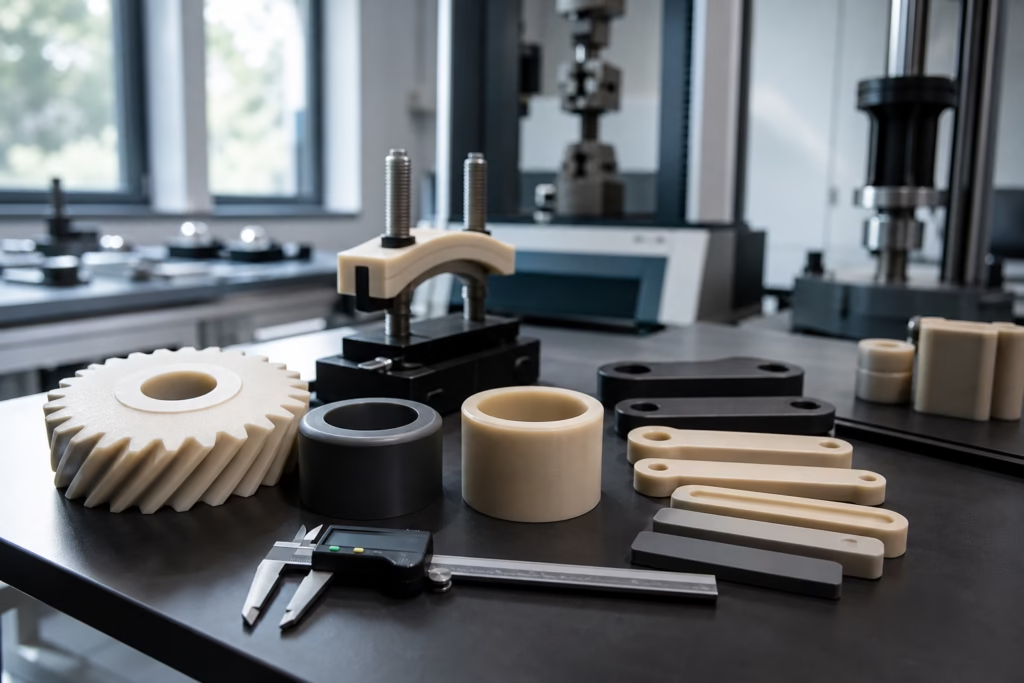
Heat resistance should be evaluated in context. The part may not need a very high melting point; it may only need to retain stiffness at the highest operating temperature plus frictional heat. That is why heat deflection temperature, thermal aging, and dimensional retention matter more than a single headline heat number.
When a project runs near thermal limits, the best step is to compare resin families and then confirm the thermal window with testing. Our guide on how to choose heat-resistant plastic compounds is useful for teams that need to translate temperature exposure into real material choice rather than a generic heat-resistance label.
Processing and Molding Factors That Affect Final Performance
Even the right resin can underperform if processing is poorly controlled. Moisture content, drying method, melt temperature, mold temperature, gate design, and cooling rate all influence the final motion part.
For polyamides, moisture control is especially important because water uptake can change dimensions and mechanical behavior. For POM and other low-friction grades, proper temperature control helps avoid degradation and surface defects. For filled compounds, fiber orientation can affect shrinkage and warpage, which in turn changes tooth contact, bore alignment, or slide smoothness.
We usually look at these processing checkpoints:
- Drying conditions: confirm the actual resin requirement, not a generic plant standard.
- Flowability: ensure the part fills thin sections without excessive orientation or burn marks.
- Shrinkage and warpage: check critical dimensions after cooling, not only immediately after demolding.
- Surface quality: verify that the contact face is smooth enough for the intended wear duty.
- Post-mold conditioning: allow the part to reach a stable state before final dimensional approval.
For this reason, processing and chemical exposure should be reviewed together. In many real cases, failure starts not with mechanical overload but with a cleaner, oil, or industrial fluid that changes the surface behavior. Our discussion on how plastics fail in oil, cleaners, and industrial media is especially relevant when the part is inside equipment that is regularly maintained, washed, or lubricated.
At Poly Maro, we often adjust compounding to help balance moldability, wear, and dimensional stability. For OEM and ODM projects, this is where Poly Maro can support resin development decisions such as reinforcement level, additive package, color matching, and batch consistency planning.
Common Material Selection Mistakes in Industrial Equipment Parts
We see the same selection errors repeatedly across gear, bushing, and sliding-part programs:
- Choosing by strength alone: a strong resin may still wear too fast or creep under continuous load.
- Ignoring friction and mating material: the best polymer choice depends on what it rubs against.
- Overusing glass fiber: stiffness rises, but surface wear and shaft abrasion can rise too.
- Underestimating temperature rise: frictional heat can push a borderline material out of its safe zone.
- Skipping moisture analysis: especially risky for polyamides in humid or wet environments.
- Testing only one prototype condition: real equipment often sees more load variation than lab trials suggest.
A useful rule is this: if the part is low cost but high consequence, do not optimize only for raw material price. Downtime, scrap, service visits, and warranty cost can quickly exceed the resin savings.
Verification and Test Methods Before Mass Production
Before mass production, we recommend validating the material in conditions close to real use. Prototype testing should not only prove that the part fits; it should show that it survives the motion environment.
Useful test methods include:
- Wear testing: to compare life under the intended motion pattern.
- Torque or drive load testing: to check resistance and power demand.
- Dimensional inspection: before and after conditioning, load, and heat exposure.
- Aging tests: to observe property drift over time.
- Application simulation: to recreate alignment, duty cycle, lubrication, and contamination conditions.
For POM, PA, and modified engineering plastics, a quick internal comparison is usually not enough. Teams should check not only the initial run but also the second and third production samples to confirm batch-to-batch consistency, color stability if relevant, and molding repeatability. This is where a manufacturer partner can reduce risk by aligning formulation, sample prep, and production process before full release.
Supplier Evaluation Checklist
When sourcing industrial plastic parts material, technical fit is only part of the supplier decision. The other part is whether the supplier can repeat that fit in real production.
| Supplier Check | What to Confirm | Why It Matters |
|---|---|---|
| Datasheet detail | Mechanical, thermal, wear, and moisture data | Supports better shortlist decisions |
| Formulation support | Ability to adjust reinforcement or additives | Needed for application-specific tuning |
| Sample consistency | Whether trial pellets match production intent | Reduces validation risk |
| Lead time and MOQ | Whether supply fits project timing | Prevents launch delays |
| Process guidance | Drying, molding, and conditioning advice | Improves first-pass success |
| Change control | How formulation and process changes are managed | Protects long-term production stability |
For production planning, it is better to ask early whether the material can be supplied as a standard grade or needs custom compounding. If the part is near a thermal or wear boundary, custom formulation can often lower risk more effectively than trying to force a standard grade into a difficult application.
How to Balance Cost, Service Life, and Processability
The lowest-cost resin is not always the lowest-cost part. In industrial equipment, part cost should include scrap rate, molding cycle, wear life, downtime risk, maintenance frequency, and replacement labor. A slightly more expensive compound may reduce total system cost if it extends service life or stabilizes production.
The most practical selection logic is often:
- Start with the lowest-cost resin that can realistically meet the duty cycle.
- Move to a wear-modified or filled version if friction or deformation is the limiting factor.
- Move to a heat-resistant or chemically resistant compound if environment is the limiting factor.
- Use reinforcement only when stiffness or creep control is truly needed.
This logic helps avoid overengineering. It also helps procurement teams explain why a resin upgrade is justified by service life or process stability rather than by a material spec alone.
Recommended Selection Workflow for Engineers and Buyers
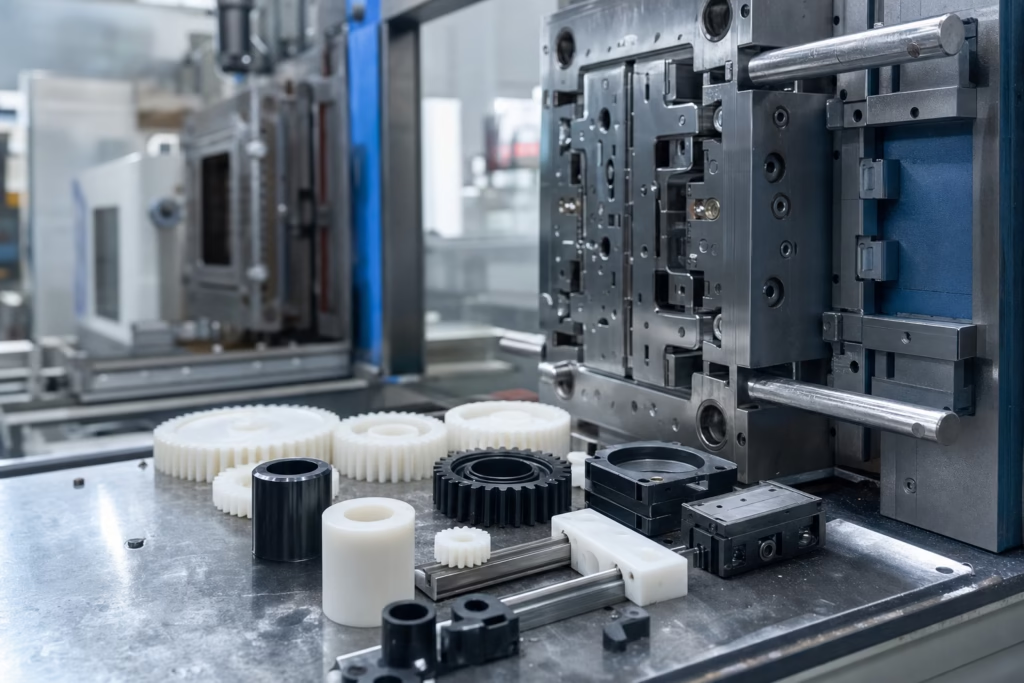
From our material development perspective, the fastest way to choose a good industrial plastic parts material is to follow a structured workflow rather than debating resin names first.
- Define load, speed, temperature, lubrication, contamination, and chemical exposure.
- Identify the dominant failure mode: wear, creep, heat, impact, or dimensional drift.
- Shortlist 2 to 4 candidate resin families and modification routes.
- Check processing fit: drying, molding window, shrinkage, and warpage risk.
- Run prototype testing under real duty cycle conditions.
- Review sample consistency and supplier change control before release.
- Lock the final grade only after the part passes both performance and production checks.
This workflow is especially valuable for gear, bushing, and slider programs because the material choice affects not only part life but also assembly accuracy and machine uptime.
Conclusion
Choosing industrial plastic materials for gears, bushings, and sliding parts is a balancing act between wear, friction, creep, heat resistance, dimensional stability, and processing reliability. The right choice depends on how the part moves, what it touches, and what environment it must survive. POM, PA, PBT, PPS, PC, TPU, and modified compounds all have a place, but each one has a different operating window.
If you start with the real service conditions, test early, and verify both performance and molding behavior, you can reduce failure risk and improve production consistency. For motion parts, that is usually more valuable than chasing a single headline property. In our view, the best result comes when engineering, procurement, and the material supplier evaluate the part as one system, not three separate tasks.
FAQs
What is the best industrial plastic parts material for gears?
There is no single best resin for all gears. POM is often a strong starting point for precision, low-moisture applications, while PA grades may suit higher load or tougher conditions. The final choice should depend on torque, speed, temperature, and the mating material.
Are bushings better in POM or PA?
POM is often preferred when low friction, low water absorption, and dimensional stability are important. PA can be better when the bushing needs higher toughness or load capacity, but moisture effects must be managed carefully.
When should I use a glass fiber reinforced compound?
Use glass fiber reinforcement when stiffness, creep resistance, or thermal stability is the main limitation. It is less ideal when the part has sensitive mating wear surfaces, because the added stiffness can increase abrasion in the contact system.
How do I know if a sliding part will wear too fast?
Look at the combination of load, speed, lubrication, surface finish, and contamination. If the part runs dry, under pressure, or against a rough mating surface, a wear-modified grade or a different resin family may be needed. Prototype wear testing is the most reliable check.
Does moisture really matter for industrial plastic moving parts?
Yes, especially for polyamides. Moisture can change dimensions, stiffness, and long-term behavior. For tight-clearance gears and bushings, moisture uptake can cause fit changes that are large enough to affect noise, wear, or assembly performance.
How should buyers evaluate a supplier for these parts?
Ask for detailed datasheets, sample consistency, drying and molding guidance, lead time, MOQ, and change-control rules. If the part is critical, confirm that the supplier can support custom compounding and can keep formulation consistent across production lots.