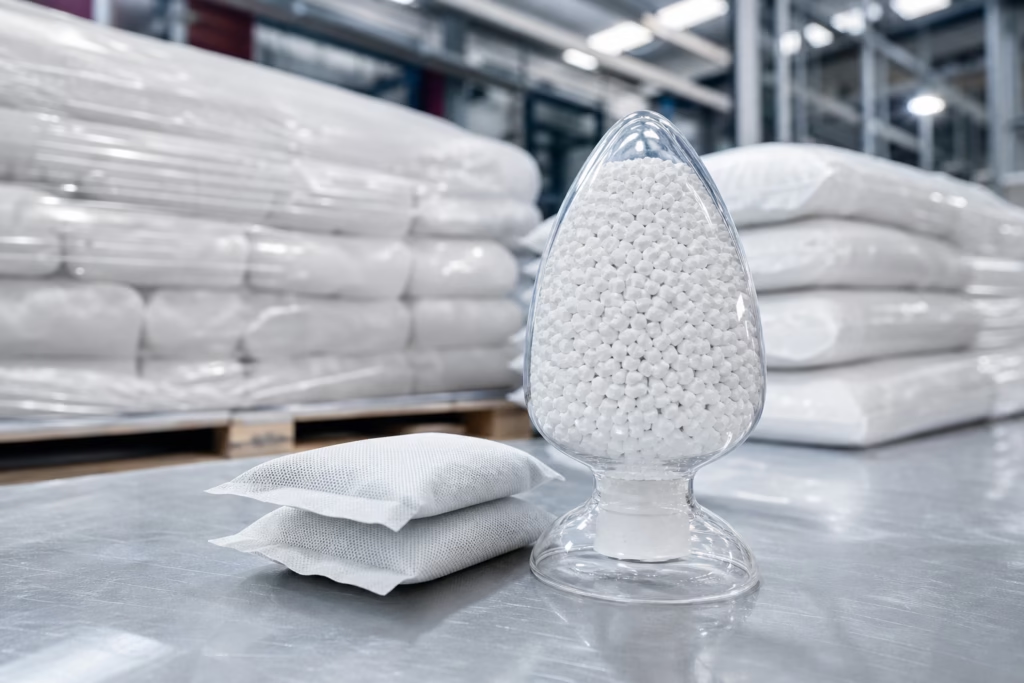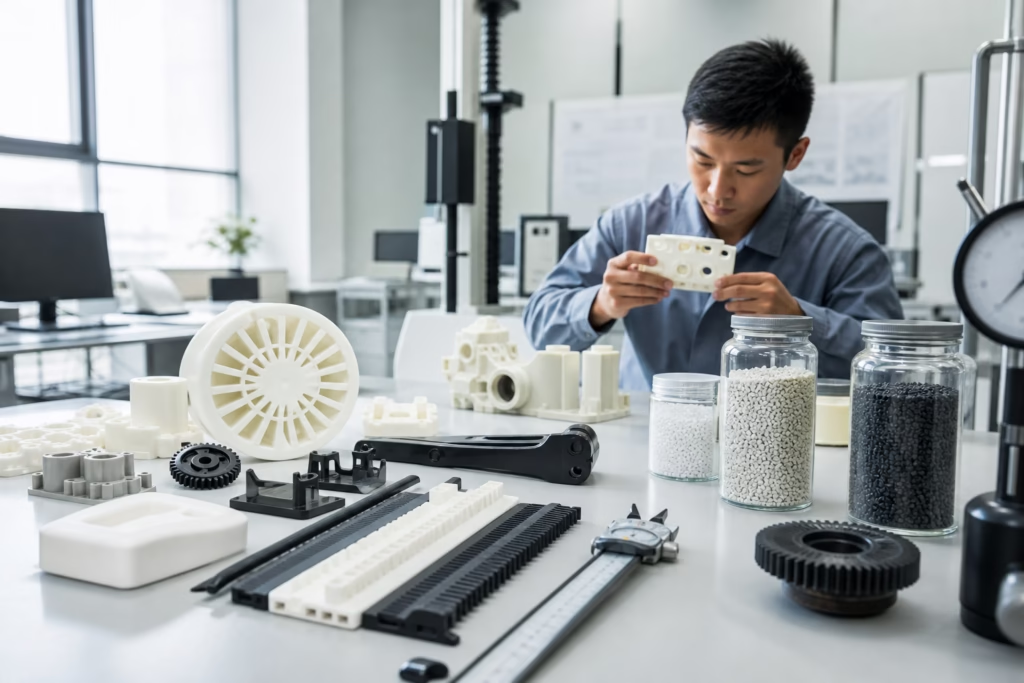
At first glance, extrusion and injection molding may seem to ask for the same thing: a plastic that flows well and meets the part’s performance target. In practice, extrusion vs injection material selection cannot follow one shared rulebook. The process changes the way the melt moves, how long it stays hot, what defects matter most, and which property trade-offs are acceptable.
For teams choosing resin grades, that difference is not academic. A compound that looks excellent in a datasheet may run cleanly in a die but fail in a mold because of packing, shrinkage, or weld-line sensitivity. If your project needs custom formulation support, our custom plastic compounding support approach is built around the actual process window, part geometry, and production risk rather than a one-size-fits-all resin recommendation.
Why extrusion and injection molding do not share the same selection logic
Extrusion is a continuous process. The melt is pushed through a die and formed into a profile, sheet, pipe, film, or other steady geometry. Injection molding is a cyclic process. The melt is forced into a closed cavity, packed, cooled, and ejected as discrete parts. That single difference changes the entire material-selection logic.
In extrusion, the resin must maintain stable flow over time, support a consistent profile, and cool without excessive distortion or die swell problems. In injection molding, the resin must fill complex cavities quickly, withstand pressure and shear during filling and packing, and solidify into a dimensionally accurate part with controlled shrinkage and appearance. If you want a good overview of the difference between standard and customized compound behavior, the article on custom plastic compound vs standard grade is a useful companion to this guide.
From our compounding and pellet-development perspective, the mistake we see most often is trying to evaluate both processes with the same “good flow equals good material” mindset. Flow is necessary in both, but the meaning of good flow is different.
| Selection factor | Extrusion priority | Injection molding priority |
|---|---|---|
| Flow behavior | Stable continuous flow through die | Fast cavity filling and packing |
| Thermal history | Steady melt exposure, often longer running time | Shorter but more intense thermal and shear events |
| Appearance risk | Die lines, surface consistency, profile stability | Flow marks, weld lines, sink marks, gate defects |
| Dimensional concern | Straightness, profile uniformity, cooling shrink behavior | Shrinkage, warpage, thickness balance, mold compensation |
| Material fit | Process stability and surface quality | Fillability, packing response, release, cycle consistency |
The core process difference: continuous flow in extrusion vs rapid cavity filling in injection molding
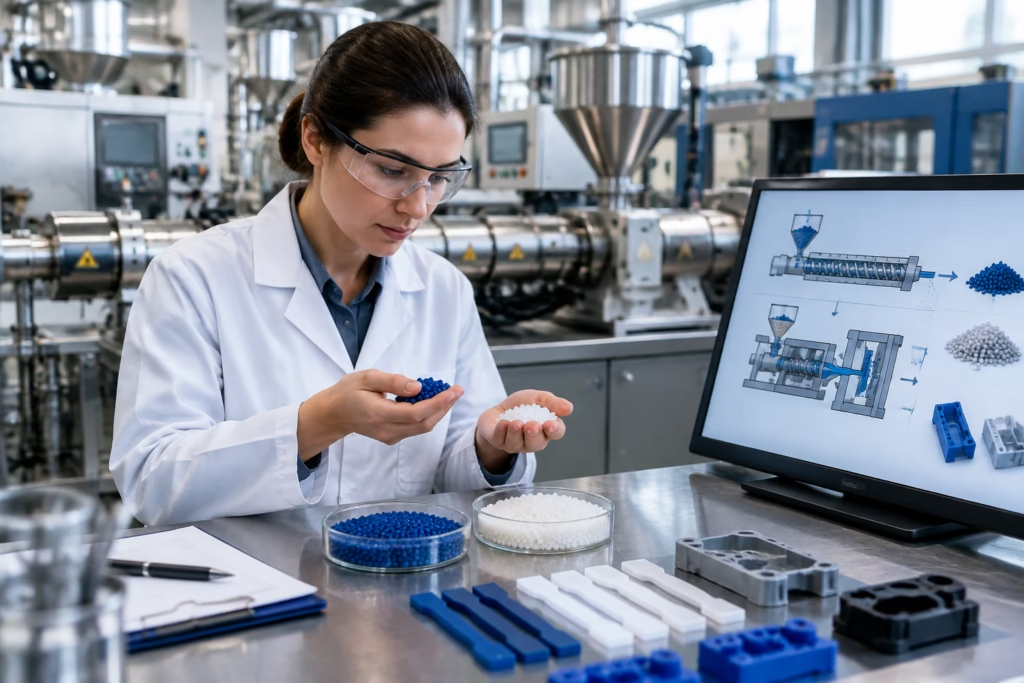
Extrusion asks the polymer to behave like a stable stream. The die controls the shape, and downstream cooling controls whether that shape stays true. The material should tolerate long runs, pressure fluctuations, and steady thermal exposure without excessive viscosity drift or degradation. A profile extrusion line can be very sensitive to melt instability, but the melt does not need to rush into a thin, complex cavity.
Injection molding is different because the material has to behave under fast filling, high shear, and short cooling times. The melt must travel through runners, gates, and thin section transitions before the polymer starts freezing. That means the resin’s flow response, crystallization behavior, and packing response all affect whether the part forms properly. The technical guide on engineering extrusion and material selection is a helpful reminder that extrusion values continuous profile quality, while injection molding is built around cavity filling and pack-out.
In practical terms, a material that is forgiving in extrusion may still create flash, short shots, sink marks, or weld-line weakness in injection molding. The reverse is also true: a grade optimized for fast filling may not offer the profile stability or surface uniformity needed in extrusion.
How these process differences change the material requirements
Once the process is different, the material requirements shift as well. Engineers should not start with resin family alone. They should start with the process constraints, then choose the resin family and modification package to match.
Flow behavior: viscosity, melt flow, and shear response
For extrusion, melt flow needs to be stable over a long operating window. A compound that fluctuates too much in viscosity can create thickness variation, rough surface, die buildup, or unstable profile dimensions. For injection molding, the question is not only whether the resin flows, but whether it can fill the cavity before freezing and still pack out dense sections without excessive pressure. That is why melt flow index is useful, but never sufficient on its own.
We often advise customers to read the datasheet in the context of the part and process rather than chasing the highest flow number. High flow can help thin-wall injection parts, but it may reduce mechanical performance or increase flash risk. In extrusion, a slightly lower-flow material may actually be easier to stabilize if the profile is sensitive to sag or die swell.
Thermal stability: residence time and degradation risk
Thermal history is one of the biggest reasons extrusion and injection molding cannot use identical material selection logic. In extrusion, the resin may remain in a heated state for a relatively long time, especially during start-up, color change, or line fluctuation. In injection molding, the residence time may be shorter, but the melt experiences intense shear, rapid filling, and repeated thermal cycling.
For moisture-sensitive or heat-sensitive materials, this changes everything. Polyesters, polyamides, and other engineering resins can degrade if drying, melt temperature, or residence time are not controlled tightly. For a practical reference on process sensitivity in molding, see injection molding defect causes and solutions, which illustrates how degradation, shrinkage, and flow issues show up differently in molded parts than in continuous profile processes.
From our experience, if a material shows any sign of thermal weakness, we look at three points before recommending it for injection molding: drying sensitivity, dwell time tolerance, and the part’s wall thickness balance. For extrusion, we look more closely at sustained thermal stability and long-run consistency.
Appearance and surface quality
Appearance defects do not mean the same thing in both processes. In extrusion, the major concerns are die lines, surface roughness, melt fracture, and profile consistency. In injection molding, the major concerns are flow marks, weld lines, gate blush, sink marks, silver streaks, and differential gloss.
That is why the same resin can be judged very differently depending on the process. An extrusion profile may tolerate a surface texture that a consumer-facing injection part cannot. A molded housing may accept a resin with excellent fillability but only if its weld-line strength and surface finish are acceptable. When a buyer asks us why one grade runs beautifully in a mold but poorly in a die, the answer often comes down to surface-quality priorities, not just flow rate.
For a deeper look at defect causes, the article which plastic molding surface defects are material-related helps connect material choice to visible outcomes such as flow marks and surface inconsistency.
Shrinkage, warpage, and dimensional stability
Both processes care about dimensions, but they care about different dimension risks. Extrusion mainly worries about profile stability, straightness, and controlled cooling shrinkage over length. Injection molding must manage cavity shrinkage, differential cooling, rib and boss effects, and warpage induced by flow orientation or reinforcement.
When dimensional tolerance is tight, the process can determine whether a resin is acceptable at all. A material that seems stable in a simple injection test may still warp more than expected in a long extrusion profile. Likewise, a profile-grade compound may not pack evenly in an injection cavity and may produce unacceptable distortion after ejection. If your decision hinges on dimensional control, the guide on how to evaluate dimensional stability in plastics is directly relevant.
Mechanical performance priorities are not identical
Teams sometimes assume the highest stiffness or the highest impact strength wins. In reality, the right balance depends on process and part function. Extrusion parts often prioritize stiffness retention, long-span stability, and resistance to creep or bending over time. Injection molded parts may need a better balance of impact resistance, weld-line strength, and local feature durability around ribs, snap-fits, bosses, or clips.
For example, glass fiber reinforced compounds can be useful in both processes, but their selection logic differs. In extrusion, the focus may be on profile straightness and load-bearing performance. In injection molding, the focus may be on filling behavior, fiber orientation, anisotropy, and the risk of warpage or visible surface patterning. This is one reason we treat reinforcement as a process decision, not just a mechanical upgrade.
At Poly Maro, we typically evaluate whether the part needs stiffness, impact balance, heat resistance, or dimensional stability first, then decide whether the compound should be unfilled, mineral-filled, glass fiber reinforced, or impact modified. The goal is not only to meet a spec on paper, but to keep the process stable in real production.
Moisture sensitivity and drying requirements
Moisture control is another place where the same resin behaves differently by process. Polyamides, PET, and several engineering plastics can absorb moisture and lose performance if processed wet. In injection molding, wet material can create splay, hydrolysis, bubbles, reduced mechanical properties, and unstable appearance. In extrusion, moisture can still hurt quality, but the effect may show up as surface instability, bubbles, or profile inconsistency rather than the same defect pattern seen in molded parts.
The practical consequence is that drying conditions, hopper management, and material handling must be matched to the process. A resin that is “acceptable enough” for a short extrusion trial may not survive a long injection cycle without quality loss. This is especially true for precision molded electrical parts and technical housings. For a focused example of moisture-sensitive molding, the technical page on polyamide injection molding and drying guidance shows why PA grades need controlled drying and process discipline before molding.
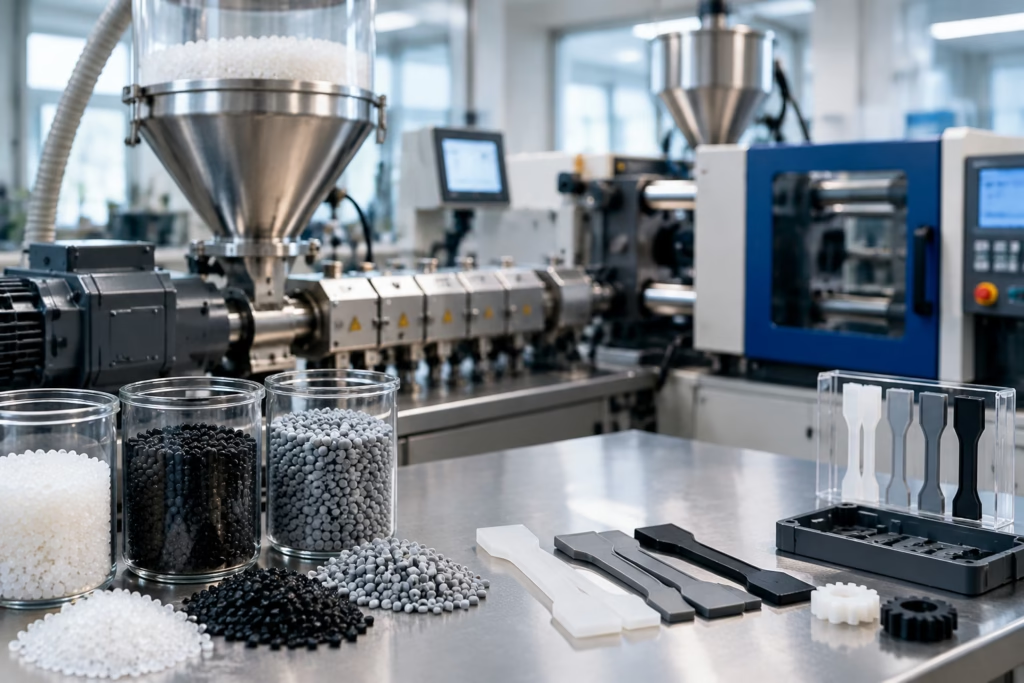
When we recommend a compound, we also consider how the plant actually stores and dries it. If the processing team cannot maintain the correct drying window, even a technically suitable resin may become a production risk.
Common material families and how their behavior changes by process
Different resin families bring different process advantages, and that is why selection logic must be process-specific.
| Material family | Often favorable in extrusion | Often favorable in injection molding | Main caution |
|---|---|---|---|
| PP | Profiles, sheets, film, pipes | General parts, housings, caps | Can be too soft for structural loads if unmodified |
| ABS | Some profile and sheet uses | Housings, covers, appliance parts | Heat and chemical limits must be checked |
| PA6 / PA66 | Profiles, wear parts, industrial shapes | Gears, structural parts, connectors | Moisture absorption and drying are critical |
| PBT / PET | Some profile and technical extrusion uses | Electrical and precision molded parts | Crystallization and drying control affect quality |
| PC / PC-ABS | Limited profile use depending on design | Durable housings, transparent or tough parts | Flow and thermal sensitivity vary by grade |
These are only broad tendencies. The final choice should reflect part geometry, tolerance, appearance, and production environment. A compound that is ideal for one process may need a different stabilizer package, filler level, impact modifier, or molecular-weight balance in the other.
How to judge whether a compound is better suited for extrusion or injection molding
A good way to screen a material is to ask which failure mode is most expensive for the project. If profile stability, surface uniformity, and continuous throughput matter most, extrusion-friendly behavior is usually the priority. If complete cavity filling, fast cycle time, and detailed geometry matter most, injection-friendly behavior becomes the deciding factor.
We usually evaluate five practical questions:
- Does the resin maintain stable viscosity during the expected residence time?
- Can the part fill, pack, and cool without excessive shrinkage or warpage?
- Is the surface acceptable under the intended cosmetic standard?
- Does the mechanical balance match the process orientation and geometry?
- Can the plant dry, feed, and process the material consistently?
If the answer to any of these is uncertain, the material should be tested in the real process rather than assumed to work because the datasheet looks strong. For many projects, a custom compound with tuned flow and reinforcement is more reliable than a standard resin used outside its best process window. For a useful selection lens, see how to choose heat-resistant plastic compounds when thermal load is part of the decision.
Typical selection mistakes when teams apply the wrong process logic
One common mistake is choosing a resin only because it has a high melt flow index. In injection molding, high flow can be useful, but it may also reduce strength, increase flash, or worsen sink sensitivity. In extrusion, the same resin may run too soft, too thin, or too unstable for the required profile.
A second mistake is ignoring thermal history. Buyers sometimes compare two grades only by nominal melt temperature or tensile strength, then discover that one grade is more sensitive to drying or degradation in actual production. A third mistake is assuming that a good molded part will translate directly into a good extrusion profile, or vice versa. Geometry, cooling, and flow pattern create different stress states, so the same formulation may need a different balance of viscosity, stabilizer package, or filler type.
Surface defects are another trap. If a team sees flow marks in molded parts, they may blame only the mold. Sometimes the material’s rheology is the real issue. Likewise, a profile that shows surface waviness may need a different compound rather than only a die adjustment. Material choice, process settings, and tooling all interact, but the resin must be capable of succeeding within that system.
A practical selection checklist for engineers and procurement teams
When we help customers narrow a choice, we recommend starting with a short checklist:
- Define the process first: extrusion, injection molding, or both.
- List the critical part requirements: strength, heat, surface, tolerance, color, or chemical resistance.
- Identify the highest-risk defect: warpage, short shot, surface marks, die line, shrinkage, or cracking.
- Confirm drying and storage capability at the plant.
- Review whether reinforcement or impact modification is needed.
- Ask for sample parts or trial pellets under actual process conditions.
- Check batch consistency, lead time, MOQ, and supply continuity before release.
That last point matters because the “best” resin on a single lab sheet may not be the best supply choice for production. A stable supplier relationship is often worth more than a small theoretical gain in property performance if the process is sensitive. For buyers balancing sourcing and technical fit, our approach at technical support for material selection focuses on matching performance, processability, and supply practicality together.
When to request modified compounds or custom formulation support
Custom compounding becomes valuable when the standard grade sits too close to the risk boundary. That may mean the resin flows too slowly for the mold, warps too much in the profile, absorbs too much moisture, or lacks the heat resistance required by the application. In those cases, a modified compound can tune the melt behavior, reinforcement level, thermal stability, or appearance profile to fit the target process more closely.
This is especially true for applications such as electrical housings, industrial covers, connectors, structural profiles, and functional components where one material may need to balance stiffness, impact, insulation, and dimensional control. If the process is not forgiving, the material should be designed around the process instead of forcing the process to compensate for the material.
From our material-development perspective, that is the core lesson of extrusion vs injection material selection: the process defines the performance target as much as the product design does.
How a plastic pellet manufacturer should evaluate process fit
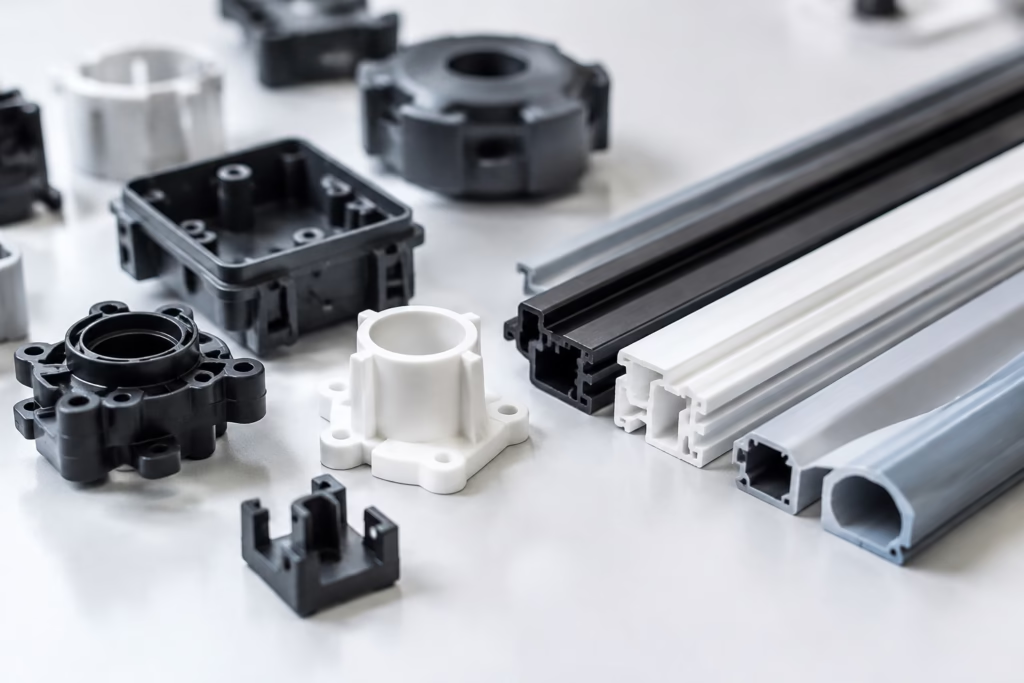
A manufacturer should not only ask “Does this resin meet the spec?” but also “Will it stay within spec after real processing?” That means evaluating the pellet’s consistency, drying behavior, thermal stability, flow response, and sensitivity to shear. It also means checking whether the compound can be reproduced across lots without drifting in color, viscosity, or mechanical response.
For extrusion, we look for stable output, low fluctuation, and predictable cooling behavior. For injection molding, we look for fill balance, release behavior, weld-line behavior, and shrink control. If one material must serve both processes, we usually recommend a process-specific variant rather than forcing one compromise grade to do everything.
The safest route is to define the process first, then test the compound in the real production window. That is how you reduce scrap, protect appearance, and avoid last-minute grade changes.
Conclusion
Extrusion and injection molding may use the same polymer families, but they do not use the same material selection logic. Continuous flow, die stability, and long-run profile quality lead extrusion decisions. Cavity filling, packing, cooling, shrink control, and appearance quality lead injection decisions. When teams confuse those priorities, they often choose a resin that looks right on paper but behaves poorly in production.
If you are comparing compounds for a new part, start with the process, then check flow, thermal stability, moisture sensitivity, surface quality, and dimensional behavior. That sequence produces better decisions, fewer trials, and lower risk. In our view, that is the practical way to make extrusion vs injection material selection work in real manufacturing.
FAQs
Can one plastic compound work well for both extrusion and injection molding?
Sometimes, but only if the part requirements are moderate and the resin has a balanced process window. In many real projects, a compound that works well in one process is only an acceptable compromise in the other. If the part is critical for appearance, tolerance, or mechanical reliability, we usually recommend process-specific validation before committing to one grade.
Why does a resin with good flow still fail in injection molding?
Good flow does not guarantee good filling, packing, or dimensional stability. A resin may fill the cavity easily but still create sink marks, warpage, flash, weld-line weakness, or poor surface quality. Injection molding requires the material to perform under pressure, cooling, and geometry-driven stress, not just to flow.
Why is drying more important for some materials in injection molding?
Moisture-sensitive materials such as polyamides and PET can lose properties or produce visible defects if they are processed wet. In injection molding, that may show up as splay, bubbles, or hydrolysis damage, while extrusion may show different surface or stability issues. The correct drying window depends on the resin and the process.
How should buyers compare extrusion grades and injection grades?
Do not compare them only by melt flow or tensile strength. Compare the process window, thermal stability, shrinkage behavior, surface requirements, drying sensitivity, and expected defect risk. A good buying decision should reflect how the resin behaves in the actual production method, not just in a datasheet summary.
When should we ask for a modified compound instead of a standard grade?
Ask for a modified compound when the standard grade is too risky for flow, heat, impact, stiffness, dimensional stability, or appearance. If the part has thin walls, tight tolerances, long profiles, or demanding service conditions, a custom formulation can reduce trial-and-error and improve production stability.
What should we test first before approving a new material?
Start with process-relevant samples: mold or profile appearance, dimensional stability, drying behavior, and the defect that matters most for your part. Then confirm mechanical performance and batch consistency. If the first trial does not match production conditions, the result is not reliable enough for approval.