
Private label plastic pellet programs can create real business value, but they also create a question many teams do not address early enough: how do you develop a material that performs to spec without exposing the formulation logic behind it? That is where custom plastic compounding IP becomes a practical sourcing topic, not just a legal one. When the resin system, additive package, reinforcement level, processing window, and validation data are handled correctly, a buyer can launch differentiated parts while reducing the risk that the same material is easily copied or compared line by line by competitors.
custom plastic compounding support is often the right starting point when a team needs a private label pellet program built around confidentiality, controlled sample release, and application-specific performance. At Poly Maro, we view this kind of project as a combination of material development, manufacturing discipline, and information control: selecting the resin family, tuning properties, documenting only what is needed for production, and keeping the underlying formulation knowledge protected through the development cycle.
Why custom plastic compounding becomes a black box in the first place
For many manufacturers, a custom compound is useful precisely because the final pellet is not a simple commodity grade. The compound may contain glass fiber, mineral filler, impact modifiers, flame retardants, lubricants, color system adjustments, or conductive additives. Each of these choices can change stiffness, impact strength, heat deflection temperature, shrinkage, warpage, electrical behavior, and processability. When those variables are combined, the material becomes a tuned engineering product rather than a public recipe.
That “black box” effect is not accidental. In a private label pellet program, the buyer usually wants two things at the same time: predictable production behavior and reduced competitive visibility into the material recipe. If a competitor can easily identify the base resin, additive ratio, and process route, the product can be reverse engineered faster. If the development partner does not manage confidentiality well, even the sample stage can expose too much of the formulation logic.
In practical terms, the black box exists because a good compound often depends on hidden detail. A small change in stabilizer package may improve processing stability. A shift in reinforcement ratio may control shrinkage but also change surface finish. A resin blend can look ordinary on paper but behave very differently in the mold. That is why the material development relationship must be managed as both a technical project and an IP-sensitive commercial project.
What product IP really means in plastic pellet development
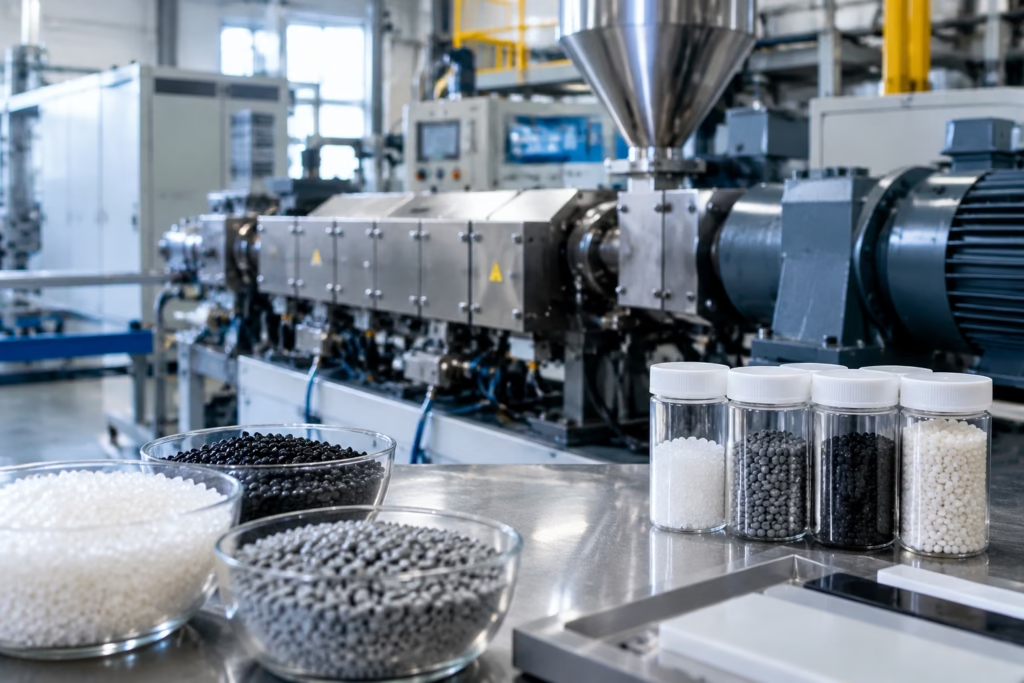
In plastics, product IP is usually broader than one single formula. Buyers often focus only on the final resin name, but the real value may sit in several layers:
- Formulation identity: the base polymer, blend structure, filler system, color strategy, and functional additives.
- Process window: drying method, melt temperature range, screw design behavior, residence time sensitivity, and injection or extrusion stability.
- Performance targeting: impact balance, rigidity, heat resistance, wear behavior, electrical insulation, flame performance, or dimensional stability.
- Validation data: test methods, sample history, comparative builds, and iteration notes that explain why the formulation was selected.
- Application know-how: the practical understanding of what works in a specific part, mold, wall thickness, or assembly environment.
From a sourcing standpoint, these layers matter because the strongest intellectual property is often not the resin type itself. It is the combination of selection logic, additive balance, and processing know-how that produces a stable part in production. Two suppliers may quote the same general polymer family, yet one can deliver a more durable solution because they understand how to preserve the hidden performance structure.
Common IP risks when buying off-the-shelf resin versus private label plastic pellets
Off-the-shelf resin is attractive because it is simple to buy and easy to compare. But that convenience often comes with an IP trade-off. Commodity grades are visible in the market, broadly documented, and often substitutable. If a product depends on a common PP, ABS, PA, or PC grade, competitors may be able to match the material behavior with limited effort.
By contrast, private label plastic pellets can reduce direct copying risk when the compound is developed for one customer, one application, or one performance target. The key is that the private label program must be structured to keep the most sensitive information inside the development relationship. If the buyer shares end-use requirements too openly with multiple sources, or if one supplier receives full production data while another provides a near-identical trial, the information can leak across the market.
Common IP risks include:
- using a standard grade that is easy to source elsewhere
- sharing full part drawings and performance targets without an NDA or technical agreement
- sending samples to multiple suppliers without sample control
- accepting a “custom” compound that is only a lightly modified catalog resin
- allowing process settings, additive choices, or color details to spread beyond the core project team
When buyers evaluate sourcing options this way, they begin to see why material selection and confidentiality cannot be separated. The wrong resin choice can expose the same product structure to the market, while the right custom program can make the formulation more difficult to mirror.
How custom compounding protects confidentiality across development stages
Confidentiality is strongest when it is designed into the workflow rather than added as an afterthought. A reliable compounder should control information at each stage: initial inquiry, sample formulation, pilot batching, production scale-up, packaging, and post-shipment technical support.
At the early stage, the supplier should limit access to the minimum necessary project team. Not every engineer, operator, and sales contact needs the full application story. The formulation may be discussed in functional terms first, then narrowed only after the buyer confirms the performance direction. This is especially important when projects involve sensitive features such as impact modification, flame retardancy, antistatic behavior, or reinforcement strategy.
During pilot production, the compounder should protect the link between the buyer’s part requirement and the final recipe. The formulation may be prepared from internal compounding logic while the buyer only receives the agreed sample code, technical summary, and selected test values. That approach helps preserve performance transparency without exposing the complete recipe.
At scale-up, packaging and batch marking must also be controlled. Private label pellets should not carry unnecessary indicators that reveal the exact structure of the compound. When possible, the supplier should separate customer-facing documentation from internal batch records and maintain traceability internally.
From our perspective at Poly Maro, confidentiality is most effective when the development partner manages both people and paperwork. Even a strong formula can become a weak IP position if the sample route, production notes, or approval history are widely visible.
What a reliable plastic pellet manufacturer should keep confidential
Not every piece of project information carries the same sensitivity, but a good supplier should treat several items as confidential by default:
| Confidential item | Why it matters | Typical risk if exposed |
|---|---|---|
| Resin system | Defines the core material family and substitution path | Competitors can identify the likely base platform |
| Additive package | Controls impact, stability, flame response, lubrication, or appearance | Key performance logic becomes easier to replicate |
| Reinforcement ratio | Affects stiffness, shrinkage, warpage, and weight | Part behavior can be reverse engineered faster |
| Processing parameters | Impact molding stability and final properties | Production know-how may leak outside the program |
| Testing history | Shows how the formulation evolved and why it works | Development logic becomes visible |
For buyers, the important question is not whether the supplier shares anything at all. It is whether the supplier shares the right level of information for production while keeping the formula logic and application tuning protected. A manufacturer that over-discloses in the name of openness may actually create more sourcing risk than one that communicates carefully and consistently.
NDA, technical agreement, and sample control: the minimum documents buyers should require
A non-disclosure agreement is not the only protection, but it is the starting point. For sensitive compounding projects, the buyer should consider three layers of documentation: an NDA, a technical agreement, and a sample control process.
The NDA should define what counts as proprietary information, who may receive it, how long it may be retained, and what happens after project termination. A useful reference for structuring that type of information handling is the NDA terms for proprietary formulation disclosure, which reflects the principle that disclosure should be limited and controlled when proprietary technical information is exchanged.
The technical agreement should align the material target with the use case. It should state the resin family, performance targets, test methods, batch expectations, acceptable tolerances, and the boundary between customer-owned information and supplier-owned process know-how. This helps prevent confusion later when the project moves from lab sample to production pellet.
Sample control matters because many IP leaks occur before mass production. Samples should be numbered, tracked, and assigned to the correct project stage. A buyer should know whether a sample is for initial screening, tooling validation, or final sign-off. When samples are copied, shared broadly, or combined with unclear notes, the program can lose control of the material story.
How private label plastic pellets support brand differentiation
Private label plastic pellets are not just a branding exercise. They can support real differentiation when the material is tied to the product’s function and user experience. If two companies sell structurally similar parts, the one with a more stable, better-processing, or more specialized compound may gain a practical advantage even if the end product looks comparable at first glance.
For example, a buyer may need a material that balances stiffness and toughness, or a resin that maintains dimensional stability across humidity and heat cycles. Another buyer may need a surface that resists creep, an electrically safe formulation, or a compound that keeps part appearance consistent after repeated molding. In those cases, the value lies in how the pellet performs during production and in the field, not only in the resin name.
Private label also reduces direct comparison risk. When the pellet is developed for a specific application and supplied under controlled specifications, the buyer is less exposed to a simple “same as” comparison against a catalog grade. That can matter in competitive sectors such as electronics housings, connectors, appliance parts, and industrial components.
Custom compounding for performance-specific needs
Some projects are not primarily about secrecy; they are about meeting a demanding application without revealing the exact performance recipe. This is where custom modification and IP protection support each other.
If a product needs higher stiffness and lower weight, a reinforcement strategy may be used. If it needs heat resistance, the resin family and stabilizer package may shift. If electrical behavior matters, the compound may require conductive or anti-static tuning. If safety regulations are part of the design, flame-retardant formulation may be essential. For metal replacement applications, a compound may need a different balance of modulus, impact, and creep resistance. In these situations, the formulation becomes a business-critical asset because it helps the buyer solve a real design problem without relying on a widely available standard grade.
When a project calls for elevated temperature performance, buyers often start with the resin family first, then review the processing window and mechanical retention. For that reason, we often discuss heat-resistant plastic compound options early in the specification stage, especially for parts that must hold shape, avoid deformation, or remain stable after repeated thermal exposure.
For demanding structural or replacement parts, performance may also depend on a metal-substitution mindset. That can be relevant when the part must hold load, resist deformation, or survive repeated assembly cycles. In such cases, the value of metal replacement plastic compound solutions is not just mechanical strength; it is the ability to preserve a confidential formulation while creating a part-specific functional advantage.

Other projects may need safety-oriented or electrically active materials. Where flame performance is important, one should not rely on a generic resin description. The supplier should explain how the formulation supports the application and how it should be processed. A targeted discussion of flame-retardant plastic compound solutions can help buyers understand what is being controlled, what is being tested, and what remains proprietary.
Likewise, electronics and industrial equipment often require controlled static behavior. When a project needs conductivity or static dissipation, the formulation logic can be quite sensitive. That is one reason conductive and anti-static plastic compound options are usually developed with tighter handling of the additive structure and batch control than a commodity resin purchase.
How to tell whether a formulation is truly proprietary
Buyers sometimes hear the word custom but receive a standard resin with a color change or a minor additive tweak. That does not necessarily mean the material is bad, but it may mean the project offers less IP value than expected.
A truly proprietary or at least application-specific formulation usually shows several signs:
- the supplier can explain the performance target, not just the resin family
- the material is tied to a defined processing window and sample validation path
- the supplier discusses trade-offs rather than claiming every property improved at once
- the sample history shows intentional iteration, not just one generic trial
- the documentation separates customer-facing spec data from internal compounding know-how
By contrast, a lightly modified standard grade often has vague justification. The supplier may say only that it is stronger, tougher, or more stable, without explaining what was changed or why the formulation should remain exclusive. In that case, the buyer should ask what part of the value is actually custom and what part is simply commercial packaging around an existing resin.
Prototype-to-mass-production transition: where IP leakage often happens
Many development programs protect the first sample well but lose control later during scale-up. This happens because the prototype stage and production stage are managed by different people, different plants, or different document sets. If the transition is not controlled, the material story can fragment.
A good supplier should preserve the same project code, approval logic, and release criteria from prototype to stable production. The buyer should avoid sending a prototype to one source and then asking a second source to duplicate it from a public datasheet. That split path often creates unnecessary exposure and can lead to mismatched performance.
Scale-up also brings process drift risk. The mold, drying conditions, feeding method, residence time, and screw behavior can affect the final part. If those process details are not documented properly, the supplier may need to expose more of the formulation to explain what changed. This is one reason a manufacturer with strong technical discipline can help protect IP while stabilizing production.
When we manage development internally, we try to keep the formulation identity stable while refining the process details in a controlled way. That allows the customer to move from test parts to production parts without turning every adjustment into a public technical discussion.
Supplier qualification checklist for custom plastic compounding partners
A sourcing team evaluating a compounder should ask questions that reveal both technical capability and information discipline. The supplier does not need to disclose everything, but it should demonstrate that it knows what must remain confidential and how to manage it.
| Qualification area | What to ask | Why it matters for IP |
|---|---|---|
| Project intake | Who sees the application brief and how is access limited? | Reduces early-stage information spread |
| Formulation control | How are recipes stored, approved, and revised? | Protects the compound structure internally |
| Traceability | Can batches be traced without exposing the formula? | Supports consistency and risk management |
| Sample handling | How are trial samples numbered and released? | Prevents uncontrolled circulation |
| Documentation | What is shared in TDS, COA, and production notes? | Separates needed data from sensitive know-how |
| Scale-up discipline | How is the prototype translated into mass production? | Reduces reformulation leakage during transfer |
For supply-chain control, traceability should not be treated as a paperwork burden. It is part of protecting commercial value. Standards-oriented thinking around traceability and verification, such as the approach described in ASTM traceability and verification in resin supply chains, helps buyers manage consistency without exposing more than necessary.
When traceability is weak, a buyer may be forced to ask for extra technical detail to understand what changed between batches. When traceability is strong, the supplier can prove consistency through controlled records rather than through uncontrolled disclosure.
Questions procurement teams should ask before starting a custom resin project
Procurement teams do not need to become polymer scientists, but they do need to ask the right questions early. The most useful questions usually focus on scope, control, and business risk:
- What exact performance problem must the material solve?
- Which part properties are non-negotiable, and which can be traded off?
- What information will the supplier need, and what information should remain restricted?
- Will the project require an NDA, technical agreement, or exclusive use clause?
- How will samples be labeled, tracked, and approved?
- What batch consistency checks will be used in production?
- How much lead time is needed for development and revalidation?
These questions help the buyer separate genuine development from generic reselling. They also force the project team to define the minimum information needed for success. That is a useful IP discipline because over-sharing often starts with vague requirements rather than bad intent.
Cost, MOQ, lead time, and exclusivity trade-offs
Private label programs usually involve a trade-off between control and flexibility. A highly customized compound may require a higher minimum order quantity, longer lead time, and more sample iterations. That is normal. What matters is whether the added commitment creates enough technical and commercial value to justify the structure.
From a buyer’s point of view, exclusivity can also change cost dynamics. If the supplier dedicates a formulation or production path to one customer, the economics may be different than for a shared catalog grade. The buyer should understand whether exclusivity applies to the exact formulation, the application, the region, or only the brand label. Without that clarity, a project may look protected while still being broadly reusable by the supplier.
We advise buyers to balance the following factors:
- MOQ: enough to support efficient production without overcommitting inventory
- Lead time: long enough for development, but not so long that launch schedules slip
- Exclusivity: narrow enough to be enforceable, broad enough to matter competitively
- Cost-performance: not just pellet price, but total value from reduced scrap, better processing, and less copying risk
In many cases, a custom compound delivers value even when the unit price is higher, because it reduces technical rework and supports more consistent production. The business case should include process savings, part quality, and IP protection together.
Common mistakes that expose product IP
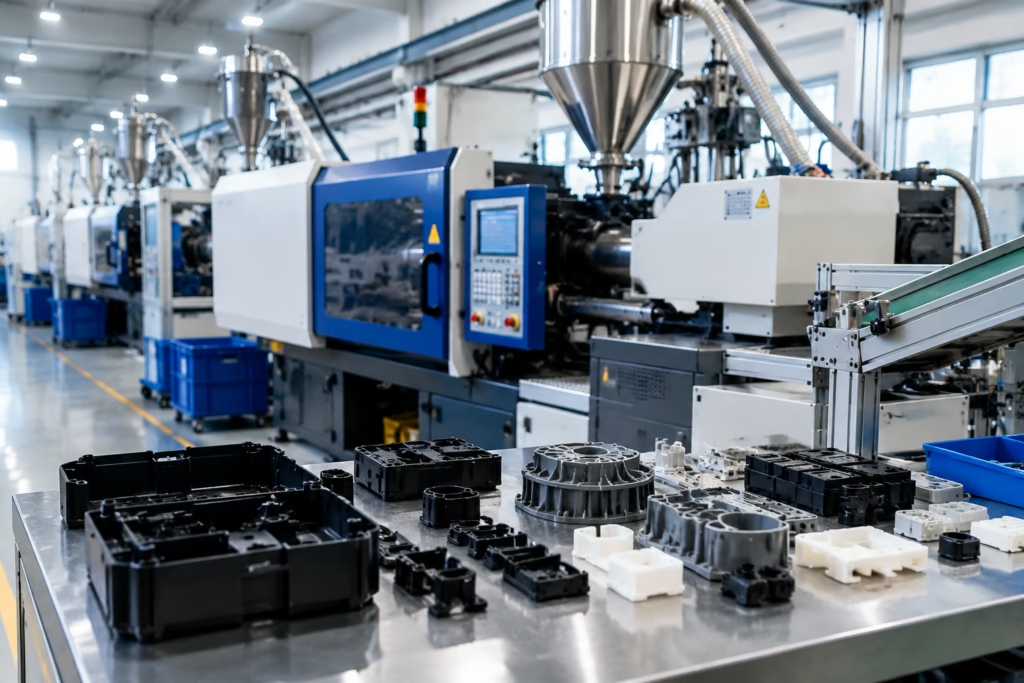
Some of the most serious IP exposures are surprisingly ordinary. Teams are often careful about legal documents but less careful about operational behavior.
- Sending the same sample brief to multiple suppliers without restricting how it can be used
- Sharing full part requirements too early before confirming supplier capability
- Using vague sample naming that makes it easy to confuse projects later
- Approving a formulation before checking batch consistency
- Assuming a catalog grade is unique just because it was repackaged under a private label
- Letting production settings circulate beyond the project team
These mistakes are avoidable if the buyer treats the material development flow as a controlled process. The safest programs define who can see what, when samples may be released, and how production data will be handled. That discipline is often what separates a genuine proprietary resin program from a short-term sourcing arrangement.
When to contact a custom plastic pellet manufacturer for confidential development support
A buyer should engage a custom compounder as early as possible when the product depends on a unique combination of properties, a narrow processing window, or a need to protect market differentiation. This is especially true when the project involves new part design, performance upgrades, supplier replacement, or private label pellet branding.
If your team is asking whether to standardize a resin, modify an existing grade, or build a fully custom formulation, the best time to discuss the project is before release for tooling or mass quoting. Early technical alignment can reduce revisions, avoid unnecessary disclosure, and make it easier to protect product IP while still meeting commercial targets.
At Poly Maro, we see the strongest projects as the ones where engineering, procurement, and confidentiality are handled together. That approach does not just create a pellet that meets spec; it creates a sourcing process that is easier to control, easier to explain internally, and harder for competitors to copy.
FAQs
What does custom plastic compounding IP mean in practice?
In practice, custom plastic compounding IP refers to the valuable information behind a private label resin program: the formulation, reinforcement balance, additive package, processing window, validation method, and application know-how. Protecting that information helps keep the material more difficult to copy.
Why is private label plastic pellet development better for confidentiality than off-the-shelf resin?
Private label pellet development can be better for confidentiality because the compound is created for a specific project, not purchased as a public catalog grade. That allows the buyer and supplier to control who sees the formulation logic, sample history, and production details.
What documents should buyers request before sharing product requirements?
Buyers should usually request an NDA, a technical agreement, and a sample control process. Those documents help define what information is proprietary, how it may be used, and how trial samples will be labeled, tracked, and returned or destroyed if needed.
How can a buyer tell if a formulation is truly custom?
A truly custom formulation usually has a clear performance target, a defined process window, and a documented development path. If the supplier only offers a generic resin name with a minor adjustment, the material may be closer to a modified standard grade than a proprietary compound.
What is the biggest risk during prototype-to-production transfer?
The biggest risk is losing control of formulation and process information when the project moves from lab sample to mass production. If the sample route, approvals, and batch records are not managed carefully, sensitive know-how can spread beyond the core project team.
How should procurement evaluate cost, MOQ, and exclusivity?
Procurement should compare not only pellet price but also development time, MOQ, lead time, and the scope of exclusivity. A slightly higher cost can be justified if the formulation reduces scrap, improves part consistency, and lowers the risk of direct copying.