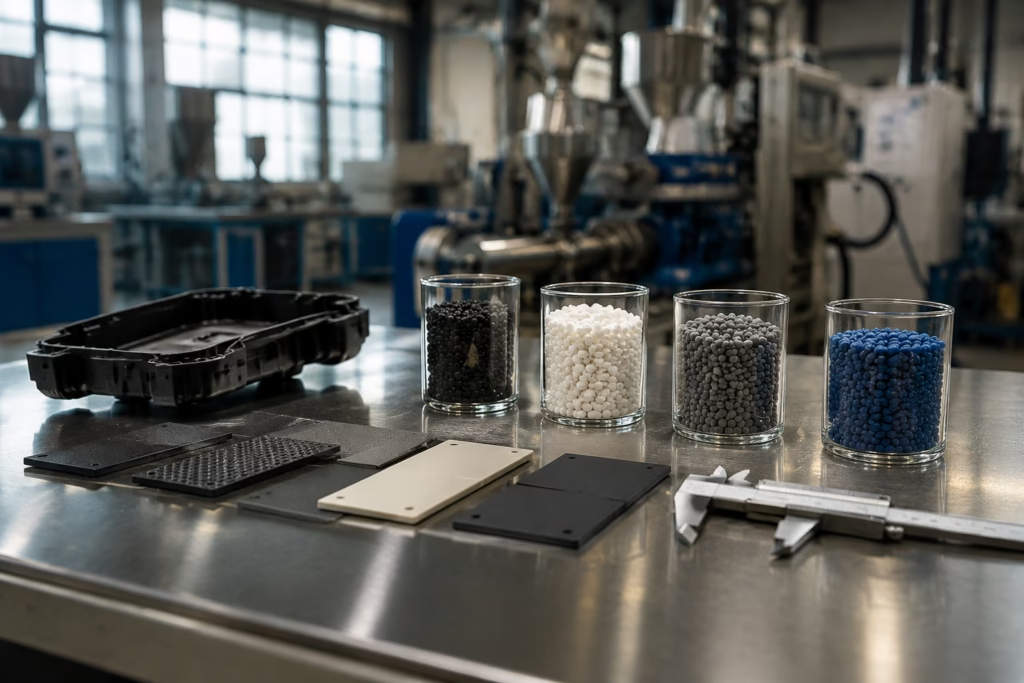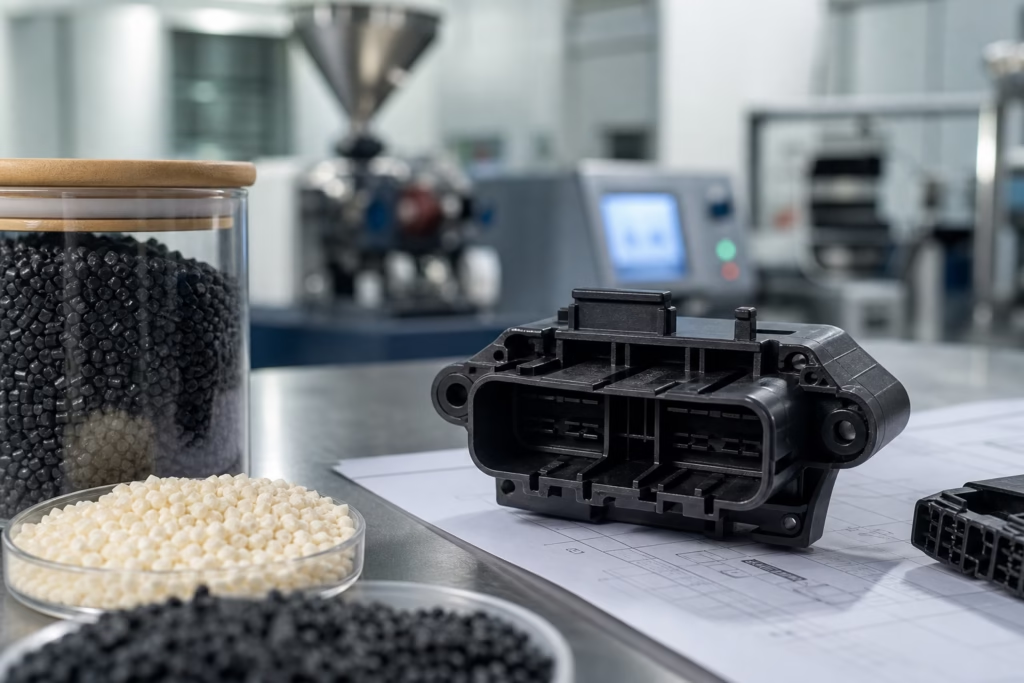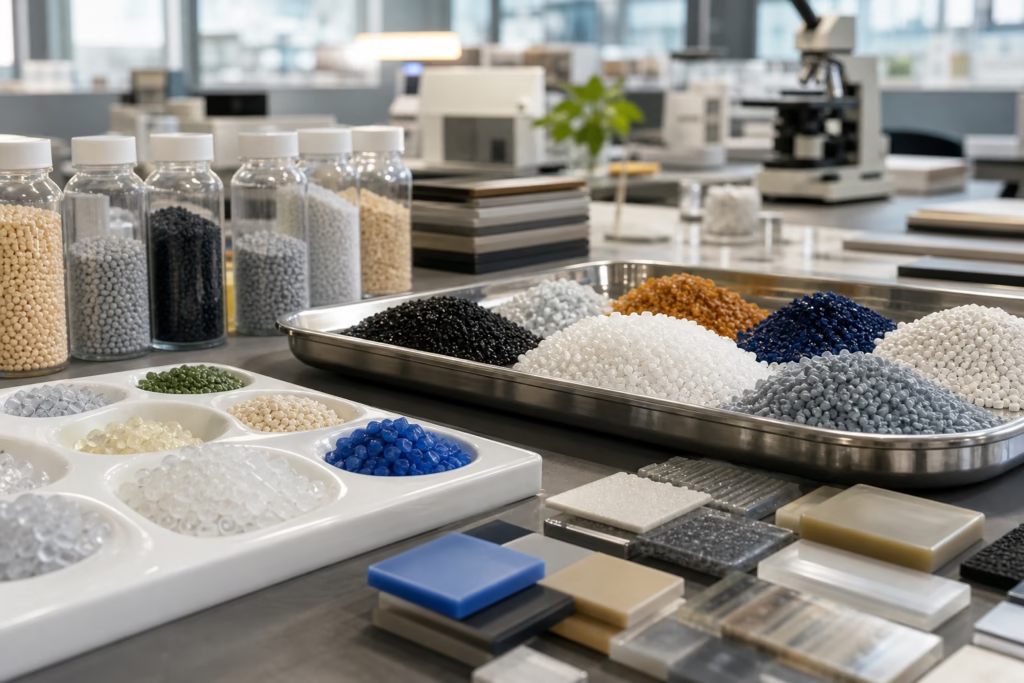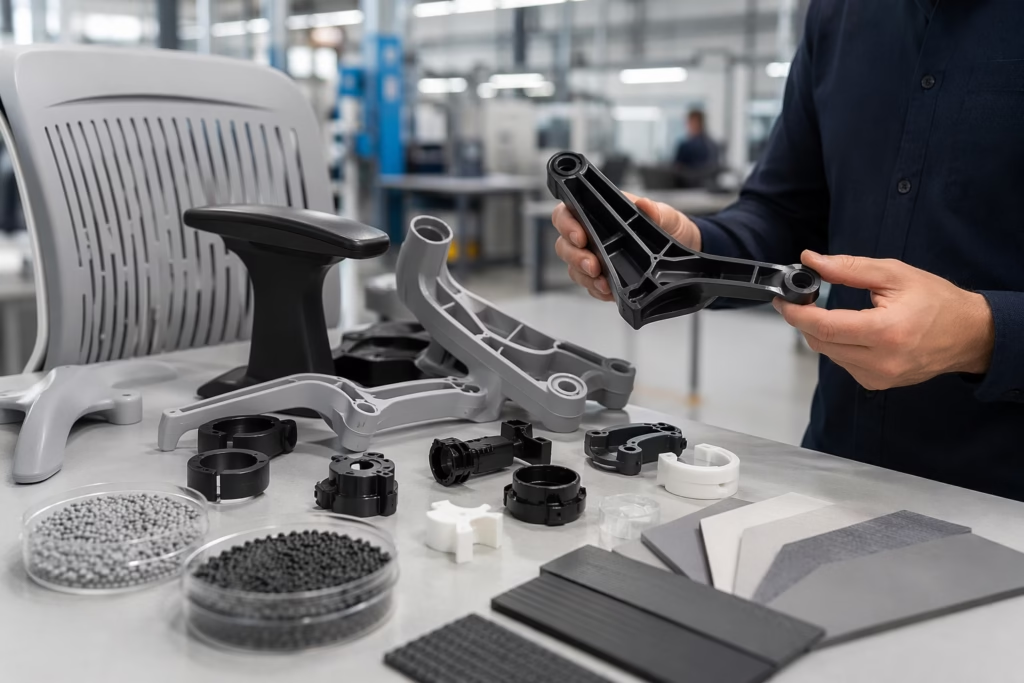
In appliance development, the outer shell and the hidden working parts solve different problems, so they should rarely share the same resin logic. The visible housing must protect the product image, feel stable in the hand, mold cleanly, and survive handling, while the internal parts may face heat, load, friction, electrical stress, chemicals, and long service life. That is why appliance plastic material selection should start with part function, not with a single “general-purpose” resin assumption.
For teams comparing materials across the full appliance platform, our appliance material selection paths for housings and internal parts can help translate end-use needs into a more practical resin direction. At Poly Maro, we approach these projects as a manufacturing problem: choose the right resin family, define the right modification path, confirm processability, and then validate the part under real molding and assembly conditions before mass production.
Why housings and internal parts need different selection logic
Many sourcing mistakes begin when one resin decision is stretched across the entire appliance. A housing and an internal functional part may sit in the same product, but they are evaluated by different criteria. A front cover is judged by appearance, scratch behavior, color stability, and dimensional fit with decorative elements. A bracket, gear, switch carrier, connector body, or fan support is judged by strength, thermal resistance, wear behavior, and long-term reliability.
This difference matters because “good enough” for one part can be a hidden failure point for the other. For example, a material that looks excellent in a visible cover may still creep under load inside the machine. A resin that performs very well in a loaded internal part may be overkill, expensive, or visually inconsistent for a cosmetic shell. The right strategy is to split the decision into two application tracks, then align each track with the real working environment.
Two different design questions
- For housings: How does the part look, feel, and hold shape after molding and use?
- For internal parts: How does the part survive heat, load, friction, insulation requirements, and assembly stress?
- For both: Can the resin be processed consistently at the factory’s cycle time, drying setup, and quality target?
Once a project team answers those questions separately, material selection becomes far clearer and fewer compromises are hidden inside the specification.
What appliance housings care about most

Outer covers, bezels, control-panel shells, and decorative trim are often the first thing a customer notices. Their material choice must support visual quality and manufacturing stability at the same time. In many cases, the housing is not the highest-stress part, but it is the most visible part, so surface quality and color consistency matter more than the ultimate mechanical rating.
Typical housing priorities include:
- Appearance: gloss, texture, color uniformity, and low defect visibility
- Scratch resistance: resistance to handling marks during transport, installation, and daily use
- Color stability: retention of appearance under cleaning, light exposure, and heat
- Surface finish: good replication of mold texture and low flow mark visibility
- Dimensional control: stable fit with screws, clips, windows, and decorative pieces
- Impact resistance: tolerance to knocks, drops, and service handling
- UV resistance: especially important for appliances near windows or in brighter environments
- Moldability: good filling, easy demolding, and controlled shrinkage
From a resin-selection perspective, housings often favor grades that balance appearance and processability rather than maximum heat or wear performance. That is why ABS, PC/ABS, PP, and modified compounds are common starting points. The final choice depends on whether the part needs a premium surface, a lighter cost structure, or a better balance of impact and heat resistance.
For a housing that needs better heat resistance and impact balance without giving up too much appearance, many teams compare against PC/ABS resin options for appliance housings. A PC/ABS blend is often considered when the design needs a more premium look and a broader processing window than a pure polycarbonate part, while still remaining more robust than basic commodity resins.
What internal functional plastic parts care about most
Internal functional parts live in a very different world. They may be hidden from view, but they are often the most technically demanding parts in the appliance. Their performance is measured by how well they hold up under load, temperature, repeated motion, fastening stress, humidity, and electrical or chemical exposure.
Typical internal-part priorities include:
- Strength: to carry load without cracking or permanent deformation
- Heat resistance: to remain stable near motors, heaters, power devices, or warm airflow paths
- Creep resistance: to avoid slow deformation under constant stress
- Wear resistance: for sliding, rotating, or repeated contact components
- Electrical insulation: for connectors, supports, and device-keeping structures
- Chemical resistance: against oils, cleaners, humidity, or internal residues
- Long-term reliability: stable performance over the appliance life cycle
Internal parts often need engineering plastics such as PA6, PA66, PBT, POM, PPS, and reinforced or flame-retardant compounds. These materials are selected less for cosmetic finish and more for structural performance under real service conditions. For example, a gear or sliding mechanism may need low wear and stable dimensions; an electrical bracket may need flame-retardant performance and good insulation; a hot-zone support may need high heat resistance and low deformation at load.
When motion, wear, or low-friction requirements are central, POM material choices for internal motion and wear parts are often part of the shortlist. POM is frequently evaluated for gears, latches, rotating interfaces, and precision moving elements because it can offer a practical balance of stiffness, low friction, and dimensional stability when the design is well matched to the resin.
Why the same resin family can behave differently in housings and internal parts
A resin family is not a single answer. A material can be excellent in one application and only acceptable in another, depending on thickness, geometry, color, reinforcement, and loading. Even within the same family, the modification package changes performance significantly.
Take PP as an example. In a housing, PP may be selected for cost, weight, and moldability, especially when high gloss or low density is attractive. But in a loaded internal structure, unmodified PP may be too flexible or too weak under heat unless the design is generous and the stresses are low. Likewise, PA6 may work well in an internal structural part because of strength and toughness, but for a visible housing it may raise concerns around moisture behavior, surface appearance, or dimensional shift unless those risks are handled carefully.
The same logic applies to reinforced or flame-retardant grades. Glass fiber can improve stiffness and heat performance, but it may also affect surface quality, shrinkage, warpage, and weld line appearance. Flame-retardant compounds can help compliance and safety, but they may require more careful drying, gating, or mold temperature management. The correct selection is therefore not “which resin is strongest,” but “which material family gives the right balance for this specific part, process, and cost target.”
When heat load is a major design driver, teams often move toward heat-resistant plastic compound solutions rather than forcing a general-purpose resin to do a high-temperature job. This is especially relevant for appliance zones near heaters, motors, or power electronics where long-term distortion is more important than a short-term tensile number.
Typical material directions for appliance housings
Housing material selection usually starts with a visual and processing shortlist. The right grade should fill the mold reliably, reproduce surface texture well, and keep shrinkage and warpage under control. Depending on the appliance type, design style, and budget, the team may evaluate several directions.
| Material direction | Typical strengths | Typical cautions | Best fit |
|---|---|---|---|
| ABS | Good surface, easy processing, cost-effective | Lower heat resistance than more advanced blends | General housings, trims, covers |
| PC/ABS | Balanced impact, appearance, and heat performance | May cost more than ABS and need tighter process control | Premium visible housings, control panels |
| PP | Low density, good cost-performance, easy molding | Lower stiffness and heat resistance in many grades | Large covers, non-critical outer shells |
| Modified materials | Can tune impact, UV, flame retardancy, or texture response | Needs supplier coordination and validation | Custom appliance housings with special requirements |
For a housing program, one of the most important questions is whether the visual target can survive the actual molding window. A resin may look excellent on the data sheet but still show visible weld lines, flow marks, or gloss variation in a large thin-wall cover. This is where appliance plastic material selection becomes a manufacturing decision, not just a polymer comparison.
Typical material directions for internal functional parts
Internal parts often need more engineering discipline than visual parts because failure modes are less forgiving. A bracket that slowly creeps, a gear that wears too fast, or an insulating support that softens near heat can all create field issues even when the exterior looks perfect.
| Material direction | Typical strengths | Typical cautions | Best fit |
|---|---|---|---|
| PA6 / PA66 | Good mechanical performance, toughness, broad engineering use | Moisture absorption can affect dimensions and properties | Structural supports, clips, load parts |
| PBT | Good electrical properties and dimensional behavior | Heat and impact balance depends on grade | Connectors, housings near electronics |
| POM | Low friction, wear resistance, good precision | Heat and chemical limits must be checked | Gears, sliders, latches |
| PPS | High heat and chemical resistance | Higher material cost and processing demands | Hot-zone or demanding electrical parts |
| Reinforced / FR compounds | Improved stiffness, heat, safety, or insulation profile | May increase warpage or reduce impact if not balanced | Load-bearing, electrical, or safety-critical parts |
When a project needs flame-retardant performance, the resin choice must be linked to part location and compliance target. In those cases, we often guide teams to flame-retardant plastic compound support so the material is developed around the actual electrical and thermal exposure rather than selected only from a generic resin list.
For appliance internal parts, the key is not just whether a material passes a test in isolation. It is whether it remains stable after drying, molding, screw tightening, assembly stress, and continuous service. The best part specification is one that survives both the lab and the production floor.
How working temperature, load, humidity, and assembly method change the choice
The same appliance may create very different environments inside different zones. A front housing near room temperature has a simple duty. A motor bracket, heater shield, or steam-exposed internal support may face heat and humidity at the same time. Assembly method also matters: screws, ultrasonic welding, snap fits, and overmolding each create their own stress pattern.
When temperature rises, resin stiffness and creep resistance become more important. When humidity rises, moisture absorption and dimensional stability become more important. When the part is assembled with fasteners, the material must resist stress concentration around bosses and ribs. When the part is a snap-fit, ductility and local strain tolerance matter more than a stiff but brittle response.

This is why the same product can require different resin logic for housing and internal part even if both pieces are made from plastic. One is optimized for appearance and fit; the other is optimized for stress survival and service reliability. If the team uses one selection rule for both, at least one part usually receives the wrong compromise.
Processing concerns that matter differently for each part
Material choice is only half the job. The part also has to run well in the mold. Housing and internal parts fail for different reasons during processing, so their process windows should be evaluated separately.
| Processing topic | Housing priority | Internal part priority |
|---|---|---|
| Flowability | Fill thin walls without visible defects | Fill ribs, bosses, and precision features reliably |
| Drying | Prevent splay, gloss issues, and surface defects | Protect strength, electrical stability, and consistency |
| Shrinkage | Maintain external fit and cosmetic alignment | Maintain function, gear mesh, or connector tolerance |
| Warpage | Avoid panel twist, sink-related distortion, and edge lift | Avoid misalignment in assembly or motion systems |
| Weld line strength | Reduce visible marks and local weakness in the surface | Preserve structural integrity around joints and gates |
| Cycle time | Support stable output with good appearance | Support stable output without sacrificing performance |
Drying deserves special attention in engineering plastics. For moisture-sensitive materials, poor drying does not just affect appearance; it can change mechanical strength, electrical performance, and molded consistency. That is one reason material selection and process design should be discussed together, especially when a part must hold tolerance after long production runs.
From a manufacturer’s perspective, we prefer to review the intended molding setup before finalizing the resin recommendation: machine size, screw type, drying conditions, runner design, wall thickness, and expected cycle time. This is where Poly Maro often supports appliance projects by aligning compound formulation with actual processing conditions instead of treating the grade as a standalone catalog item.
Common mistakes in appliance plastic material selection
Even experienced teams can make selection errors when pressure is high and timelines are short. The most common mistakes are not technical mysteries; they are usually mismatches between part function and resin assumption.
- Over-specifying housings: choosing an expensive engineering resin where appearance and cost control matter more than heat resistance
- Under-specifying internal parts: using a visually acceptable resin that cannot hold load, heat, or wear over time
- Ignoring moisture absorption: especially risky for PA-based parts where dimensions and properties can shift
- Overlooking flame-retardant needs: especially in appliance areas near power or heat sources
- Choosing a grade without mold validation: the datasheet may look good, but the part may warp or weld line poorly in the real cavity
- Not separating appearance and function goals: one material strategy cannot always do both well
Another frequent issue is treating cost as if it were only a resin price. In practice, the true cost includes scrap rate, molding stability, cycle time, secondary finishing, assembly rejects, and field risk. A cheaper material that raises scrap or weakens the part can end up costing more than a better compound with a slightly higher unit price.
Balancing performance, cost, and molding stability
The best appliance programs are usually not the ones with the most advanced resin. They are the ones where the material is matched to the real tolerance for risk. For a decorative shell, that may mean prioritizing appearance and cost-performance. For a safety-related internal component, it may mean accepting a more expensive compound because replacement risk is unacceptable.
A practical way to balance the decision is to rank the part requirements in order. If appearance and moldability are first, start with housing-oriented resins such as ABS or PC/ABS. If load, heat, or wear come first, move to engineering resins such as PA, PBT, POM, or PPS. If the part needs both special function and production reliability, then custom modification becomes a serious option rather than a last resort.
That is why custom compounding often outperforms standard grade selection in appliance projects. The material can be tuned for impact, stiffness, flame retardancy, color, UV resistance, shrinkage control, or wear behavior while keeping the part closer to its real production needs. For teams comparing this path with off-the-shelf materials, our custom plastic compound vs standard grade article can be useful for framing the trade-off between flexibility and simplicity.
Sample testing and validation checklist
No appliance material decision should end at the data sheet. The real check is whether the material performs in the actual mold, the actual assembly, and the actual working environment. For both housing and internal parts, we recommend a structured sample validation plan.
For housings, check:
- surface gloss, texture, and color consistency
- visible weld line behavior and flow mark tendency
- shrinkage and fit with adjacent decorative or functional pieces
- impact behavior during handling or drop risk scenarios
- UV or cleaning resistance when the product requires it
For internal functional parts, check:
- heat response at expected operating temperature
- load retention and creep under long-term stress
- wear or friction behavior for moving components
- electrical insulation or flame-retardant target where relevant
- dimensional change after conditioning and assembly
During validation, it is useful to compare not just the nominal properties but also the part behavior after drying, after repeated molding cycles, and after assembly stress. Batch consistency should be checked early, because a material that passes once but varies too much from lot to lot creates hidden sourcing risk.
For parts where impact performance is a major concern, we also recommend checking the material family against real application stress rather than relying on general toughness claims. Our how to choose an impact-resistant plastic compound guide can help teams think through that validation logic from a procurement and engineering perspective.
Supplier evaluation points for appliance programs
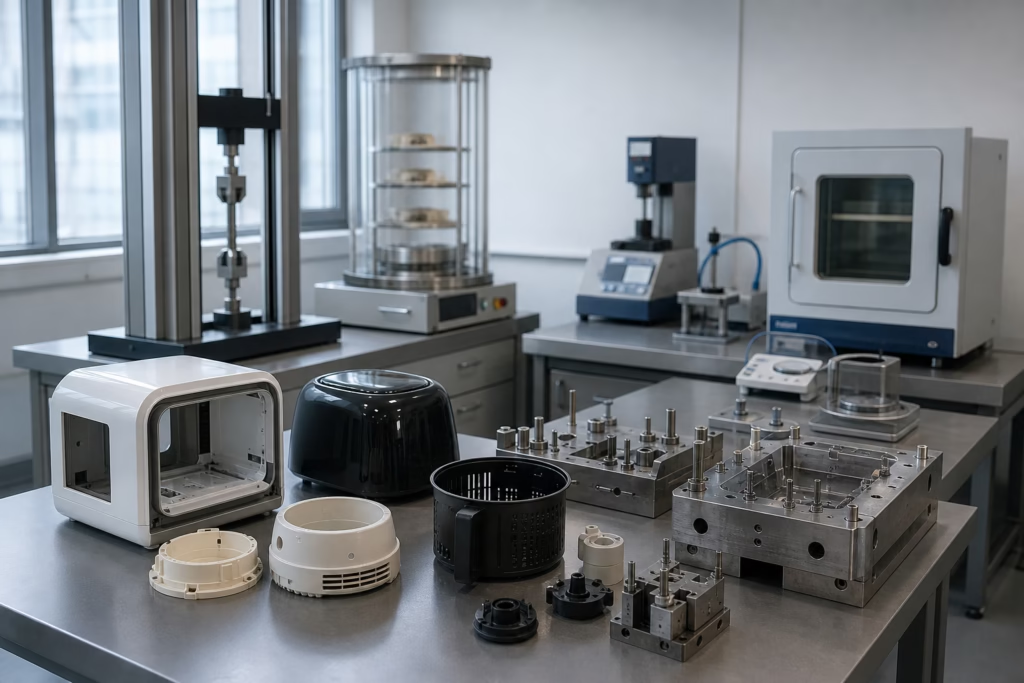
Material performance matters, but so does supplier capability. In appliance projects, the supplier is part of the product-development system. A reliable supplier should help interpret the part function, recommend a workable grade, and support trial-to-mass-production transition without constant reformulation surprises.
Key supplier questions include:
- Can the supplier customize the formulation for housing or internal-part requirements?
- Can they maintain batch consistency across pilot and mass-production lots?
- What is the MOQ, and does it fit the project phase?
- What is the lead time for standard and customized grades?
- Can they support sample validation, processing feedback, and troubleshooting?
- Do they understand appliance-specific trade-offs such as appearance, heat, flame retardancy, and dimensional control?
If your program includes electrical or heat-adjacent internal parts, it is worth reviewing compliance expectations in the same conversation as resin selection. Standards and safety testing shape what can be used, not just what looks good on a datasheet. A useful reference point is UL Solutions’ overview of plastic standards and compliance testing, which helps connect material selection to the compliance checks often expected for appliances and other plastic products.
At the sourcing stage, the safest approach is to ask for a material recommendation that includes processing notes, intended application limits, and sample comparison guidance. That is far more useful than a price-only quote, because the hidden cost of a poor resin match often appears later in scrap, rework, or field failures.
Project recommendation framework for outer parts and inner parts
For a new appliance platform, we suggest separating the material strategy from the start. Treat the housing as a visual and assembly interface, and treat internal functional parts as performance components. Then build a resin shortlist for each group based on actual requirements instead of trying to force one universal grade across the entire device.
A simple framework looks like this:
- Step 1: define whether the part is visible, structural, moving, insulating, heat-exposed, or safety-relevant
- Step 2: rank the top three performance targets for that part
- Step 3: identify process limits such as wall thickness, drying, gate location, and cycle time
- Step 4: compare resin families and modification options against those needs
- Step 5: validate samples in the real mold and real assembly flow
- Step 6: lock batch consistency, packaging, MOQ, and lead time before mass production
This approach reduces technical risk and also reduces procurement risk. When the team understands why the housing uses one strategy and the internal part uses another, sourcing discussions become more precise, and the whole project becomes easier to scale. In practice, that is the core of good appliance plastic material selection: not choosing one “best” resin, but building the right material logic for each function inside the same product.
FAQs
Can the same plastic be used for both appliance housings and internal parts?
Sometimes, but only when the part requirements are genuinely similar. In most appliance projects, housings and internal parts face different stresses, so the same resin can become either over-specified for the shell or under-specified for the hidden function. It is usually safer to create separate material logic for appearance-driven parts and performance-driven parts.
Why is PC/ABS so common for appliance housings?
PC/ABS is popular because it can offer a practical balance of impact resistance, appearance, and molding behavior. It is often considered when the part needs a better visual finish than many engineering resins and a more robust feel than basic commodity plastics. The exact grade still needs to match wall thickness, color, and tooling design.
What is the biggest risk when choosing material for internal appliance parts?
The biggest risk is underestimating service conditions. Internal parts may see heat, load, repeated movement, moisture, or electrical stress even when they are hidden from view. A resin that looks suitable on paper can fail in use if creep, wear, or thermal deformation were not part of the original selection logic.
Do moisture-sensitive materials need special attention in appliance parts?
Yes. Moisture-sensitive materials can change in both processability and final performance if drying is inadequate or if the part absorbs moisture during service. This matters especially for polyamide-based parts, where dimensions, strength, and electrical behavior can shift. Drying and conditioning should always be part of the evaluation plan.
When should a project consider flame-retardant plastic compounds?
Flame-retardant compounds should be considered when the part is near electrical, heat, or safety-critical zones, or when the appliance design must meet a defined flammability target. The choice should be tied to the exact part location and compliance requirement, not used automatically across the whole product.
What should procurement ask a plastic supplier before mass production?
Procurement should ask about batch consistency, MOQ, lead time, customization capability, and technical support during sample validation. It is also useful to confirm processing notes, packaging, and any part-specific limitations. A good supplier should help reduce sourcing risk, not just quote a material price.