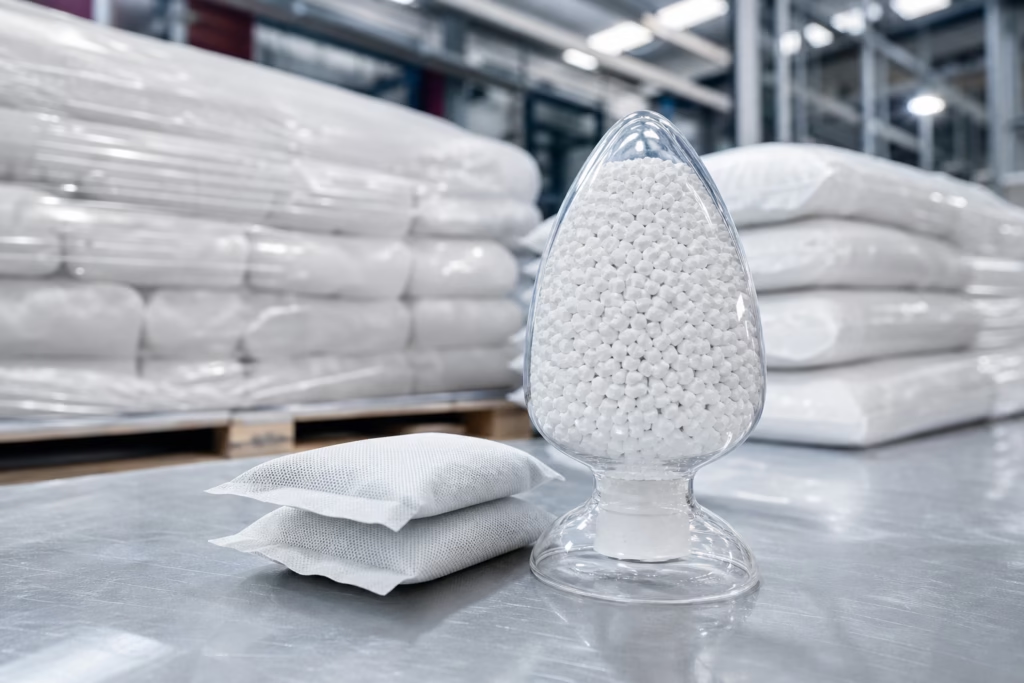
When a flame-retardant PBT part develops a white film, dusty powder, sticky residue, or a dull patch on the surface, the problem is often described as blooming or exudation. For engineers and buyers, the important question is not just what it looks like, but whether the root cause is the material formulation, the molding process, or the service environment. In many cases, the failure is connected to flame retardant migration plastic behavior, where low-compatibility additives or unstable processing conditions push part of the flame-retardant package to the surface over time.
This article focuses on diagnosis and correction, not theory alone. If your project needs molded electrical housings, connectors, or appliance parts with stable flame-retardant performance and clean appearance, our flame-retardant plastic compound solutions for molded parts are designed around the same practical questions: which flame-retardant system is compatible with PBT, how the additive package affects blooming risk, how drying and residence time influence surface quality, and how sample validation can reduce after-sales surprises. From our compounding and resin-selection perspective, the most reliable path is to match formulation design, processing window, and end-use environment before mass production starts.
At Poly Maro, we see this problem most often when a material passes a short-term appearance check but fails after heat aging, humidity exposure, or warehouse storage. That is why the right diagnosis matters: the same visible powdering can come from different causes, and each one needs a different countermeasure.
What blooming looks like on flame-retardant PBT parts
Blooming on flame-retardant PBT is usually a surface phenomenon. It may appear as white haze, chalk-like powder, oily film, roughened gloss, or a thin layer that wipes off and then reappears. In some cases, the surface feels slightly sticky at first, then becomes dusty after aging. In others, the bloom is concentrated near gates, thin walls, ribs, corners, or areas with more heat history.
Before assuming the resin has failed, it is important to distinguish blooming from other common defects:
- Contamination: dust, packaging debris, mold grime, or foreign resin may sit on the surface but usually does not recur after cleaning.
- Poor drying: moisture-related splay or silvering often appears as streaks or bubbles rather than a uniform white film.
- Mold release residue: this may create a shiny or greasy patch and often correlates with recent release-agent use.
- Additive precipitation: a formulation-related bloom usually reappears after wiping and may worsen during heat aging or storage.
The quickest field check is simple: wipe the surface, record where the residue appears, then compare fresh molded samples, aged samples, and samples from another lot. If the symptom returns after a short period, and especially if it worsens with heat or humidity, the issue is more likely tied to the formula or process than to one-time contamination.
Why flame-retardant PBT is sensitive to surface migration
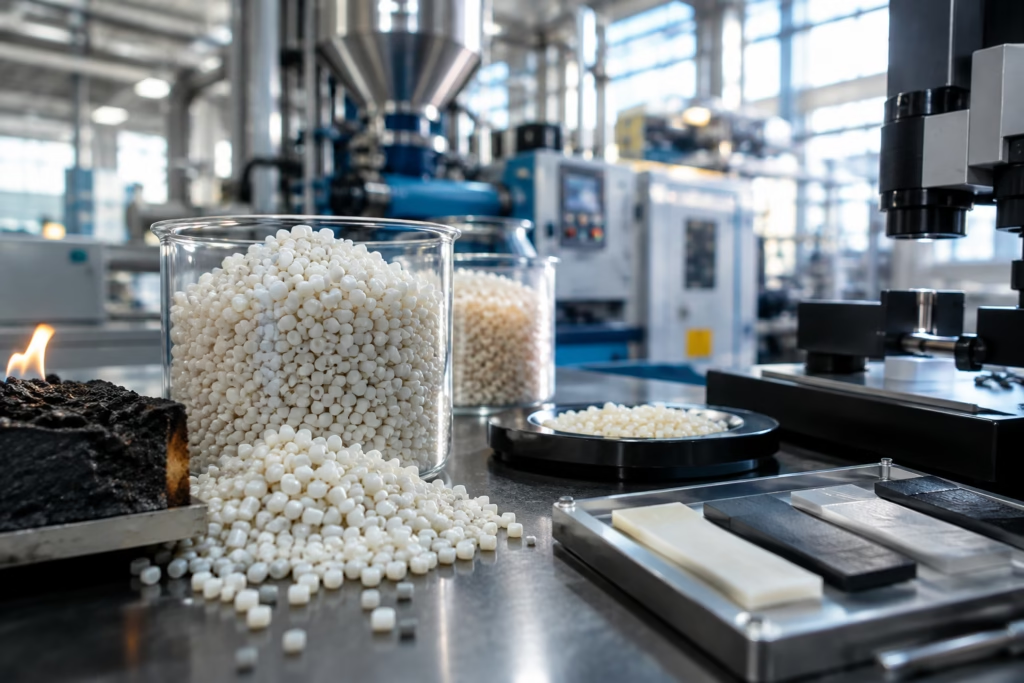
PBT is widely used in electrical and engineering parts because it offers a useful balance of strength, dimensional stability, electrical insulation, and processing efficiency. In many applications, those advantages make it a strong base resin for flame-retardant modification. For a general view of the material family and its engineering role, the PBT background information in PBT material properties and flame-retardant grade overview is a helpful reminder that the base polymer already has a defined balance of chemical resistance, electrical performance, and dimensional behavior before additives are introduced.
However, flame-retardant PBT can be more prone to migration than an unmodified grade because the flame-retardant system must be added in meaningful quantity, and not every system has the same compatibility with the polyester matrix. When additive loading rises, the margin for formulation imbalance becomes smaller. If the carrier resin, flame-retardant package, stabilizer, lubricant, and impact modifier are not well matched, the least compatible component can slowly move toward the surface during storage, heat aging, or processing.
In practice, blooming risk increases when the formulation tries to do too many things at once: high flame retardancy, low cost, good mechanical strength, stable color, and easy molding. When the additive package is pushed too far in one direction, the surface often pays the price first.
Main root causes of flame retardant migration plastic failures
1. Incompatible flame-retardant system
The first cause is simple: the flame-retardant chemistry may not be fully compatible with PBT. Some systems can meet the flame-retardant target but still migrate more readily than desired. If the additive is not sufficiently embedded in the polymer phase, it may bloom under heat, stress, or time.
2. Insufficient dispersion in compounding
Even a suitable additive can cause problems if it is not dispersed evenly. Poor dispersion creates local concentration zones. Those zones behave like weak points, not only for appearance but also for mechanical consistency and processing stability. In compounding, dispersion quality is often more important than nominal additive percentage alone.
3. Low molecular compatibility between ingredients
Flame-retardant packages are rarely used alone. They interact with stabilizers, lubricants, release aids, colorants, and impact modifiers. If the package balance is weak, one ingredient may squeeze another out of the matrix. That is one reason two materials with the same flame rating can show very different blooming behavior in the field.
4. Overloaded additive levels
Sometimes the easiest way to reach a performance target is to add more flame retardant. But every additive has a threshold beyond which the polymer matrix can no longer hold it comfortably. Overloading can increase viscosity, worsen brittleness, reduce flow balance, and raise the chance of surface exudation.
5. Formulation imbalance around the entire package
Blooming is not always caused by the flame retardant alone. The complete recipe matters. Excess lubricant, an unstable processing aid, or an incompatible color masterbatch can contribute to surface migration. This is why a formulation review should consider the full additive stack, not just the flame-retardant name on the datasheet.
| Root cause | Typical field sign | What it usually means |
|---|---|---|
| Incompatible flame retardant | Recurring white film or powder | Additive compatibility is weak |
| Poor dispersion | Patchy bloom, often near thick or hot zones | Compounding quality needs review |
| Overloading | Brittleness plus surface residue | Additive level may be too aggressive |
| Package imbalance | Bloom changes by lot or color | Other additives may be interacting |
How processing conditions trigger blooming
Processing can either preserve a stable formulation or expose its weakness. A resin that looks acceptable in a sample plaque may bloom after repeated thermal stress in production. The most common process triggers are overheating, long residence time, excessive shear, poor drying, unstable back pressure, and excessive regrind use.
Overheating can accelerate degradation and make low-compatibility ingredients more mobile. Long residence time gives the melt more time to separate chemically or thermally. Excessive shear may damage the polymer or alter additive distribution. Poor drying is especially important for PBT because moisture can interfere with processing stability and surface quality. Unstable back pressure and poorly controlled screw conditions can create lot-to-lot variation that looks like a material defect even when the recipe is the same.
Repeated regrind use is another hidden risk. Regrind that has already seen heat once may carry a different additive balance than virgin material. When that material is blended back in too aggressively, blooming can become less predictable and surface appearance may drift over time.
For practical selection and molding guidance, our a practical guide to selecting flame retardant plastic compounds explains why flame-retardant grades should be evaluated not only by performance target but also by flow behavior, thermal stability, and processing tolerance. If the molding window is too narrow, a small process deviation can produce a visible surface defect long before the part fails mechanically.
How part design and service environment affect exudation
Even a well-formulated flame-retardant PBT can bloom if the part design or service environment amplifies the risk. Thin-wall parts may expose more surface area relative to volume, which can make exudation easier to notice. Thick sections and dead zones may retain heat longer after molding, which can drive additive movement. Sharp corners, ribs, bosses, and gate-adjacent areas often show defects first because local stress and thermal history are uneven.
Service environment matters just as much. Heat aging can slowly mobilize additive components. Humidity can change the surface condition and sometimes accelerate visible haze. Chemical exposure from oils, cleaners, or assembly fluids may disturb the surface balance and make bloom more obvious. Packaging and storage also matter: if parts are stored in warm, humid, or poorly ventilated conditions, the defect may appear in the warehouse rather than on the machine.
That is why the same grade may work in one product and fail in another. A connector in a dry cabinet, a housing near a heat source, and an appliance cover exposed to cleaning agents do not impose the same surface demands. We always recommend evaluating both the part geometry and the real service environment before freezing the grade.
Material-side countermeasures for blooming control
The most durable fix usually starts with the material design. If a flame-retardant PBT is blooming, the first question is whether the additive system itself is the right one for the application. In many cases, the answer is to improve compatibility rather than simply lowering the flame-retardant level.
Choose a more compatible flame-retardant system. The goal is to keep the needed flame performance while reducing surface migration tendency. Not every system behaves the same way in PBT, so the selection should reflect the end-use thickness, thermal environment, and appearance target.
Improve compounding dispersion. Better twin-screw dispersion, correct feeding sequence, and stable processing conditions help prevent additive pockets that later become bloom points.
Adjust the carrier resin. Carrier selection can influence whether the package stays anchored in the matrix or moves under stress. When carrier and base resin are better matched, the part often shows better long-term appearance stability.
Balance the additive package. A stable flame-retardant PBT is rarely the result of one additive. Lubricants, stabilizers, impact modifiers, and colorants should be reviewed together so that one component does not undermine surface quality.
For engineers comparing structural engineering materials, PBT material options for electrical and engineering parts is relevant because it frames PBT as a family with different modification paths rather than a single universal grade. That matters when a project needs flame retardancy, dimensional stability, and surface cleanliness at the same time.
Processing-side countermeasures that reduce migration risk
Material improvements alone will not solve every case. Processing discipline is the second half of the solution. In our experience, many blooming complaints become manageable once the molding conditions are stabilized and the thermal history is controlled.
Dry the resin properly. Follow the supplier’s recommended drying temperature, time, and moisture target. For PBT, inconsistent drying can create unstable surfaces and increase the chance that a marginal formulation shows its weakness.
Control melt temperature. Avoid unnecessary overheating. The aim is not just to fill the part, but to keep the melt inside a safe processing window that protects the additive package.
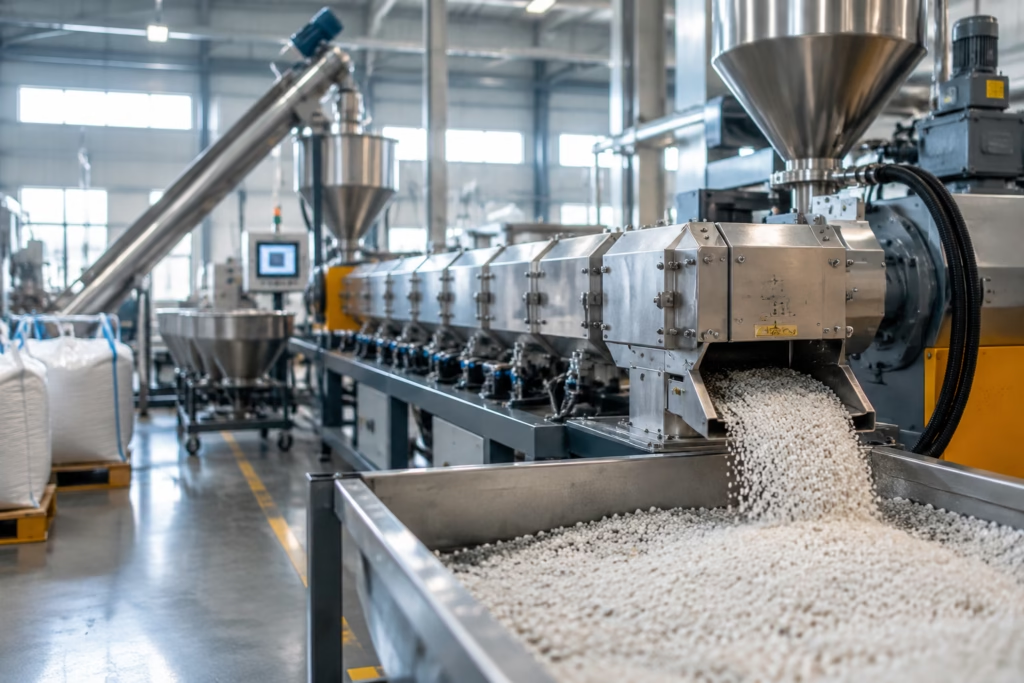
Reduce residence time. Long dwell time in the barrel can increase degradation and encourage migration. If the machine is oversized for the part, this risk becomes more important.
Stabilize screw settings. Excessive back pressure or aggressive shear can create heat and stress that make additive movement more likely. Stable, repeatable settings are more valuable than chasing short-term cycle speed.
Limit regrind ratio. A controlled amount of regrind may be acceptable in some products, but the ratio should be validated by appearance, aging, and lot consistency tests.
When surface defects are the main concern, our material-related molding surface defects such as flowering and silver streaks can help teams separate material-origin defects from process-origin defects. That distinction saves time because it prevents the wrong countermeasure from being applied to the wrong failure mode.
How to tell if the problem is material or process related
A good failure analysis starts with side-by-side comparison. We usually recommend a simple but disciplined reproduction plan:
- Run a fresh sample from the same lot under the current production settings.
- Run the same material with more conservative temperature and residence time settings.
- Compare virgin material against the actual regrind blend.
- Compare parts taken directly from the press with parts stored for several days or aged under heat and humidity.
- Inspect the mold, drying system, hopper, and color feeding path for contamination or residue.
If the bloom appears on multiple machines and multiple parameter sets, the formulation should be investigated first. If the defect shifts strongly with processing conditions, then the molding window or handling practice is likely the main trigger. In many real cases, both sides contribute: a borderline formulation becomes visible only after the process adds thermal stress.
One helpful rule is this: if the same part looks good immediately after molding but deteriorates during storage, the material and environment deserve more attention. If the part looks bad straight off the machine, processing is more likely to be involved.
Supplier and procurement checklist for flame-retardant PBT
Procurement teams often see blooming as a quality issue after delivery, but it is better handled as a sourcing question during grade selection. Before placing volume orders, ask the supplier for the data that actually predicts field behavior.
- Formulation stability across lots
- Blooming or exudation resistance under heat and humidity exposure
- Target flame-retardant performance at the relevant part thickness
- Recommended drying and molding conditions
- Lot-to-lot consistency and color consistency
- Regrind guidance and storage guidance
- Sample validation results on the actual part, not only test bars
When compliance and performance targets are part of the decision, UL 94 testing and plastic flammability classification is an important reminder that flammability qualification is tied to controlled testing conditions and thickness. A material that meets a target in one configuration may not behave the same way in a real molded part with different geometry or processing history.
For buyers, the real risk is not just whether a grade looks good on paper. The risk is whether the supplier can support repeatable production, stable packaging, clear drying guidance, and technical feedback when appearance issues appear after launch.
Testing and validation before mass production
Blooming problems should be validated before volume release, not after customer complaints. A practical validation plan should include short-term and accelerated checks that reflect the real environment of the part.
| Test or observation | Purpose | What it can reveal |
|---|---|---|
| Visual surface inspection | Detect bloom, haze, powdering | Early appearance instability |
| Heat aging | Simulate thermal service stress | Whether migration increases over time |
| Humidity exposure | Check storage and climate sensitivity | Surface haze or residue formation |
| Wipe and reappearance check | Confirm exudate behavior | Whether residue returns after cleaning |
| Abrasion check | See how easily the surface sheds material | Powdering severity |
| Cross-lot verification | Compare batch stability | Formulation consistency |
It is also wise to test the actual molded part, not only standard specimens. A flat plaque may hide a problem that appears in a thin rib, a textured housing, or a connector body with different cooling history. Real geometry changes the result.
Common mistakes that make blooming worse
Some corrective actions accidentally make the problem more visible. The most common mistakes are easy to avoid once they are recognized.
- Switching to a cheaper grade too quickly: a lower-cost material may save money on paper but can increase after-sales risk.
- Ignoring drying control: even a stable formulation can look unreliable if moisture is not controlled.
- Increasing flame-retardant loading without review: more additive is not always better if compatibility drops.
- Using too much regrind: this can amplify thermal history and surface variation.
- Skipping long-term storage checks: some products bloom only after days or weeks, not immediately.
We also see cases where a team changes color, mold release practice, and resin grade at the same time. That makes diagnosis almost impossible. One change at a time is slower, but it is the only reliable way to know what fixed the issue.
Practical selection guidance by application
Connectors and terminals: these parts often need flame retardancy, dimensional precision, and clean surfaces. Any bloom near contact or assembly surfaces is a serious risk because it may affect handling, automated insertion, or customer perception.
Electrical housings: appearance is important, but so is long-term stability under heat and storage. Housings benefit from a balanced formulation that resists powdering during warehouse time and field service.
Appliance parts: these parts may face humidity, heat cycles, and occasional chemical exposure from cleaning agents. A surface that looks fine on day one may still fail after aging if the formulation is too marginal.
High-temperature electrical components: if the environment is harsher, some teams compare alternatives such as PPS and PBT. In those cases, PPS vs PBT for high-temperature electrical components is useful when the choice is not only about flame resistance, but also about how much heat, creep, and surface stability the part must withstand.
In our view, the right material is not simply the one with the highest flame rating. It is the one that stays stable after molding, survives storage and service, and fits the real cost-performance target.
Troubleshooting flow for fast correction
When a blooming complaint comes in, a simple sequence helps the team move faster:
- Confirm the defect is actually bloom, not contamination or release residue.
- Check whether the problem is immediate or appears after aging.
- Compare fresh parts, stored parts, and parts made with different parameters.
- Review drying, melt temperature, residence time, and regrind ratio.
- Ask the supplier for formulation guidance and lot comparison data.
- Decide whether the next step is material change, process correction, or both.
This flow avoids the two biggest delays: blaming the process when the formulation is unstable, and blaming the material when the machine settings are creating the defect. In a production environment, the fastest answer is the one that narrows the problem correctly the first time.
Why manufacturer support matters in FR PBT troubleshooting
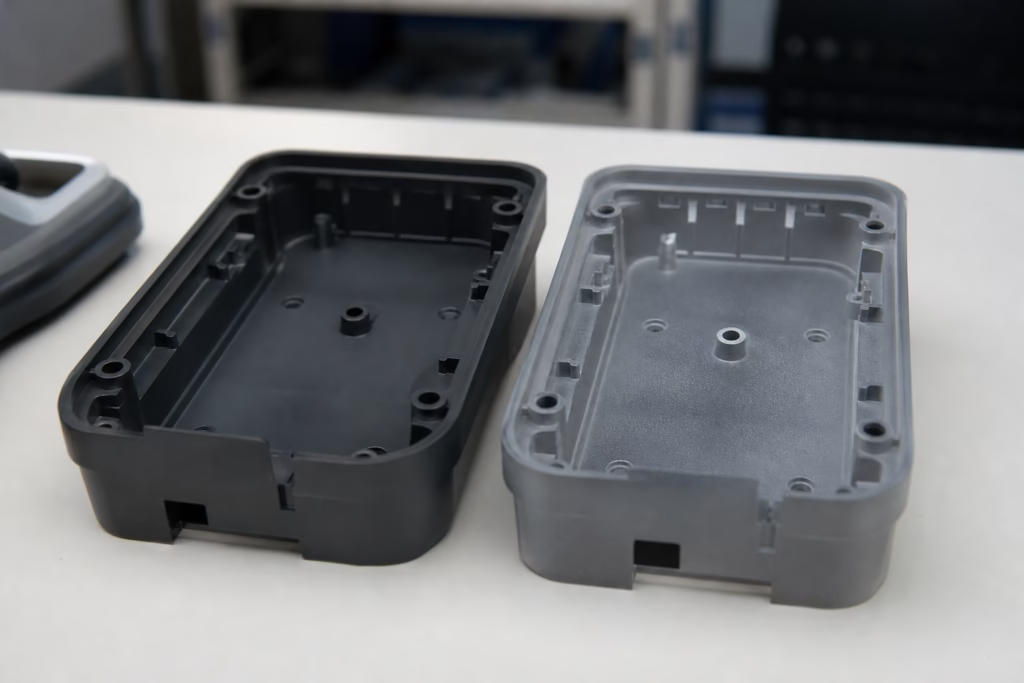
Because blooming is a mixed material-process-environment issue, it is difficult to solve with one-off advice. A good supplier should be able to discuss formulation balance, processing window, appearance stability, and lot consistency together. That is one reason many buyers work with a manufacturer rather than a simple reseller. The technical feedback loop is shorter, and the path from sample to mass production is easier to control.
At Poly Maro, our approach is to start with the application: the part geometry, the service temperature, the flame-retardant target, the appearance standard, and the molding conditions. From there, we can adjust the compound structure, dry-molding guidance, and verification plan so the part is more likely to stay clean after launch.
Conclusion
Blooming in flame-retardant PBT is rarely caused by a single factor. More often, it is the result of additive compatibility, dispersion quality, process heat history, part geometry, and service environment working together. The good news is that the defect is usually diagnosable if the team compares fresh and aged samples, reviews the full formulation, and checks the molding window carefully. When the root cause is identified early, the corrective action is often straightforward: improve the compound design, tighten processing control, and validate under the actual end-use conditions.
If your project is showing signs of flame retardant migration plastic behavior, the safest next step is not to guess. It is to verify the mechanism, confirm the aging pattern, and select a flame-retardant PBT formulation that matches the part’s real thermal and appearance demands.
FAQs
Why does flame-retardant PBT sometimes turn white or powdery after molding?
White or powdery surfaces usually mean a low-compatibility additive has migrated to the surface, or the part has experienced enough thermal history for the formulation to separate. The defect may appear immediately or after aging, depending on the material balance and process conditions.
How can I tell blooming from contamination or mold release residue?
Contamination usually disappears after cleaning and does not return. Mold release residue often looks greasy or localized near the mold surface. Blooming tends to reappear after wiping and may worsen during storage, heat aging, or humidity exposure.
Can processing alone cause a blooming problem in FR PBT?
Yes. Overheating, long residence time, unstable screw settings, poor drying, and excessive regrind can all make a borderline formulation fail visually. Processing may not be the root cause, but it often exposes the weakness faster.
What material changes help reduce flame retardant migration plastic issues?
Better additive compatibility, improved dispersion, a more suitable carrier resin, and a balanced package of stabilizers and lubricants can all help. In some cases, the flame-retardant level needs to be re-optimized rather than simply increased or reduced.
What should buyers ask a flame-retardant PBT supplier before mass production?
Ask for lot consistency data, drying and molding guidance, heat and humidity stability information, appearance validation on the actual part, and support for cross-lot comparison. The goal is to understand both performance and long-term surface stability.
Which parts are most sensitive to blooming problems?
Thin-wall connectors, electrical housings, appliance parts, and parts stored in warm or humid conditions are especially sensitive. Parts with sharp geometry changes, uneven cooling, or demanding appearance standards often reveal the problem earliest.