
Precision electronics do not fail only because of circuit design; they also fail when packaging, trays, housings, fixtures, or assembly tools allow static charge to build up or discharge at the wrong time. For that reason, ESD plastic material selection, conductive plastic pellets should be treated as an engineering decision, not a generic procurement choice. The right modified pellets must match the part’s resistivity target, the operating environment, the molding process window, and the contamination sensitivity of the electronic component.
If you are evaluating trays, carriers, connector-related fixtures, housings, or assembly aids, our conductive and anti-static plastic compound options for precision electronics are a practical starting point because the choice is rarely about conductivity alone. At Poly Maro, we usually help teams balance resistivity target, resin family, filler system, mechanical strength, dimensional stability, and batch consistency so the final pellet spec fits both the product and the production line.
Why precision electronics need ESD-safe plastics
In electronics manufacturing, electrostatic discharge can damage sensitive components immediately or create latent defects that appear later in the field. Plastic parts are often close to chips, connectors, PCB assemblies, terminals, and inspection tools, so the wrong material can become a source of charge generation or accumulation. ESD-safe plastics are used to reduce this risk by providing controlled dissipation or conduction rather than allowing high charge retention.
The practical reason buyers should care is that the material is part of the protection chain. A tray may need to move safely through assembly. A housing may need to prevent charge build-up near circuits. A fixture may need to preserve stable surface behavior across dry winter conditions and humid summer conditions. This is why the material selection goal is not simply “make it conductive,” but “make it electrically appropriate for the application.”
We recommend aligning material choice with the facility’s electrostatic protection strategy rather than treating resin selection in isolation. The broader handling and protection logic used in electronics manufacturing is reflected in the IEC framework for electrostatic device protection, which emphasizes the system-level nature of ESD control and the importance of matching materials to the protection program.
Understand the three ESD material categories

Most buyers evaluate ESD plastics in three broad groups: anti-static, static-dissipative, and conductive. These categories sound similar, but they behave differently in practice and are not interchangeable.
| Category | Typical Role | Practical Behavior | When It Fits Best |
|---|---|---|---|
| Anti-static | Reduce surface charge generation | Helps limit static build-up, but may not provide stable discharge paths for sensitive electronics | General packaging, lower-risk handling, dust reduction, temporary transport |
| Static-dissipative | Provide controlled charge decay | Allows charge to dissipate at a controlled rate without acting like a strong conductor | Trays, carriers, housings, work-in-process tools, component handling parts |
| Conductive | Create low-resistance charge pathways | Supports rapid charge transfer and grounding behavior, but may increase filler loading and processing complexity | High-control fixtures, sensitive transport systems, grounded parts, special assembly tools |
For many precision electronics applications, static-dissipative materials are the safest starting point because they offer a balance between ESD control and processability. Conductive materials are not automatically better; they are only better when the end-use function really needs a lower resistivity path.
How we decide between dissipative and conductive
From a compounding and application perspective, the key question is not whether a pellet can measure as conductive in a lab. The question is whether the part must discharge quickly enough under real use conditions without creating unnecessary trade-offs in strength, appearance, corrosion risk, or tool wear. That is why conductive plastic compound vs antistatic vs ESD is a useful comparison only when tied to the actual part function, handling flow, and resistivity target.
A component tray used in a dry cleanroom may need a different resistivity band than a grounded inspection fixture. Likewise, a black conductive housing for an assembly aid may behave very differently from a light-colored dissipative container. The correct category depends on the charge-control goal, the physical environment, and the cost-performance envelope.
How to use resistivity to select the right modified pellets
Resistivity is one of the most useful ways to compare ESD and conductive materials because it translates a vague “static-safe” requirement into a measurable property. Two values matter most: surface resistivity and volume resistivity.
- Surface resistivity reflects how easily charge moves across the outside of a molded part.
- Volume resistivity reflects how easily charge moves through the material body.
In real applications, surface behavior often matters more for trays, housings, and exposed handling surfaces. Volume behavior becomes especially relevant when the design needs through-thickness charge transfer or when the part includes grounded or semi-grounded structures.
For moderately conductive materials, the test method matters as much as the reading itself. Standards such as ASTM D4496 are used for D-C resistance or conductance of moderately conductive materials, while general-purpose resistivity methods may not always capture the intended band correctly. In selection meetings, we advise buyers to ask not only for the number but also for the test method, conditioning state, and sample geometry behind it.
Typical resistivity bands and application logic
| Selection Band | What It Usually Indicates | Typical Application Direction | Decision Note |
|---|---|---|---|
| Higher resistivity, anti-static range | Charge suppression and reduced buildup | Packaging, non-critical transport, dust-sensitive but lower-risk parts | Good for broad use, but may not be enough for sensitive electronics |
| Mid-range static-dissipative band | Controlled charge decay | Trays, carriers, housings, fixtures, work surfaces | Often the most balanced option for precision electronics |
| Lower resistivity conductive band | Rapid charge transfer | Grounded tools, special fixtures, high-control assembly or transfer systems | Requires closer evaluation of filler loading, appearance, and processability |
The exact resistivity target should always be tied to the part’s function and the customer’s internal electrostatic specification. Two materials with similar electrical readings can still behave differently because of humidity sensitivity, surface wear, filler distribution, or resin family.
Key resin families for ESD and conductive pellets
Resin selection determines whether the ESD modification will be practical in molding and reliable in use. In precision electronics, the most common base resins include PP, ABS, PC, PC/ABS, PA, PBT, and PPE blends.
- PP is cost-effective and easy to process, but heat resistance and dimensional stability are limited compared with engineering resins.
- ABS offers good balance for housings and trays, with decent appearance and moldability.
- PC is useful when impact resistance and heat resistance both matter.
- PC/ABS often provides a strong compromise among toughness, appearance, and processability.
- PA systems can offer strength and wear resistance, but moisture behavior must be managed carefully.
- PBT is favored where dimensional stability and electrical insulation are important.
- PPE blends can offer stability and a useful balance for demanding electronic housings.
The best base resin is not the one with the longest datasheet. It is the one that can carry the ESD system while still meeting the part’s mechanical, thermal, and molding requirements. For example, a tray that must remain dimensionally stable in repeated handling may need a more rigid engineering resin, while a cover or fixture may prioritize impact and surface quality.
When a project needs part-specific tuning, custom plastic compound development support is often more useful than forcing a standard grade to do too much. At Poly Maro, we typically review the electrical target first, then refine the resin, reinforcement level, and additive package to fit the processing and end-use requirements.
How conductive systems work in modified pellets
Conductive and ESD pellets achieve their function through different kinds of conductive or charge-control systems. The choice of system changes not only resistivity, but also surface appearance, mechanical behavior, density, wear on tooling, and sensitivity to processing variation.
- Carbon black is common for conductive and dissipative compounds because it can provide stable electrical performance at reasonable cost.
- Carbon fiber can improve conductivity while also increasing stiffness, but it may affect surface finish and anisotropy.
- Stainless fiber or metal-based fillers can support conductive behavior in selected applications, though they may add density and raise tool wear concerns.
- Conductive polymers and specialty additive systems may support targeted antistatic or dissipative behavior when appearance or low loading is important.
- Antistatic additives may reduce surface charge build-up, but they can be more sensitive to migration, humidity, or wear depending on the formulation.
Filler choice affects the whole part, not just the electrical reading. Higher loading often improves conductivity but can reduce impact strength, raise viscosity, increase shrinkage variation, or make welding and cosmetic quality harder to control. This is why resistivity alone should never be the only selection criterion.
Performance trade-offs every buyer should evaluate
For precision electronics, the material must do more than control electricity. It must survive molding, assembly, transport, and repeated handling without creating new risks.
| Trade-off | What Improves | What Can Decline | What to Check |
|---|---|---|---|
| Higher conductive loading | Lower resistivity, stronger charge transfer | Impact, appearance, flow, weld line quality | Part geometry, cosmetic requirement, tool venting |
| More engineering resin content | Toughness, heat resistance, stability | Cost, sometimes flow | Mold fill, gate design, cycle time |
| More mineral or fiber reinforcement | Stiffness, dimensional stability | Warp balance, surface finish, anisotropy | Shrinkage, rib design, flatness |
| Lower-cost resin choice | Procurement efficiency | Thermal margin, durability, long-term stability | Operating temperature and service life |
In many projects, the hidden cost is not the resin price per kilogram. It is the cost of scrap, long cycle times, downstream rejection, or field failure. That is why processability should be treated as a cost factor, not just a convenience factor.
Processing considerations for electronic parts
ESD and conductive plastics can be more sensitive to processing variation than unfilled commodity resins. Drying, melt temperature, mold temperature, gate design, and packing pressure all influence the final part’s electrical and physical behavior.
Some base resins, especially polyamides, absorb moisture and require careful drying before molding. If moisture is not controlled, the part can show inconsistent dimensions, surface defects, or property drift. Even when the resin itself has stable resistivity, the finished molded part may behave differently if the process is unstable or if filler dispersion is uneven. This is particularly important when a project is moving from samples to mass production and the team needs to preserve batch-to-batch consistency.
We also encourage buyers to consider whether the part will face low-humidity operation. The EOS/ESD Association’s humidity guidance for ESD materials is a helpful reminder that materials should be qualified under the driest conditions expected in the facility, not only in a comfortable lab environment. A material that looks acceptable in one season may not behave the same way in another.
From a molding standpoint, fillers that support conductivity may raise melt viscosity and reduce flow length. That can matter for thin-wall trays, complex housings, or parts with long runners. A material that is electrically correct but difficult to fill will create hidden production problems, so flowability should be discussed early with the supplier.
Selection by application scenario
The fastest way to narrow the options is to start from the application rather than the resin family. Precision electronics use cases usually fall into a few patterns.

Component trays and carriers
These parts often need static-dissipative behavior, good dimensional stability, and enough rigidity to prevent part movement. Surface quality matters because trays may contact visible or delicate components. A balanced PC/ABS, ABS, or PBT-based ESD grade may be a practical fit depending on temperature and loading needs.
Transport boxes and handling containers
Boxes need reliable electrical performance plus impact resistance and repeat-use durability. If the part is frequently stacked, dropped, or cleaned, the resin must preserve both electrical behavior and mechanical integrity over time.
IC packaging and sensitive-device transport
For sensitive devices, control of surface resistivity and contamination risk becomes critical. The material may need lower surface charge generation, stable color, and low dusting or shedding during use.
Connectors and connector-related fixtures
Connectors themselves often have specialized insulation or structural requirements, so the material choice must be coordinated with the design intent. For teams working through such parts, connector material selection for electrical connectors can help frame how heat resistance, stiffness, and dimensional accuracy interact with the electrical requirement.
Tool fixtures and assembly aids
Fixtures may call for conductive behavior to control static while also maintaining wear resistance and low deformation under repeated use. In these cases, conductive fillers may be justified if grounding performance is truly needed.
Critical technical questions to ask before sampling
Before requesting samples, we recommend asking the supplier to define the material around the part function, not just the resin name. The most useful questions are often the simplest ones.
- What resistivity range is targeted, and is it surface resistivity, volume resistivity, or both?
- Which test method was used, and under what conditioning state?
- What is the expected operating humidity and temperature?
- Does the part need flame retardancy, and if so, what compliance target is required?
- What color is needed, and will color affect the electrical formulation?
- Will the part be exposed to abrasion, cleaning agents, or repeated handling?
- What is the acceptable balance between conductivity, impact strength, and appearance?
These questions help avoid a common procurement mistake: approving a sample that works in a simple test but fails under actual factory conditions. For teams reviewing datasheets and safety data, how to read TDS and SDS for plastic compounds is especially useful because it helps separate core performance data from assumptions about real processing behavior.
How to validate samples in real production
Sample validation should include both electrical and non-electrical checks. A part can meet the resistivity target and still be unacceptable if it warps, wears too quickly, or creates cosmetic defects.
- Resistivity testing: confirm the target range on molded parts, not just on pellets or plaques.
- Aging checks: evaluate whether electrical behavior changes after heat exposure or storage.
- Humidity checks: compare behavior at the lowest humidity expected in the plant.
- Abrasion checks: determine whether the conductive surface remains stable after repeated use.
- Dimensional checks: verify shrinkage, flatness, and fit in real tooling.
- Batch repeatability: compare multiple lots to detect drift in filler dispersion or resistivity.
We often see teams focus on the first sample only. That is risky. A modified pellet grade must be validated as a production material, not as a one-time demonstration. If the project is important, ask for information about lot control, production consistency, and the supplier’s ability to reproduce the same formulation on the next order.
Common mistakes in precision electronics material selection
Several errors appear repeatedly in ESD and conductive plastic sourcing.
- Choosing conductivity without an application reason: lower resistivity is not automatically better.
- Ignoring humidity influence: a material may behave differently in dry air than in a conditioned lab.
- Overlooking flowability: a good electrical grade can still be hard to mold.
- Using the wrong base resin: the electrical target may be met, but the part can fail on heat or impact.
- Not defining the test method: ambiguous data makes supplier comparison unreliable.
- Neglecting contamination concerns: fillers, dusting, or migration can be a problem in clean electronics environments.
These mistakes can usually be avoided if the buyer defines the part function first, then the environmental exposure, then the electrical target, and finally the processing window.
What to ask from suppliers of modified pellets
A capable supplier should be able to discuss more than just the resin name. Ask for the exact base polymer, filler system, target resistivity band, test conditions, and the expected molding window. If you are comparing options, procurement teams should also ask about MOQ, lead time, color matching possibility, packaging format, and whether the material can be tuned for a specific part geometry.
At Poly Maro, we treat supplier communication as part of technical risk control. The goal is not to oversell a grade; it is to make sure the selected pellet can be processed reliably, measured consistently, and repeated in production.
For a structured evaluation, we also recommend checking whether the supplier can support sample planning, trial feedback, and production follow-up. The process factors covered in why processability changes the total cost of plastic compounds often matter as much as the raw resin price because an easier-to-run material can reduce scrap and rework.
How Poly Maro supports custom ESD and conductive compound development
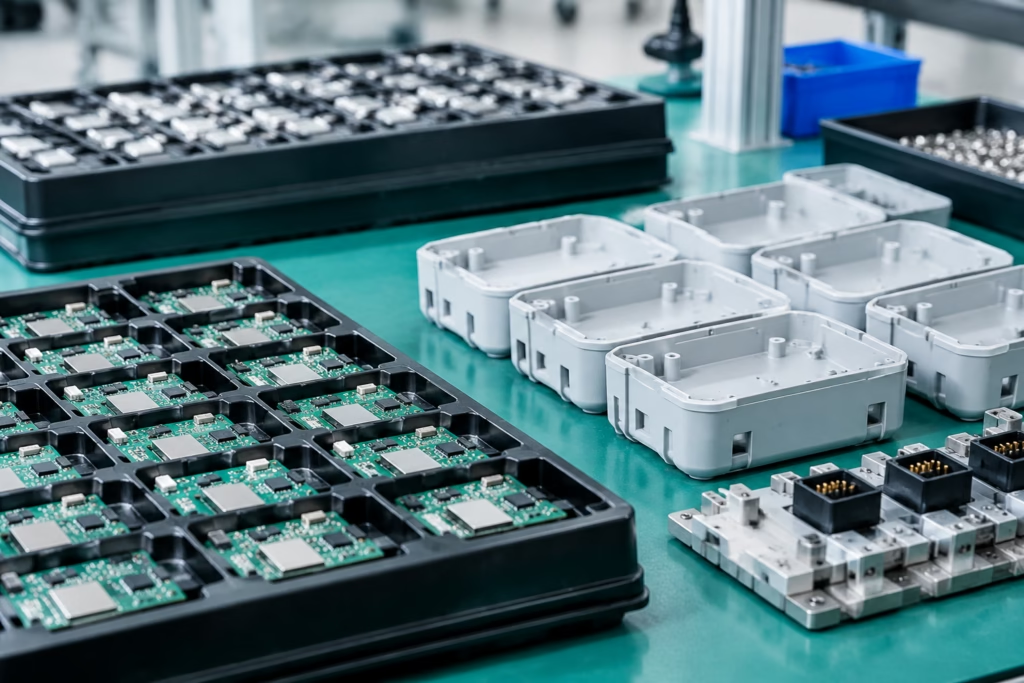
From our material development perspective, the best ESD material is the one that fits the full manufacturing story: part design, target resistivity, moldability, mechanical strength, appearance, and supply stability. That may mean a dissipative ABS-based grade for a tray, a conductive reinforced compound for a fixture, or a custom blend that balances low warpage with stable charge control.
We help manufacturers and procurement teams compare resin families, adjust filler systems, and define practical validation criteria before moving to mass production. In many cases, the most valuable step is not changing the material aggressively, but tuning it enough to reduce risk while preserving the process conditions the factory can already support.
For buyers building an internal sourcing strategy, the key message is simple: use resistivity as the starting point, but make the final decision with heat, flow, dimensional stability, appearance, and long-term stability in mind.
Conclusion
Successful ESD plastic material selection, conductive plastic pellets depends on matching the resistivity band to the part’s actual job. Anti-static grades may be enough for some packaging tasks, static-dissipative materials are often the most balanced choice for precision electronics, and conductive compounds are best reserved for cases where fast charge transfer is truly necessary. The right decision comes from understanding the resin family, the filler system, the processing window, and the validation plan together.
If your team is selecting materials for trays, housings, fixtures, connectors, or assembly tools, the safest path is to define the electrical target, confirm the testing method, and then verify the material in real production conditions. That approach reduces sourcing risk, limits scrap, and improves part consistency over time.
FAQs
What is the difference between anti-static, dissipative, and conductive plastics?
Anti-static plastics help reduce charge buildup, dissipative plastics allow controlled charge decay, and conductive plastics create a lower-resistance path for faster charge transfer. The right choice depends on the part’s function and the level of electrostatic control required.
Should I choose conductive pellets whenever I need ESD protection?
Not necessarily. Conductive pellets are useful when rapid charge transfer is needed, but they can bring trade-offs in appearance, processability, and mechanical balance. For many trays, housings, and fixtures, dissipative materials are the more practical choice.
Why do surface resistivity and volume resistivity both matter?
Surface resistivity describes how charge moves across the part exterior, while volume resistivity describes how charge moves through the material body. Depending on the part design, one may matter more than the other, and both should be defined clearly during sourcing.
How does humidity affect ESD plastic performance?
Humidity can change surface behavior and charge dissipation, especially in materials that rely on surface conditions or additives. That is why validation should include the driest expected production environment, not only a controlled lab condition.
What should I ask a supplier before sampling modified pellets?
Ask for the target resistivity range, test method, resin family, filler system, operating temperature range, humidity sensitivity, color options, MOQ, lead time, and expected molding window. These details help you compare samples fairly and reduce production risk.
How can I reduce warpage and molding issues in ESD parts?
Start with the right base resin, then confirm filler loading, drying conditions, gate design, and mold temperature. A material that is electrically suitable but hard to mold will create cost and quality issues, so processability must be part of selection.